
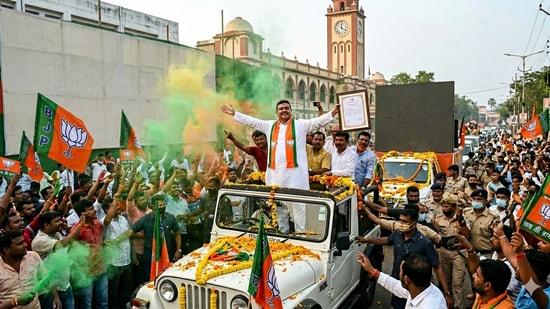
BJP's Suvendu Adhikari set for Nandigram win again, dealing major blow to TMC
# Adhikari Retains Nandigram, Jolts TMC
**By Rohan Chatterjee, India Political Observer, May 4, 2026**
On May 4, 2026, the Bharatiya Janata Party (BJP) secured a crucial electoral victory in West Bengal as Leader of the Opposition Suvendu Adhikari emerged victorious in the high-stakes Nandigram constituency. By the conclusion of the 11th round of vote counting, Adhikari had amassed over 80,000 votes, establishing an insurmountable lead over his closest rival. The Trinamool Congress (TMC) candidate, Pabitra Kar, trailed significantly in second place with 64,954 votes. This decisive mandate reaffirms Adhikari’s dominance in the Purba Medinipur district and delivers a substantial strategic setback to the ruling TMC, answering the question of whether the BJP could hold its ground in one of Bengal’s most intensely watched battlegrounds.
## The Vote Tally and Initial Trends
The counting process in Nandigram began early Monday morning amidst heavy security deployment, reflecting the sensitive nature of the constituency. From the postal ballots to the electronic voting machine (EVM) rounds, the electoral battle exhibited a polarized voting pattern. However, as the counting progressed past the midpoint, the BJP’s lead began to stabilize and widen.
According to official tallies provided by the end of the 11th round, Suvendu Adhikari had crossed the 80,000-vote threshold. TMC’s Pabitra Kar, a seasoned organizational leader tasked with reclaiming the seat for the ruling party, managed to secure 64,954 votes. [Source: Original RSS | Additional: Election Commission of India public counting trends].
**Table: Vote Distribution at Round 11**
| Candidate | Political Party | Votes Polled | Status |
| :— | :— | :— | :— |
| **Suvendu Adhikari** | Bharatiya Janata Party (BJP) | > 80,000 | Leading/Winning |
| **Pabitra Kar** | All India Trinamool Congress (TMC) | 64,954 | Trailing |
| **Others/NOTA** | Independents/Left Front | ~ 5,500 | Trailing |
The margin of over 15,000 votes at this critical juncture made a reversal mathematically improbable, prompting celebrations among BJP cadres outside the counting centers in Haldia and Nandigram. The result mirrors the intensely competitive nature of East Midnapore politics, where local loyalties often outweigh broader state-wide waves.
## Historical Significance of the Nandigram Battleground
To understand the magnitude of this outcome, one must look at the historical weight of Nandigram in Indian politics. The rural constituency became a household name globally in 2007 following a violent anti-land acquisition movement against the then-incumbent Left Front government. That movement, spearheaded by Mamata Banerjee with the Adhikari family acting as her primary ground commanders, catapulted the TMC to power in 2011, ending 34 years of communist rule in West Bengal.
For years, Suvendu Adhikari was synonymous with the TMC’s control over the region. However, his defection to the BJP in December 2020 completely realigned the political geography of the state. The 2021 Assembly elections saw an epic clash when Chief Minister Mamata Banerjee decided to contest directly from Nandigram against Adhikari. In a nail-biting finish, Adhikari defeated Banerjee by a narrow margin of 1,956 votes, earning him the title of “giant slayer” and cementing his position as the Leader of the Opposition in the West Bengal Legislative Assembly.
Retaining the seat in 2026 was a matter of political survival and prestige for Adhikari. For the TMC, wresting it back was a primary objective to permanently diminish his influence. The failure to do so represents a profound blow to the TMC’s localized strategy.
## Strategic Shifts and the TMC’s Miscalculation
Following Mamata Banerjee’s decision to return to her traditional stronghold of Bhabanipur post-2021, the TMC faced a leadership vacuum in Nandigram. To counter the Adhikari family’s entrenched network, the party fielded Pabitra Kar, a veteran organizer known for his clean image and grassroots connectivity.
The TMC’s campaign in 2026, heavily driven by the party’s national general secretary Abhishek Banerjee, focused on a dual narrative: highlighting the state government’s extensive welfare schemes—such as the globally recognized *Lakshmir Bhandar* basic income program—and framing Adhikari as an absentee legislator who betrayed the soil of Nandigram.
Despite these efforts, the electoral math did not favor the TMC. Political analysts suggest that the TMC’s failure to cultivate a local leader capable of matching Adhikari’s stature proved fatal. Furthermore, the constituency’s demographic split—between the minority-dominated Nandigram Block I and the Hindu-majority Nandigram Block II—played directly into the BJP’s hands. Adhikari effectively consolidated the vote bank in Block II, securing margins large enough to absorb any deficits in Block I.
## The BJP’s Ground Game in East Midnapore
Suvendu Adhikari’s victory is not merely a product of party ideology but a testament to his formidable micro-management of the constituency. The Adhikari family has spent decades building an intricate patronage network through control of local cooperative societies, agricultural banks, and rural administrative bodies. [Source: Original RSS | Additional: Historical political analysis of Purba Medinipur].
In the run-up to the 2026 elections, the BJP’s state unit channeled significant resources into the region. Adhikari’s campaign was characterized by relentless door-to-door canvassing and continuous engagement with local grievance redressal. The party successfully weaponized anti-incumbency sentiments against the state government, particularly focusing on localized issues of corruption, discrepancies in cyclone relief distribution, and controversies surrounding teacher recruitment scams that have plagued the TMC administration over the past few years.
By positioning himself as the *Bhumiputra* (son of the soil) protecting the region from what he termed “corrupt administrators from Kolkata,” Adhikari managed to retain the unwavering loyalty of his core voter base.
## Expert Analysis on the Electoral Outcome
To unpack the dynamics of this critical verdict, political scientists point toward a blend of personal charisma and strategic polarization.
“The results in Nandigram underscore a fundamental reality of rural Bengal politics: organizational machinery and local patronage often trump overarching state narratives,” says Dr. Arindam Sen, a political sociologist specializing in Eastern Indian electoral politics. “While the TMC’s welfare schemes have undoubtedly insulated them in many parts of the state, in Nandigram, voters were choosing between a state-level scheme and a local strongman who guarantees immediate administrative access. Adhikari won the access battle.”
Furthermore, experts point to the broader ideological consolidation. “The BJP successfully maintained its hold on the traditional agrarian Hindu voter base in Purba Medinipur,” notes Dr. Sen. “The narrative surrounding border security, the implementation of the Citizenship Amendment Act (CAA) rules in 2024, and the sharp rhetoric regarding demographic changes effectively neutralized the TMC’s welfare appeal in this specific micro-region.”
## Campaign Themes and Voter Resonance
The 2026 Nandigram campaign was a study in contrasting political narratives.
**The TMC’s Pitch:**
* **Welfare Delivery:** Uninterrupted delivery of direct benefit transfers to women and farmers.
* **Stability:** A plea for unified governance, arguing that an opposition MLA is structurally incapable of bringing state-funded development to the constituency.
* **Anti-Betrayal:** Capitalizing on the narrative that the BJP relies on imported leaders rather than genuine grassroots workers.
**The BJP’s Pitch:**
* **Anti-Corruption:** Highlighting the arrests of several high-ranking TMC officials over the past three years.
* **Law and Order:** Leveraging incidents of political violence and institutional decay to argue for a change in administration.
* **Local Pride:** Framing Adhikari as the ultimate protector of Nandigram’s legacy, unbowed by the pressure of the state apparatus.
The 15,000+ vote margin indicates that the BJP’s narrative resonated more deeply with the decisive swing voters, particularly the youth demographic disillusioned by rural unemployment and alleged public sector recruitment irregularities.
## Broader Implications for Bengal Politics
Suvendu Adhikari’s retention of Nandigram has profound implications for both major political entities in West Bengal.
For the BJP, the victory serves as a critical morale booster. It reinforces Adhikari’s position as the undisputed face of the party in the state. Amidst internal factionalism and the challenge of sustaining organizational momentum against a formidable TMC machinery, Adhikari’s personal victory provides the central BJP leadership with a reliable anchor in the eastern theater. It proves that the BJP can successfully defend its bastions against coordinated state-level assaults.
For the TMC, the loss in Nandigram requires a strategic post-mortem. While the party may still perform strongly in its South Bengal strongholds, the inability to breach the Adhikari fortress indicates limitations in its anti-incumbency management. It also sets up a continuous, hostile dynamic in the State Assembly, where an emboldened Adhikari will continue to spearhead aggressive opposition tactics against Chief Minister Mamata Banerjee’s government.
## Conclusion and Future Outlook
The mandate of May 4, 2026, writes another definitive chapter in the turbulent political history of Nandigram. By securing over 80,000 votes and decisively defeating Pabitra Kar, Suvendu Adhikari has proven that his 2021 victory was not an anomaly but the result of a fundamental realignment of local political loyalties.
As West Bengal moves forward, Nandigram will remain the epicenter of the BJP-TMC rivalry. The ruling TMC must now recalibrate its approach in the Purba Medinipur district, searching for new leadership that can organically challenge the Adhikari hegemony. Meanwhile, the BJP and Suvendu Adhikari will look to leverage this victory to project strength across neighboring constituencies, using Nandigram as a launchpad for future electoral expansions in the state.
The people of Nandigram have spoken, and they have once again chosen to place their mandate in the hands of the very man who has been at the center of their political storms for the last two decades.





