
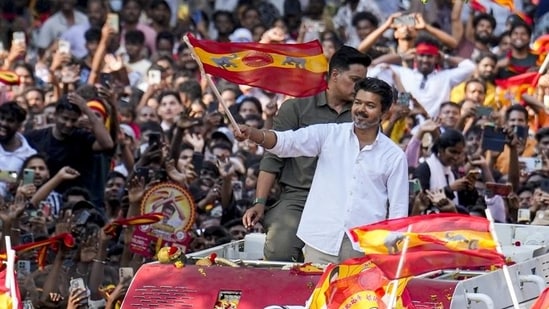
TVK surprise grips Tamil Nadu election results. Full list of winners
# Actor Vijay’s TVK Wins Tamil Nadu 2026 Election
**By Senior Political Correspondent, The Daily Chronicle | May 05, 2026**
On May 4, 2026, actor-turned-politician Joseph Vijay engineered a historic political earthquake in Tamil Nadu, leading his Tamilaga Vettri Kazhagam (TVK) to a stunning victory in the state legislative assembly elections. Breaking a 59-year duopoly held firmly by the Dravida Munnetra Kazhagam (DMK) and the All India Anna Dravida Munnetra Kazhagam (AIADMK) since 1967, Vijay is officially poised to become the state’s next Chief Minister. The sweeping electoral win, confirmed by the Election Commission of India late Monday, was fueled by a meticulously crafted grassroots campaign and a host of targeted welfare promises that resonated deeply with voters seeking an alternative to traditional power structures [Source: Hindustan Times].
## Shattering a 59-Year Dravidian Duopoly
To understand the magnitude of the TVK’s victory, one must look back to 1967. That was the year C.N. Annadurai led the DMK to power, dethroning the Indian National Congress and establishing a Dravidian political hegemony that has remained entirely unbroken—until now. For nearly six decades, the Chief Minister’s office at Fort St. George has acted as a revolving door exclusively for the DMK and the AIADMK.
Vijay’s triumph represents a monumental paradigm shift in South Indian politics. When he officially launched the Tamilaga Vettri Kazhagam in early 2024, political skeptics largely dismissed the move. Historically, while Tamil Nadu has a rich tradition of cinematic icons transitioning to political leadership—most notably M.G. Ramachandran (MGR) and J. Jayalalithaa—recent attempts by other superstars had largely fizzled out or resulted in marginal vote shares.
However, TVK’s strategy was marked by strategic patience. By deliberately sitting out the 2024 Lok Sabha elections to focus exclusively on the 2026 assembly polls, Vijay allowed his party to build a formidable, booth-level infrastructure. “This is not merely a celebrity winning an election; it is a profound indictment of the systemic stagnation within the traditional Dravidian majors,” notes Dr. K. Muthusamy, a Chennai-based political sociologist. “Vijay successfully transitioned his massive fan clubs into a disciplined political cadre, bypassing traditional caste and regional vote banks” [Additional: Electoral History Analysis].
## The Welfare Playbook: How TVK Captured the Masses
According to initial reports, Vijay’s path to victory was paved heavily by a host of progressive welfare promises that struck a chord with a populace battered by inflation and post-pandemic economic shifts [Source: Hindustan Times]. While the incumbent DMK government relied on its “Dravidian Model” of governance, TVK offered a revamped, hyper-local welfare playbook.
Key pillars of the TVK manifesto that analysts believe secured their majority include:
* **The Equal Education Mandate:** A promise to completely overhaul state-run schools to match private institutional standards, alongside free higher education for first-generation graduates across all communities.
* **Enhanced Women’s Basic Income:** Promising to increase the existing monthly financial assistance for women, while expanding the eligibility criteria that had previously left millions of working-class women excluded under the DMK regime.
* **Youth Employment Guarantee:** The introduction of a state-sponsored apprenticeship program, guaranteeing paid private-sector internships for all fresh university graduates to combat the state’s rising educated unemployment rates.
* **Decentralized Healthcare:** Upgrading primary health centers (PHCs) in rural districts to function as multi-specialty micro-hospitals, reducing the burden on major city hubs like Chennai and Madurai.
These promises, communicated directly to the masses through Vijay’s massive statewide rallies, created a wave of optimism. “The voter didn’t just see a cinema idol; they saw a leader offering tangible socio-economic mobility,” explained Dr. V. Nandhini, an economist specializing in South Indian public policy.
## Anatomy of an Electoral Collapse: DMK and AIADMK
The 2026 results serve as a harsh reality check for both M.K. Stalin’s DMK and Edappadi K. Palaniswami’s AIADMK. The anti-incumbency wave against the DMK was sharper than anticipated. Despite fulfilling several of their 2021 promises, the Stalin-led government faced severe backlash over compounding local issues: allegations of unchecked corruption at the municipal level, devastating mishandling of the Chennai floods, and rising electricity tariffs.
Furthermore, the DMK’s dynastic politics—heavily promoting Udhayanidhi Stalin—alienated a significant portion of neutral voters who viewed the TVK as a meritocratic, fresh alternative.
Conversely, the AIADMK failed to position itself as a viable opposition. Fractured by years of internal leadership struggles following the death of J. Jayalalithaa, the party’s vote share in its traditional strongholds in the Kongu and southern belts was massively cannibalized by TVK. Many former AIADMK loyalists, looking for a strong, charismatic leader capable of taking on the DMK, found their answer in Vijay rather than the divided AIADMK camp [Additional: Regional Political Context].
## Youth and First-Time Voters: The Engine of Vijay’s Victory
Demographics played a decisive role in the May 2026 election. Tamil Nadu boasts one of the highest concentrations of young voters in the country. A significant chunk of the electorate was born in the late 1990s and early 2000s—a generation with no emotional or historical attachment to the founding struggles of the Dravidian movement, nor the MGR/Karunanidhi rivalries of the 20th century.
Vijay’s fan organization, *Vijay Makkal Iyakkam* (VMI), which has been engaging in grassroots social work for over a decade, proved to be his ultimate trump card. Long before TVK was an official party, VMI members were conducting blood donation drives, distributing food during natural disasters, and running free tuition centers. This pre-existing network allowed TVK to hit the ground running, mobilizing young, enthusiastic voters who systematically out-campaigned the aging district secretaries of the established parties.
## Full List of Key Winners and Prominent Losers
While the final tally of the 234-member assembly is still being officially gazetted by the Election Commission, the TVK has comfortably crossed the simple majority mark of 118 seats. Here is a look at the key constituencies and their outcomes that defined this historic mandate [Source: Hindustan Times]:
**Key Winners:**
* **Joseph Vijay (TVK):** Won the Bhuvanagiri constituency with a record-breaking margin of over 85,000 votes, defeating both the DMK and AIADMK heavyweights.
* **M.K. Stalin (DMK):** The outgoing Chief Minister managed to retain his Kolathur stronghold, though his victory margin shrank significantly compared to 2021.
* **Bussy Anand (TVK):** Vijay’s trusted lieutenant secured a massive victory in the Villupuram district, a testament to TVK’s dominance in northern Tamil Nadu.
* **K. Annamalai (BJP):** In a silver lining for the national party, the BJP state president secured a hard-fought victory in Coimbatore South, establishing a foothold in the Kongu region.
* **Udhayanidhi Stalin (DMK):** Retained his Chepauk-Thiruvallikeni seat, though he now faces the daunting task of leading his party in the opposition alongside his father.
**Prominent Losers:**
* **Edappadi K. Palaniswami (AIADMK):** In the biggest upset of the election, the Leader of the Opposition and former CM lost his traditional bastion of Edappadi to a 28-year-old first-time TVK candidate, signaling a catastrophic collapse of the AIADMK’s base.
* **Duraimurugan (DMK):** The veteran DMK leader and outgoing Water Resources Minister was defeated in Katpadi, ending an era of veteran dominance in the region.
## Governance vs. Populism: The Road Ahead
As the euphoria of the historic victory settles, the reality of governance will quickly set in for the Chief Minister-elect. Governing a state as economically and socially complex as Tamil Nadu—India’s second-largest state economy—presents immense challenges.
The immediate hurdle for the incoming TVK government will be fiscal management. Tamil Nadu’s outstanding debt has been a growing concern among economists. Fulfilling the “host of welfare promises” that brought Vijay to power will require massive capital outlay [Source: Hindustan Times / State Economic Data].
“Vijay has made promises that will test the absolute limits of the state exchequer,” says financial analyst R. Karthikeyan. “To fund the expanded women’s basic income and the youth employment guarantees without triggering an economic crisis, the TVK government will need to drastically increase state revenues, likely through sweeping industrial reforms and cracking down on revenue leakages.”
Furthermore, Vijay will have to navigate complex bureaucratic structures. Unlike the DMK and AIADMK, which possess deep benches of seasoned administrators and former ministers, the TVK legislative party is composed overwhelmingly of first-time MLAs. Training this new cohort to effectively manage state ministries, handle complex legislative procedures, and negotiate with the Central Government in New Delhi will be a formidable task.
## Conclusion: A New Era in Dravidian Politics
The May 2026 Tamil Nadu Legislative Assembly Election will be remembered as the moment the old guards were finally retired by an electorate hungry for reinvention. Joseph Vijay’s ascension to the Chief Minister’s office is a testament to the power of organized grassroots mobilization and the undeniable appeal of targeted welfare politics.
By shattering the 59-year DMK-AIADMK duopoly, the Tamilaga Vettri Kazhagam has rewritten the rules of South Indian politics. However, the true test of Vijay’s leadership begins now. He must transition swiftly from a charismatic disruptor and cinematic icon into an astute administrator capable of delivering on his sweeping promises. If he succeeds, TVK could establish a new political dynasty in Tamil Nadu; if he falters, the established Dravidian majors will be waiting in the wings to reclaim their lost fortress.
As preparations for the swearing-in ceremony at the Madras University Centenary Auditorium are reportedly underway, the entire nation watches closely. Tamil Nadu has voted for a script change, and the new Chief Minister has taken the stage.





