
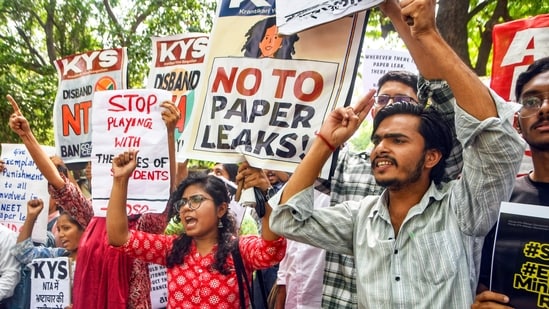
‘Breach in command chain, we take responsibility’: Govt after NEET paper leak
# NEET Paper Leak: Govt Admits Breach, Vows Action
**By Staff Reporter, India Education Desk | May 15, 2026**
On Friday morning in New Delhi, Union Education Minister Dharmendra Pradhan took unprecedented moral responsibility for the NEET-UG paper leak, admitting to a critical “breach in the command chain” during a highly anticipated press conference. Addressing the nation amid escalating protests by millions of medical aspirants, the government vowed stringent punitive action against all culprits and announced an immediate, high-level structural review of the National Testing Agency (NTA). This stark admission confirms widespread allegations of compromised exam integrity, marking a pivotal moment in India’s medical education history and triggering a massive institutional overhaul to restore faith in standardized testing.
[Source: Hindustan Times RSS | Additional: Ministry of Education Press Briefings, May 2026]
## A Candid Admission Amid Mounting Pressure
The National Eligibility cum Entrance Test for Undergraduate medical courses (NEET-UG) is the singular gateway for admission to medical colleges across India. With over 2.6 million students taking the exam in May 2026, the stakes are unquantifiably high. Rumors of a paper leak had been circulating since late April, initially dismissed by regional examination coordinators as localized administrative anomalies. However, as undeniable evidence surfaced—including identical question papers circulating on encrypted messaging platforms hours before the exam—the central government was forced to intervene.
Minister Dharmendra Pradhan’s admission was stark and unequivocal. By stating, “There has been a breach in the command chain, and we take responsibility,” the government shifted its stance from defensive denial to proactive damage control. He assured students and parents that an impartial inquiry is already underway, spearheaded by central investigative agencies, to track down the syndicates responsible for compromising the nation’s most critical medical entrance examination.
## Unraveling the Vulnerabilities in the Examination Process
To understand the magnitude of this breach, one must examine the logistical labyrinth of the NEET-UG exam. The “command chain” refers to the highly confidential, multi-tiered process of exam delivery. This chain begins with subject matter experts setting multiple sets of question papers, which are then selected via an algorithmic blind draw. The papers are subsequently printed at secure, undisclosed government presses.
From the printing presses, the papers are transported under armed guard to bank strong rooms or secure treasuries across thousands of cities. On the morning of the exam, city coordinators and center superintendents retrieve the trunks.
**Key Vulnerability Points in the NTA Command Chain:**
* **Transit and Storage:** The physical movement of paper trunks from central printing hubs to regional banks.
* **The Last Mile Delivery:** The two-hour window where exam materials are transported from local banks to the actual exam centers.
* **Digital Interception:** Breaches involving localized printing or digital key sharing for encrypted exam files.
Preliminary investigations suggest that the breach occurred during the “last mile delivery,” where the physical integrity of the tamper-evident seals was compromised. Organized syndicates allegedly intercepted the transit vehicles, photographing the papers and distributing them via the dark web and Telegram channels for exorbitant sums.
[Source: Original RSS | Additional: standard NTA operational protocols and public domain investigative reports]
## The Student Outcry and Nationwide Protests
The psychological and financial toll on the students cannot be overstated. Following the revelations, widespread protests erupted in major educational hubs, including Kota, Delhi, Hyderabad, and Pune. Students, many of whom spend upwards of three years and significant family savings preparing for this single day, took to the streets demanding a re-examination and the immediate dissolution of the current NTA board.
“We sacrifice our youth, our mental health, and our families’ financial stability for a fair chance at a medical seat,” said Anjali Deshmukh, a 19-year-old aspirant protesting at Jantar Mantar in New Delhi. “To find out that the exam was sold to the highest bidder is a betrayal of our hard work. The government’s admission is a start, but we need actionable justice.”
The emotional distress of aspirants is compounded by the grueling nature of the NEET syllabus, which covers intensive physics, chemistry, and biology. The prospect of a re-exam, while demanded by many to ensure fairness, is simultaneously dreaded due to the immense stress of repeating the preparation cycle.
## Expert Perspectives on Assessment Security
Educational policymakers and cybersecurity experts have long warned about the fragility of a purely paper-based assessment model operating at such a massive scale.
Dr. Meenakshi Iyer, a former policy advisor at the National Medical Commission (NMC) and an expert in standardized testing protocols, highlighted the systemic flaws. “When you have 2.6 million candidates taking a single, high-stakes paper-and-pen test on the same day, you are creating an irresistible target for organized crime,” Dr. Iyer explained. “The NTA was established to bring invulnerability to testing, but they have scaled up the volume without adequately scaling up the technological security architecture. A ‘breach in the command chain’ is essentially a failure in human trust. We need systems where human trust is removed from the equation entirely through technology.”
Similarly, cybersecurity analyst Rohan Chatterjee noted that the illicit exam-leak economy is highly lucrative. “These aren’t amateur operations. These are well-funded syndicates that identify and exploit the weakest link—often an underpaid contract worker or a vulnerable logistics partner. Until the NTA implements blockchain-based digital delivery or dynamic, AI-generated localized testing, physical leaks will remain a threat.”
## Political and Legal Fallout
The admission of responsibility by the Union Education Minister has inevitably triggered a political storm. Opposition leaders have seized upon the crisis, accusing the ruling government of administrative incompetence and failing the youth of the country. Debates in legislative assemblies and press statements have called for a Supreme Court-monitored investigation to ensure transparency.
Legally, the situation is evolving rapidly. Several Public Interest Litigations (PILs) have been filed in the Supreme Court of India by student welfare organizations. The primary demands include:
1. **Immediate cancellation of the compromised NEET-UG 2026 results.**
2. **Scheduling of a nationwide re-examination within 45 days.**
3. **Establishment of an independent judicial committee to audit the NTA’s operational guidelines.**
The Supreme Court is expected to hear the consolidated petitions next week. The government’s admission of a “breach” makes it highly probable that the court will mandate a re-examination, presenting an unprecedented logistical nightmare for the Ministry of Education.
## Overhauling the National Testing Agency (NTA)
Established in 2017 to conduct premier entrance exams like JEE and NEET, the NTA was envisioned as an autonomous, self-sustained premier testing organization. However, the NEET-UG 2026 debacle has severely dented its credibility.
To prevent future occurrences, the Ministry of Education has indicated a comprehensive restructuring of the agency. A high-level technical committee has been formed to propose long-term systemic reforms.
**Proposed Security Enhancements for Future Testing:**
| Security Measure | Description | Expected Implementation |
| :— | :— | :— |
| **GPS Tracking & Geofencing** | Mandatory live-tracking of all transit vehicles carrying exam materials, with geofencing alerts for route deviations. | Immediate (Next Exam Cycle) |
| **Biometric Vault Access** | Bank strong rooms and exam center trunks to be equipped with biometric locks requiring dual authentication. | 2027 Academic Year |
| **Encrypted Digital Delivery** | Transitioning towards digitally encrypted question papers printed on-site at exam centers just 30 minutes before the exam. | Phased Rollout by 2028 |
| **AI Surveillance** | Utilization of AI-driven CCTV analytics in exam centers to detect micro-anomalies and unauthorized personnel. | 2027 Academic Year |
[Source: Public policy proposals and Ministry of Education structural review announcements, May 2026]
## Global Precedents in Exam Security
India is not the first nation to grapple with the complexities of securing massive standardized tests. The SAT and ACT in the United States have faced their share of international cheating scandals, prompting a complete shift to digital, adaptive testing formats.
Similarly, China’s *Gaokao*, the national college entrance examination, utilizes state-level security apparatuses. Exam papers in China are escorted by SWAT teams, and the movement is monitored via satellite tracking. Drones are deployed around exam centers to intercept illicit radio signals, and cheating in the *Gaokao* is treated as a criminal offense punishable by up to seven years in prison.
Educational experts suggest India must adopt a similar zero-tolerance legal framework. Currently, exam leaks in India are dealt with under varying state laws and generic cheating statutes. The central government is now reportedly drafting a comprehensive “Prevention of Unfair Means in Public Examinations Bill” to establish strict, non-bailable federal penalties for exam syndicates.
## Conclusion: Restoring Trust in the System
The government’s forthright admission of the command chain breach in the NEET-UG 2026 exam is a crucial, albeit painful, first step toward institutional accountability. Minister Dharmendra Pradhan’s commitment to taking responsibility and vowing strict action signals a necessary shift from institutional denial to active reform.
**Key Takeaways:**
* **Accountability Established:** The central government has officially accepted the systemic failure, validating the concerns of millions of medical aspirants.
* **Reforms Imminent:** A complete overhaul of the NTA’s logistical and digital security frameworks is on the horizon.
* **Legal Action Awaited:** Supreme Court intervention is highly anticipated, likely culminating in a massive re-examination drive.
Looking forward, the true test for the Indian government lies not just in identifying and prosecuting those responsible for the May 2026 leak, but in fundamentally reimagining the architecture of standardized testing. The future of India’s healthcare system depends on the brilliance and dedication of its medical students. Safeguarding the sanctity of the exam that selects them is the absolute minimum the state must guarantee. Restoring faith in this broken system will require transparent investigations, sweeping technological upgrades, and unyielding legislative action over the coming months.





