
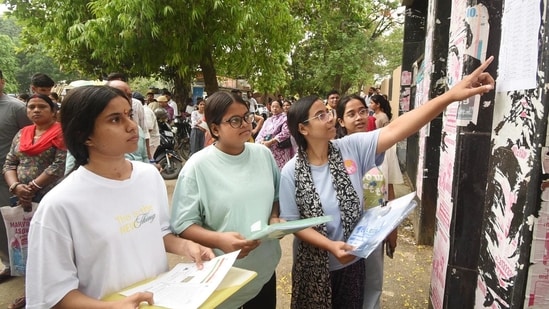
Before NEET-UG leak, parliamentary panel backed pen-and-paper exams
# Panel Backed Offline NEET Before Leaks
**By Vikram Sharma, Education Desk, May 15, 2026**
In a startling revelation amidst the ongoing medical entrance examination crisis, it has emerged that a parliamentary standing committee heavily favored retaining the traditional pen-and-paper format for the National Eligibility cum Entrance Test (NEET-UG) just prior to the recent paper leak scandal. This recommendation stands in stark contrast to the sweeping digital reforms proposed by the high-level committee led by former ISRO Chairman Dr. K. Radhakrishnan. As the National Testing Agency (NTA) grapples with systemic vulnerabilities impacting nearly 2.4 million medical aspirants across India, this fundamental policy clash highlights the complex challenge of securing mass-scale examinations against malicious actors. [Source: Hindustan Times]
## A Tale of Two Committees: Policy Paralysis at the NTA
The intersection of educational equity and examination security has become the defining battleground for India’s higher education sector. According to recent disclosures, the parliamentary panel evaluating the preparedness and operational efficiency of the NTA argued passionately for the continuation of Optical Mark Recognition (OMR) based pen-and-paper tests for NEET-UG. Their primary rationale was rooted in inclusivity, emphasizing that physical exams offer a level playing field for students from rural and marginalized backgrounds. [Source: Hindustan Times]
However, this legislative backing of traditional methods starkly contradicts the findings of the Ministry of Education’s high-level reform committee. Constituted to overhaul the NTA’s examination mechanism, this committee—spearheaded by Dr. K. Radhakrishnan—argued that the physical transportation of question papers across thousands of kilometers creates insurmountable security loopholes. The Radhakrishnan panel strongly advocated for a transition to Computer-Based Testing (CBT) or heavily encrypted hybrid models to eliminate the possibility of physical paper leaks. [Additional: Ministry of Education Public Reports, 2025-2026]
This glaring policy dichotomy left the NTA in a state of operational paralysis, ultimately leading to the execution of the most recent NEET-UG exam under the vulnerable traditional format—a decision that culminated in one of the largest paper leak controversies in the nation’s history.
## The Radhakrishnan Committee’s Technological Push
Dr. K. Radhakrishnan, known for his precision-driven leadership during India’s Mars Orbiter Mission, brought an aerospace-level risk assessment approach to the NTA’s operations. His committee’s report painted a grim picture of the logistical nightmare involved in physically printing, storing, and transporting millions of highly sensitive question papers to over 4,500 centers across the country.
**Key recommendations from the Radhakrishnan panel included:**
* **Complete Digital Transition:** Moving NEET-UG to a multi-shift Computer-Based Test (CBT), similar to the Joint Entrance Examination (JEE) Mains.
* **Encrypted Delivery:** Transmitting question papers digitally to exam centers just 15 minutes before the commencement of the exam, utilizing advanced biometrics to decrypt the files.
* **Tiered Examination System:** Exploring a two-stage examination process (Prelims and Mains) to reduce the sheer volume of candidates appearing on a single day, thereby easing the infrastructural burden.
* **AI-Driven Proctoring:** Utilizing artificial intelligence to monitor candidate behavior and flag suspicious activities in real-time.
The high-level committee’s stance was clear: in an era of organized examination syndicates utilizing dark web networks and encrypted messaging apps, relying on physical padlocks and strongrooms is an archaic and failing strategy.
## Why the Parliamentary Panel Defended Pen-and-Paper
Despite the compelling security arguments for digitization, the parliamentary standing committee’s defense of the pen-and-paper format was heavily grounded in India’s socio-economic realities. NEET-UG is unique; it is the sole gateway to modern medical education in India, drawing over 2.4 million candidates annually. A significant portion of these aspirants hails from Tier-3 cities, deeply rural districts, and agricultural families.
The parliamentary panel highlighted several critical bottlenecks regarding a sudden shift to CBT:
1. **The Digital Infrastructure Deficit:** India currently lacks the secure, high-quality computer nodes required to host 2.4 million students simultaneously.
2. **The Normalization Controversy:** If NEET-UG transitions to CBT, the lack of infrastructure would necessitate conducting the exam over multiple days and shifts. This requires “normalization” of scores—a statistical process that has previously sparked immense outrage and legal battles in other NTA exams, as students often feel the difficulty levels across different shifts are uneven.
3. **Digital Literacy:** The panel argued that students from rural government schools, who may lack regular access to computers, could face severe psychological and operational disadvantages in a high-stakes CBT environment compared to their urban counterparts.
In their view, retaining the OMR sheet was not an act of technological stubbornness, but a necessary measure to ensure democratic access to medical education. [Source: Hindustan Times | Additional: Parliamentary Proceedings Archives, 2025]
## Anatomy of the NEET-UG Leak Crisis
The tragic irony of the parliamentary panel’s recommendation is that it was formulated just months before the physical vulnerabilities of the OMR system were catastrophically exploited. The recent NEET-UG leak bypassed local center-level security entirely. Investigations have revealed that the breach occurred at the logistical mid-points—during the transit of sealed trunks from regional printing presses to bank strongrooms.
Organized syndicates allegedly managed to compromise the transit vehicles, carefully unsealing the trunks, photographing the physical question papers, and repacking them without breaking the temper-evident seals. These papers were then sold on encrypted networks for exorbitant sums, leading to artificially inflated cut-offs and robbing hundreds of thousands of meritorious students of their rightful medical seats.
Had the NTA implemented the Radhakrishnan committee’s recommendation of last-minute digital decryption, this physical transit vulnerability would not have existed. The leak has triggered nationwide protests, prolonged Supreme Court hearings, and a severe crisis of faith in the National Testing Agency’s competency.
## Expert Perspectives: Balancing Equity and Security
The educational community remains deeply divided over how to resolve this structural paradox. Security experts champion the Radhakrishnan report, while sociologists and grassroots educators echo the parliamentary panel’s concerns.
Dr. Arvind Chaurasia, a Delhi-based education policy analyst and former government advisor, notes the complexity of the issue: *”The parliamentary panel was not wrong in its assessment of India’s digital divide. Conducting a synchronized online exam for 2.4 million people is an infrastructural impossibility today. However, the NTA’s failure was treating the pen-and-paper format as business-as-usual, rather than fortifying the physical logistics with modern tracking, GPS-locked trunks, and randomized press selections.”*
Conversely, cybersecurity consultant Meera Krishnan argues that physical exams are fundamentally obsolete for high-stakes testing. *”The Radhakrishnan committee understood that human intervention is the weakest link in any security chain,”* Krishnan explains. *”When a piece of paper passes through fifty pairs of hands—from the setter to the printer, the courier, the bank manager, and the invigilator—a leak is statistically inevitable. We must move to encrypted digital delivery, even if it means bearing the temporary friction of staggered testing and normalization.”*
## Global Benchmarks and India’s Unique Scale
When viewing the crisis through an international lens, India’s challenge is unparalleled in its sheer scale. Globally, major standardized tests are moving definitively away from physical paper. The College Board in the United States successfully transitioned the SAT to a fully digital, adaptive format to curb cheating and streamline logistics. Similarly, the GRE and GMAT have been computer-based for years.
Even in Asia, China’s *Gaokao*, which sees upwards of 12 million candidates, employs draconian physical security measures, including armed escorts, drone surveillance, and severe criminal penalties (up to seven years in prison) for cheating.
India currently sits awkwardly between these two paradigms. It lacks the seamless technological infrastructure of the West to go fully digital in a single shift, yet it also struggles to enforce the flawless, militarized physical security required to protect OMR papers across thousands of decentralized transit routes.
## Conclusion: Charting a Path Forward
The glaring contradiction between the parliamentary panel’s defense of pen-and-paper exams and the Radhakrishnan committee’s push for a digital overhaul perfectly encapsulates the NTA’s current dilemma. The catastrophic NEET-UG leak has essentially settled the debate: the status quo is no longer tenable.
Moving forward, the Ministry of Education and the NTA will likely be forced to adopt a hybrid compromise. This could involve retaining the OMR format for students to ensure accessibility, but entirely digitizing the delivery mechanism. Instead of transporting printed papers, encrypted files could be sent to highly secure, localized printing hubs on the morning of the exam, drastically reducing the window of opportunity for organized syndicates.
As the dust settles on the latest examination fiasco, the millions of aspiring doctors caught in the crossfire await a system that respects both their hard work and their diverse socio-economic backgrounds. Until the NTA can reconcile the parliamentary panel’s demand for equity with the Radhakrishnan committee’s demand for uncompromised security, the integrity of India’s medical entrance system will remain precariously on the edge.





