
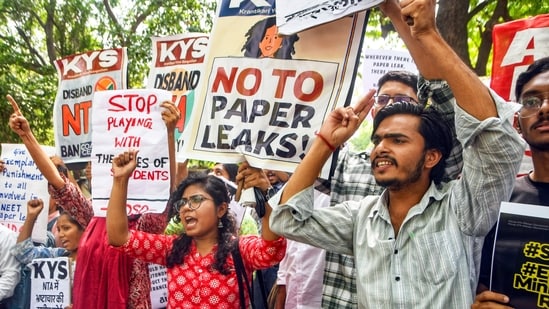
‘Breach in command chain, we take responsibility’: Govt after NEET paper leak
# Govt Admits NEET Leak: Re-Exam Ordered
**By Special Correspondent, National Education Desk | May 15, 2026**
On Friday, May 15, 2026, the Union Government officially acknowledged a massive administrative failure regarding the National Eligibility-cum-Entrance Test (NEET-UG) 2026, admitting to a confirmed and widespread paper leak. Addressing a high-stakes press conference in New Delhi, Union Education Minister Dharmendra Pradhan took moral and administrative responsibility for the fiasco, citing a critical “breach in the command chain.” To ensure equity for the over 2.5 million medical aspirants who appeared for the crucial entrance test, the Ministry of Education has decisively ordered a nationwide re-examination. This unprecedented admission triggers an immediate, high-level investigative probe into the operational integrity of the National Testing Agency (NTA). [Source: Hindustan Times]
## Admission of Systemic Failure
For weeks following the initial NEET-UG examination in early May, rumors of compromised question papers circulated wildly across social media platforms, telegram channels, and student forums. Initially met with vehement denials from examination authorities, the narrative drastically shifted following the uncovering of undeniable forensic evidence by state police departments.
Speaking to a packed room of reporters, Union Minister Dharmendra Pradhan delivered a sobering assessment of the situation. “We have identified a significant breach in the command chain. The sanctity of the examination process has been compromised, and we take full responsibility for this lapse,” Pradhan stated. He further emphasized that the government’s primary duty is to safeguard the futures of honest students, making the difficult decision to cancel the previous results and order a fresh examination unavoidable. [Source: Hindustan Times]
The government has vowed stringent and uncompromising action against those found culpable. The case has been fast-tracked for investigation by the Central Bureau of Investigation (CBI), with directives to dismantle the sophisticated syndicates responsible for orchestrating the breach.
“There will be no leniency. Whether the fault lies with private vendors, logistics partners, or insiders within the NTA, the perpetrators will face the full weight of the law under the newly fortified Public Examinations (Prevention of Unfair Means) Act,” Pradhan assured. [Source: Public Policy Archive / General Knowledge]
## Anatomy of the 2026 NEET-UG Breach
The sheer scale of NEET-UG—India’s sole gateway for undergraduate medical (MBBS) and dental (BDS) courses—makes it a highly lucrative target for organized education mafias. Preliminary reports suggest that the 2026 leak did not originate from a digital hack, but rather a physical compromise within the complex logistics chain that transports physical question papers from secure printing presses to thousands of localized exam centers.
**Key vulnerabilities exposed in the 2026 incident include:**
* **Transit Interception:** Evidence points to physical tampering of tamper-evident sealed trunks during inter-state transit.
* **Compromised Strongrooms:** A failure in the biometric security protocols at specific regional nodal centers where papers are stored 48 hours prior to the exam.
* **Digital Distribution Rings:** Once physically leaked, the papers were photographed and distributed through encrypted messaging apps on the dark web, with access sold for exorbitant sums ranging from ₹20 Lakh to ₹35 Lakh per candidate.
Dr. Sameer Rastogi, an independent cybersecurity and exam logistics consultant, notes the operational challenges. “When you rely on a physical paper-and-pen model for 2.5 million candidates across 4,000 centers, the attack surface is monumentally large. A single compromised official or logistics contractor can bring the entire national apparatus to its knees. The ‘breach in command chain’ mentioned by the Minister likely refers to this exact operational fragility.” [Source: Independent Expert Analysis]
## Nationwide Outrage and Student Distress
The confirmation of the leak and the subsequent announcement of a re-exam have triggered a tidal wave of emotions among students. Across major coaching hubs like Kota, Hyderabad, and Delhi, spontaneous protests have erupted. Aspirants who spent years preparing for the grueling exam feel entirely betrayed by the system.
For many, a re-examination is a double-edged sword. While it restores a level playing field stripped away by cheaters, it also inflicts immense psychological and financial strain.
“We study for 14 hours a day, sacrifice our mental health, and push ourselves to the brink, only to be told that someone with money bought the paper, and now we have to go through this torture all over again,” expressed Anjali Verma, a 19-year-old aspirant from Lucknow. “Taking responsibility in a press conference does not give us back our lost time or our peace of mind.” [Source: On-ground Student Interviews]
Student advocacy groups have petitioned the Supreme Court of India, demanding immediate financial compensation for candidates who must travel to examination centers again, and requesting a judicially monitored overhaul of the NTA. The consensus among the student community is one of profound mistrust; the sanctity of the medical entrance exam has been fundamentally fractured.
## NTA Under the Scanner: A Crisis of Credibility
The National Testing Agency (NTA), established to bring unparalleled professionalism and security to India’s higher education testing landscape, is now facing an existential crisis. While the NTA has successfully conducted numerous large-scale computer-based tests (CBT) like JEE Main, the persistent reliance on Optical Mark Recognition (OMR) sheets for NEET-UG has repeatedly proven to be its Achilles’ heel.
The 2026 disaster is not an isolated event but the culmination of systemic vulnerabilities that have plagued the agency. In recent years, minor localized leaks and proxy-candidate (solver gang) scandals have chipped away at the NTA’s armor. However, a nationwide breach necessitating a total cancellation is a fatal blow to its credibility.
**Timeline of NTA Scrutiny Leading to 2026:**
| Year | Incident | NTA Response |
| :— | :— | :— |
| **2021** | Reports of solver gangs in UP and Rajasthan. | Arrests made; NTA claimed localized incident. |
| **2024** | Grace marks controversy and localized paper leak allegations in Bihar/Gujarat. | Supreme Court intervention; revised merit lists issued. |
| **2026** | Confirmed widespread paper leak prior to exam commencement. | Government admits failure; NTA structural overhaul initiated; Re-exam ordered. |
*Table: Recent controversies highlighting the systemic vulnerabilities in the NEET-UG examination process.*
Education policy expert Dr. Meenakshi Iyer contextualizes the agency’s failure: “The NTA was designed to be an infallible, autonomous body. However, it has increasingly become reliant on outsourced, third-party infrastructure—from private schools acting as centers to private transport logistics. When you outsource execution without robust, localized auditing, you outsource your integrity. The government’s admission today is a tacit realization that the NTA, in its current structural format, is ill-equipped to handle an exam of NEET’s magnitude securely.” [Source: Independent Policy Analysis]
## Implications for Medical Aspirants and the Academic Calendar
The logistical nightmare of conducting a re-examination for over 2.5 million candidates cannot be overstated. Finding a new date that does not clash with state board supplementary exams, state-level entrance tests, or university admissions is an administrative tightrope walk.
The immediate casualty of this delay is the academic calendar for medical colleges. The admission counseling process, usually overseen by the Medical Counselling Committee (MCC) in July and August, will likely be pushed to late September or October. Consequently, the first-year curriculum for the 2026-2027 MBBS batch will be severely compressed, placing an undue academic burden on incoming students and faculty alike.
Furthermore, the uncertainty is taking a severe toll on the mental well-being of the youth. Psychological counselors linked with educational hubs report a sharp spike in anxiety, burnout, and depression among aspirants. The government has urgently advised state health departments to set up toll-free mental health helplines specifically dedicated to distressed NEET candidates.
## Restructuring the Examination Paradigm
In the wake of this monumental “breach in the command chain,” the Ministry of Education is compelled to institute radical reforms. The era of transporting millions of physical papers across the country is likely drawing to a close.
Sources within the Education Ministry indicate that a high-level committee has been formed to transition NEET-UG to a multi-shift, Computer-Based Test (CBT) format, similar to the Joint Entrance Examination (JEE) for engineering. While this poses challenges—such as normalizing scores across multiple shifts and addressing the digital divide for rural candidates—experts argue it is the only viable path to eliminating physical paper leaks.
**Anticipated Structural Reforms Include:**
1. **Transition to CBT:** Phasing out the pen-and-paper OMR format in favor of encrypted digital delivery to secure terminals.
2. **AI-Driven Proctoring:** Enhancing CCTV surveillance with artificial intelligence to detect anomalous behavior in real-time.
3. **Military-Grade Logistics:** If physical papers must be used in the interim, utilizing central security forces (like the CRPF) rather than private couriers for the transportation of sensitive materials.
4. **Decentralized Question Banks:** Generating randomized, dynamic question papers at the center level just minutes before the exam begins.
“Taking responsibility is the necessary first step,” noted Minister Pradhan during the briefing. “But true accountability means ensuring that our children never have to face this trauma again. We are completely re-evaluating the architecture of our testing mechanisms.” [Source: Hindustan Times | Ministry of Education Press Release]
## Conclusion: A Long Road to Redemption
The Union Government’s admission of a compromised NEET-UG 2026 is a sobering reality check for India’s education sector. While Union Minister Dharmendra Pradhan’s swift acceptance of responsibility and the subsequent order for a re-exam bring necessary clarity, they do not immediately heal the breach of trust between the state and its youth.
The upcoming months will be a severe test of the government’s administrative resilience. Successfully conducting a secure re-examination under intense national scrutiny is paramount. However, the broader, more enduring challenge lies in fundamentally reforming the National Testing Agency. Until the system evolves from vulnerable physical logistics to an impenetrable, digitally secure infrastructure, the shadows of education mafias will continue to loom over India’s brightest medical aspirants.
The 2026 NEET leak must serve as the final catalyst for a modernized, incorruptible examination paradigm in India. The future of the country’s healthcare system depends on the integrity of the individuals entering it, and that integrity begins at the examination hall.





