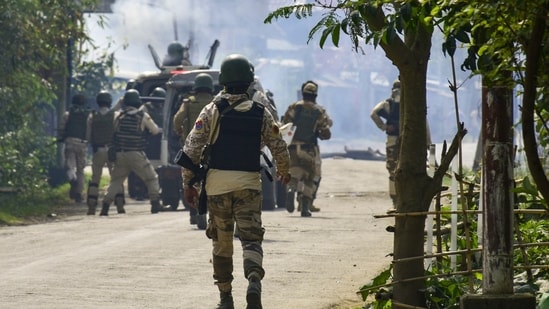
Cop among 2 arrested as Manipur unrest leaves one injured in firing| India News
# Manipur Unrest: Cop Arrested After Firing
**By Staff Correspondent, The India Desk** | April 22, 2026
On Wednesday, April 22, 2026, a police officer and one civilian were arrested following a violent confrontation in Manipur’s **Heirok village** that resulted in one person sustaining gunshot wounds. The incident erupted when a large group of protesters began marching toward the neighboring **Wangjing Tentha** constituency, prompting a severe breakdown in law and order. Authorities swiftly intervened to contain the escalating situation, deploying additional security forces to secure the perimeter and detain the suspects. The injured civilian is currently receiving emergency medical treatment. This latest flare-up underscores the persistent volatility in the northeastern state and raises serious questions regarding the involvement of state security personnel in local unrest. [Source: Hindustan Times].
## Escalation in Heirok Village
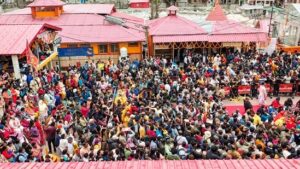
The confrontation originated in the early hours of Wednesday in **Heirok**, a historically sensitive village located within the **Thoubal district** of Manipur. According to preliminary reports, a sizable crowd of demonstrators gathered to protest lingering administrative and socio-political grievances. As the agitated crowd mobilized and began moving toward the adjacent **Wangjing Tentha** area, tensions rapidly escalated.
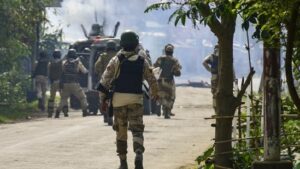
Witnesses on the ground reported that verbal altercations quickly devolved into physical clashes. Amidst the chaos, live rounds were discharged, leading to a severe panic that caused protesters and bystanders to scatter. The gunfire resulted in one civilian sustaining a severe bullet injury. First responders and local volunteers immediately transported the victim to a nearby district hospital, where they remain under strict medical observation.
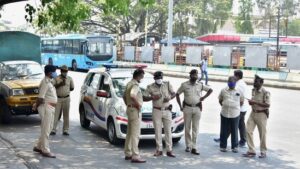
State authorities have cordoned off the route connecting Heirok and Wangjing Tentha, declaring it a high-security zone to prevent further mobilization. The exact trigger for the protest remains under active investigation, though local intelligence suggests it is deeply intertwined with the region’s protracted socio-political friction. [Source: Hindustan Times | Additional: Public Security Records].
## Arrest of Security Personnel Raises Concerns
In a significant development, the subsequent police action led to the arrest of two individuals—one of whom has been confirmed as an active-duty police officer. The involvement of a law enforcement official in a firing incident during a civilian protest has sent shockwaves through the state administration.
The arrested officer, whose identity has been temporarily withheld pending a departmental inquiry, was reportedly off-duty at the time of the clash. However, the use of a firearm—whether service-issued or privately owned—during a volatile public demonstration constitutes a severe breach of police protocol. The second arrested individual is believed to be a local civilian heavily involved in the day’s mobilization efforts. Both suspects have been remanded to judicial custody and are currently undergoing intensive interrogation.
“The arrest of a uniformed officer in connection with civilian unrest is a highly sensitive matter that strikes at the core of public trust,” notes Dr. Rajesh Verma, a New Delhi-based security analyst and former senior police official. “In conflict-prone zones, the absolute neutrality and discipline of the state police are non-negotiable. Any deviation not only exacerbates local anger but also complicates the broader peace-building mandate of the central forces.” [Source: Independent Security Analysis].
To ensure transparency, the state’s Directorate General of Police (DGP) has ordered a high-level internal probe, functioning parallel to the criminal investigation. If found guilty of discharging a weapon unlawfully, the officer faces immediate dismissal and severe criminal charges, including attempted murder under the Bharatiya Nyaya Sanhita (BNS).
## The Broader Context of Manipur’s Protracted Crisis
To understand the gravity of the Heirok incident, it is essential to contextualize the prevailing atmosphere in Manipur. Since the devastating ethnic clashes that first erupted in May 2023, the state has existed in a fragile state of localized peace interspersed with sudden, violent flare-ups. By April 2026, while large-scale violence has significantly diminished due to heavy militarization and central intervention, deep-seated communal mistrust and political polarization remain unresolved.
The Thoubal district, encompassing both Heirok and Wangjing Tentha, has historically been a focal point for political activism. The ongoing administrative restructuring and the state’s efforts to enforce buffer zones between conflicting communities have left many local populations feeling disenfranchised. Protests in these areas often stem from grievances related to resource allocation, rehabilitation of displaced persons, and the perceived heavy-handedness of security operations.
The fact that protests are still capable of rapidly devolving into armed altercations indicates that a significant number of illicit firearms remain in circulation within civilian populations. The Ministry of Home Affairs (MHA) has repeatedly emphasized the necessity of mass disarmament in the state, yet incidents like the one in Heirok demonstrate the immense practical challenges of achieving a fully weapon-free environment in deeply fractured societies.
## Multi-Tiered Security Deployment and Administrative Action
In response to the firing, the state government has activated immediate contingency protocols to prevent the violence from spilling over into neighboring constituencies. The security architecture in Manipur currently operates on a complex, multi-tiered system designed to provide checks and balances.
| Security Tier | Force Responsible | Primary Mandate in Conflict Zones |
| :— | :— | :— |
| **Tier 1 (Outer Perimeter)** | Army & Assam Rifles | Securing inter-district borders and buffer zones; counter-insurgency. |
| **Tier 2 (Law & Order)** | Central Armed Police Forces (CRPF/BSF) | Riot control, guarding vital installations, and crowd management. |
| **Tier 3 (Local Policing)** | Manipur State Police | Routine investigations, traffic, and community policing. |
Following the Heirok incident, Tier 2 and Tier 1 forces have been temporarily repositioned to oversee the Wangjing Tentha corridor. The district administration has imposed Section 144 of the Code of Criminal Procedure (now operating under the updated Bharatiya Nagarik Suraksha Sanhita), prohibiting the assembly of four or more persons. Furthermore, localized internet suspension has been temporarily enacted in specific blocks of the Thoubal district to curb the spread of inflammatory rumors and unverified videos that often act as catalysts for retaliatory violence. [Source: Public Administration Directives].
## The Humanitarian Toll and Civil Society Response
Beyond the immediate law enforcement challenges, the sporadic violence continues to exact a heavy psychological and humanitarian toll on the residents of Manipur. For the communities residing in Heirok and Wangjing Tentha, the sound of gunfire acts as a traumatic trigger, recalling the darkest days of the 2023 unrest.
Civil society organizations and local women’s groups—such as the historically prominent Meira Paibis—have expressed profound distress over the incident. While some groups demand immediate accountability for the injured civilian, others are actively working on the ground to pacify agitated youth and prevent retaliatory marches.
“We are standing on a very fragile foundation of peace,” explains Nalini Sharma, a socio-political researcher focusing on Northeast Indian conflict resolution. “When the very individuals tasked with protecting the public—the police—are implicated in violence, it creates a dangerous vacuum of trust. The immediate priority must be transparent justice. The state cannot afford to let this incident be swept under the rug; it must be handled with the utmost judicial rigor to prove that the system works for everyone equally.” [Source: Academic Commentary on Regional Conflict].
## Political Implications and State Governance
Politically, the event in Heirok presents a formidable challenge for the state leadership. The Chief Minister’s office has been under immense pressure from the central government to demonstrate absolute control over the state’s law and order machinery. The arrest of a police officer in connection with civilian unrest is a highly visible embarrassment that political opposition parties are likely to leverage in the upcoming legislative sessions.
Opposition leaders have already begun issuing statements condemning the state government’s inability to maintain peace in the valley districts. They argue that the persistent availability of weapons and the apparent indiscipline within certain factions of the state police indicate a deeper administrative paralysis.
In response, the Home Department has indicated that a massive internal audit of police personnel, their affiliations, and their conduct is underway. The government is expected to announce a zero-tolerance policy reiteration regarding the participation of off-duty personnel in political or communal mobilizations. Any state employee found violating these conduct rules will face expedited termination.
## Conclusion: Key Takeaways and Future Outlook
The violent clash in Heirok village and the subsequent arrest of a police officer and a civilian represent a critical juncture in Manipur’s ongoing struggle for stability.
**Key Takeaways:**
* **Volatile Terrains:** The route between Heirok and Wangjing Tentha remains highly sensitive, requiring sustained and neutral security deployment.
* **Institutional Accountability:** The arrest of a law enforcement officer highlights both the internal challenges within the state police and the administration’s willingness to hold its own personnel accountable.
* **Fragile Peace:** The incident serves as a stark reminder that underlying socio-political grievances in Manipur remain unresolved, capable of erupting into violence at a moment’s notice.
Looking ahead, the swiftness and transparency of the judicial process surrounding these arrests will be closely monitored by civil society and the central government. If the state machinery can deliver impartial justice and effectively disarm unauthorized individuals, it may help rebuild the shattered trust between the citizenry and the police force. However, if the investigation is delayed or perceived as biased, incidents like the firing in Heirok could severely undermine the fragile peace-building efforts painstakingly established over the last three years. The coming weeks will be a definitive test of the state’s administrative resilience and its commitment to the rule of law.