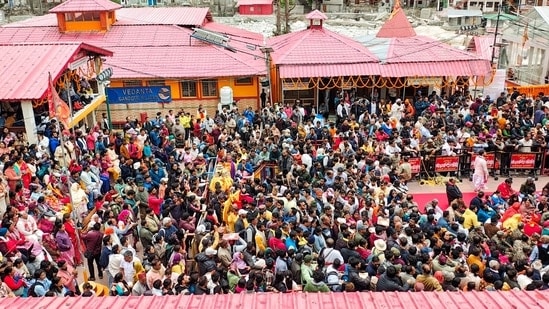
What is 'Panchgavya', a mixture containing cow urine made mandatory by Gangotri Mandir Samiti to enter temple| India News
# Gangotri Mandates Panchgavya Drink for Entry
**By National Correspondent, Heritage News Desk | April 22, 2026**
The Gangotri Temple Committee in Uttarakhand announced on Wednesday that consuming ‘Panchgavya’—a traditional sacred mixture containing cow urine and dung—will now be explicitly mandatory for all devotees seeking entry into the revered shrine. Implemented just weeks ahead of the 2026 Char Dham Yatra season, the sweeping new regulation aims to confirm visitors’ adherence to Sanatan Dharma and preserve the site’s spiritual sanctity. Temple officials stated the mixture will be physically administered to devotees at the entrance gates. This unprecedented move addresses growing local anxieties over non-Hindu visitors and “tourist-like” behavior at sacred sites, but it has simultaneously ignited widespread national debates regarding logistical feasibility, public health, and constitutional rights. [Source: Hindustan Times | Additional: Uttarakhand Tourism Records].
## Decoding Panchgavya: The Sacred Concoction
To understand the magnitude of this new mandate, it is essential to look at the religious and historical significance of Panchgavya. In traditional Hindu scriptures and Ayurvedic medicine, Panchgavya is a purifying mixture composed of five distinct products derived from the cow, an animal considered deeply sacred in Hinduism. The five elements include **milk (Kshira), curd (Dadhi), clarified butter (Ghrita), cow urine (Gomutra), and cow dung (Gomaya).**
Historically, the consumption of Panchgavya has been utilized in rigorous purification rituals (Prayaschitta) and ceremonies designed to cleanse an individual of spiritual and physical impurities. According to ancient Vedic texts, including sections of the *Sushruta Samhita*, the concoction is believed to possess divine healing properties that align the mind and body with higher spiritual frequencies.
“For centuries, Panchgavya has not just been a symbol of reverence for the ‘Gau Mata’ (Mother Cow), but a literal manifestation of spiritual cleansing,” explains Dr. Anjali Sharma, a scholar of Vedic traditions at the Banaras Hindu University. “By making its consumption mandatory, the temple committee is essentially reviving an ancient threshold of purity for modern pilgrims.” [Source: Independent Expert Commentary].
## The Catalyst Behind the Committee’s Directive
The Gangotri Mandir Samiti’s decision does not exist in a vacuum. Over the past few years, there has been a growing chorus of demands from local priests, traditionalists, and right-wing organizations in Uttarakhand to strictly regulate the entry of non-Hindus into the Char Dham shrines—comprising Yamunotri, Gangotri, Kedarnath, and Badrinath.
The primary grievance is that the spiritual epicenter of the Himalayas is increasingly being treated as a recreational tourist destination rather than a site of austere pilgrimage. Instances of visitors allegedly flouting dress codes, filming social media content in sacred precincts, and a general lack of adherence to traditional temple decorum have frustrated local custodians.
According to the temple committee, mandating the consumption of Panchgavya serves as a definitive litmus test of faith. The underlying logic is that only a devout follower of Sanatan Dharma would willingly consume a mixture containing cow urine and dung out of profound religious devotion. Consequently, the mandate acts as a self-regulating filter to prevent those lacking genuine religious intent from entering the temple’s inner sanctum. [Source: Hindustan Times].
## Logistics and the Char Dham Yatra Challenge
While the theological reasoning is clear, the logistical execution of this mandate presents a monumental challenge. The Char Dham Yatra is one of the largest annual pilgrimages in India. In recent years, the circuit has seen an influx of over **4.5 million pilgrims** within a narrow six-month window. Gangotri alone frequently receives tens of thousands of visitors daily during peak season in May and June.
Administering a freshly prepared, sacred drink to every individual at the temple gates introduces severe bottlenecking concerns. Temple authorities will need to establish dedicated verification and distribution counters. Furthermore, ensuring an adequate and continuous supply of authentic, ritually pure Panchgavya ingredients to meet the daily demand of thousands of pilgrims will strain local resources.
“The sheer volume of crowd management required is staggering,” notes Vikram Rawat, a Dehradun-based tourism logistics consultant. “If every pilgrim must pause, receive the Panchgavya, consume it, and then proceed, the queue times could easily triple. This poses not just an administrative nightmare but a potential safety hazard in the high-altitude terrain where weather conditions are highly unpredictable.”
## Constitutional Complexities and Legal Precedents
The mandatory consumption of Panchgavya for temple entry immediately intersects with the complex framework of India’s constitutional law, specifically concerning religious freedom and state intervention.
Under **Article 25** of the Indian Constitution, all persons are equally entitled to freedom of conscience and the right to freely profess, practice, and propagate religion. However, **Article 26** grants religious denominations the right to manage their own affairs in matters of religion. Historically, courts have navigated these disputes through the “Essential Religious Practices” doctrine.
Legal experts suggest that the Gangotri Mandir Samiti’s directive could face judicial scrutiny. “While temples like Jagannath Puri have historic, legally recognized rules restricting entry to orthodox Hindus, enforcing the mandatory ingestion of a substance as a proof of faith is a novel legal frontier,” explains senior Supreme Court advocate Meenakshi Iyer. “If challenged, the courts will have to determine whether the administration of Panchgavya to every visitor is an ‘essential religious practice’ of the Gangotri shrine, or an arbitrary administrative hurdle that violates an individual’s right to worship.” [Source: Constitutional Law Records].
## Public Health Perspectives and Modern Science
Beyond theology and law, the mandate has triggered urgent conversations among public health officials. While Ayurvedic practitioners maintain that properly prepared Panchgavya has detoxifying and medicinal benefits, modern medical science and food safety authorities approach the consumption of raw animal byproducts with extreme caution.
The primary concerns revolve around the unpasteurized nature of the cow milk, curd, and specifically the raw cow urine and dung. Medical professionals warn that without stringent sterilization, these components can harbor harmful pathogens, including E. coli and Salmonella. Administering such a mixture to thousands of people daily—including the elderly, children, and immunocompromised individuals making the arduous high-altitude trek—raises significant public health red flags.
“Faith and science often have different paradigms, but public health must rely on the latter,” states Dr. Rohan Kadam, an infectious disease specialist. “If this mixture is prepared and stored in bulk at high altitudes, the risk of cross-contamination or gastrointestinal infections among pilgrims is a statistically significant risk that state health departments cannot ignore.”
## Ripple Effects: Will Kedarnath and Badrinath Follow?
The Gangotri temple’s decision is already sending ripples across the wider spiritual landscape of Uttarakhand. As per the Hindustan Times report, the underlying intention of restricting non-Hindu entry is a sentiment shared by several custodians of the other Char Dham shrines.
There is now mounting speculation and pressure on the temple committees of **Kedarnath and Badrinath** to adopt similar measures. If these larger, even more heavily visited shrines implement a Panchgavya mandate, the operational dynamics of religious tourism in northern India will fundamentally transform.
Local political outfits and certain prominent seer councils (Akhadas) have publicly lauded the Gangotri Samiti’s boldness, calling it a necessary step to “reclaim the sanctity” of the Himalayas. Conversely, secular forums, opposition political figures, and tourism operators have expressed deep concern, arguing that such exclusionary practices damage India’s inclusive spiritual ethos and threaten the local economy, which relies heavily on a seamless, welcoming pilgrimage experience.
## Conclusion and Future Outlook
The Gangotri Temple Committee’s mandate to make the consumption of Panchgavya a prerequisite for entry is a watershed moment in the administration of Hindu religious sites in India. It stands at the volatile intersection of ancient religious orthodoxy, modern constitutional rights, massive logistical management, and public health.
As the ice thaws in the Himalayas and the doors of the Gangotri temple prepare to open for the 2026 season, all eyes will be on how exactly this rule is implemented on the ground. Will the state government of Uttarakhand intervene to modify the rule citing health and crowd-control concerns? Or will the mandate successfully establish a new, stringent benchmark for spiritual purity that cascades to other historical temples across the subcontinent?
Regardless of the immediate outcome, the ‘Panchgavya mandate’ has definitively ignited a national discourse on the boundaries of religious autonomy, the definition of devotion, and the future of India’s sacred spaces.