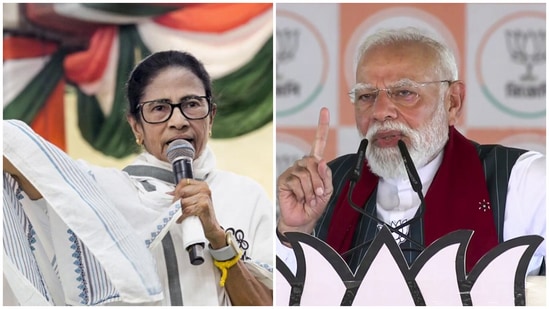
‘Cowardly’, ‘betrayed women’: Mamata vs Modi takes over Bengal ahead of state assembly polls| India News
# Mamata vs Modi: Bengal Election Clash Escalates
By Staff Correspondent, The India Briefing, April 19, 2026
West Bengal Chief Minister Mamata Banerjee launched a scathing attack on Prime Minister Narendra Modi on Sunday, escalating the political showdown ahead of the crucial 2026 state assembly elections. Responding to the Prime Minister’s Saturday address to the nation, Banerjee dismissed his remarks as “cowardly, hypocritical and fork-tongued,” particularly criticizing his stance on women’s safety and regional governance. The fierce rhetorical clash underscores the high stakes in West Bengal, where the ruling Trinamool Congress (TMC) and the opposition Bharatiya Janata Party (BJP) are locked in an intense battle for political supremacy. [Source: Hindustan Times].
## The Spark: A Weekend of Rhetorical Fire
The latest political firestorm was ignited on Saturday evening when Prime Minister Narendra Modi delivered a highly anticipated address to the nation. While the speech touched upon broader national developmental goals, it featured pointed remarks directed at opposition-ruled states, emphasizing issues of law and order, systemic corruption, and the protection of women’s rights. Though the Prime Minister did not explicitly name West Bengal in every instance, political observers widely interpreted the commentary as a direct critique of the TMC administration’s track record over the past five years.
In a swift and blistering rebuttal on Sunday, April 19, Chief Minister Mamata Banerjee convened a press conference to denounce the Prime Minister’s assertions. Pulling no punches, Banerjee accused the central government of utilizing national platforms to launch partisan political attacks.
“To use an address to the nation as a veil for a political smear campaign is cowardly, hypocritical, and fork-tongued,” Banerjee stated to the gathered press. She further alleged that the central government had systematically “betrayed women” through a combination of soaring inflation, inadequate federal funding for state-level welfare programs, and a failure to address systemic gender disparities on a national scale. [Source: Hindustan Times | Additional: General Political Context].
## Women’s Electoral Power: The Central Battleground
At the heart of this escalating war of words is the highly coveted demographic of female voters, who have historically played a decisive role in West Bengal’s electoral outcomes. The phrase “betrayed women,” highlighted prominently in Banerjee’s Sunday rebuttal, is indicative of the broader strategic narratives being deployed by both the TMC and the BJP.
For the Trinamool Congress, female voters have long served as a crucial bulwark against opposition surges. The state government has invested heavily in direct cash transfer schemes, such as the widely popular *Lakshmir Bhandar* program, alongside female education initiatives like *Kanyashree*. Banerjee’s strategy hinges on framing the BJP-led central government as fundamentally anti-poor and insensitive to the economic burdens carried by women, particularly regarding the cost of household essentials and cooking gas.
Conversely, the BJP has aggressively sought to dismantle the TMC’s narrative of female empowerment by focusing heavily on women’s safety and local law and order. Drawing upon incidents of localized political violence and historical controversies—most notably the unrest in Sandeshkhali in early 2024—the BJP has consistently argued that the TMC’s welfare schemes are a smokescreen masking a systemic failure to protect women from regional strongmen and political syndicates.
**Dr. Rupa Chatterjee**, a senior political sociologist at the Institute of Electoral Dynamics, notes the strategic necessity of this rhetoric. “Both parties recognize that women are voting more independently and in higher numbers than ever before in Bengal,” Dr. Chatterjee explains. “The BJP is attempting to override the appeal of TMC’s welfare checks with appeals to physical safety and justice, while the TMC is framing the BJP as a patriarchal outsider force that threatens the financial independence those state schemes provide.”
## Governance vs. ‘Maha Jungle Raj’
The rhetorical battle extends beyond gender dynamics into the broader spectrum of governance and administrative competence. The BJP’s campaign heavily relies on characterizing West Bengal under TMC rule as a state of “Maha Jungle Raj” (a state of absolute lawlessness).
Prime Minister Modi and senior BJP leadership have consistently highlighted federal investigations by agencies like the CBI and ED into alleged coal smuggling, school recruitment scams, and municipal corruption within the state. By painting the incumbent government as deeply entrenched in graft, the BJP is appealing to the urban middle class and youth demographics who are frustrated by employment challenges and administrative inefficiencies. The promise of a “double-engine government”—referring to the same party ruling at both the central and state levels to ensure seamless development—remains a core pillar of the BJP’s pitch.
Banerjee and the TMC, however, have fiercely counterattacked, framing the deployment of federal investigative agencies as a “witch-hunt” designed to destabilize democratically elected opposition governments. Banerjee’s assertion that the Prime Minister’s speech was “fork-tongued” is rooted in her long-standing grievance that the central government preaches cooperative federalism while actively withholding thousands of crores in legitimate federal dues owed to West Bengal, particularly for rural employment (*MGNREGA*) and housing schemes.
## The 2026 Stakes: A Fight for the Eastern Fortress
The context of the April 2026 assembly elections cannot be overstated. Following the historic 2021 assembly elections, where Mamata Banerjee secured a resounding third consecutive term despite a massive, highly energized BJP campaign, West Bengal has remained the ultimate prize for the national ruling party.
For the BJP, capturing West Bengal is an ideological and political imperative. It represents the final frontier in their eastern expansion and a chance to prove that their brand of nationalism and development politics can resonate deeply within a state historically dominated by Leftist and regional ideologies.
For the TMC, the 2026 election is about survival, legacy, and national relevance. A fourth consecutive victory would cement Mamata Banerjee’s status as one of the most formidable regional leaders in modern Indian history, reinforcing her position as a central figure in any future national opposition coalition against the BJP.
### Key Electoral Themes in the 2026 Bengal Polls
| Theme | TMC Narrative | BJP Narrative |
| :— | :— | :— |
| **Welfare Schemes** | Focus on *Lakshmir Bhandar* and direct cash transfers as tools of poverty alleviation and women’s independence. | Claims state schemes are unsustainable, mismanaged, and funded by diverting central government allocations. |
| **Law & Order** | West Bengal is a safe haven compared to BJP-ruled states; accuses central forces of overreach and intimidation. | Characterizes the state as “Maha Jungle Raj,” pointing to political violence and alleged protection of local syndicates. |
| **Federalism** | Accuses the Center of a financial blockade, withholding funds for MGNREGA and housing to artificially create distress. | Argues the state government fails to provide utility certificates for central funds, citing widespread corruption in implementation. |
| **Identity Politics** | Leans into Bengali sub-nationalism, portraying the BJP as “Bohiragato” (outsiders) unaligned with Bengali culture. | Emphasizes inclusive Hindu consolidation, national integration, and pushing back against alleged state-sponsored minority appeasement. |
## Federal Dynamics and Regional Pride
The “Mamata vs. Modi” dynamic has consistently been framed as a battle between regional pride and national integration. Banerjee has expertly wielded the narrative of Bengali sub-nationalism, positioning herself as the “daughter of the soil” defending the state’s cultural and political autonomy against an encroaching, Hindi-centric national hegemon.
In her Sunday press conference, the Chief Minister’s choice of words—calling the Prime Minister’s rhetoric “hypocritical”—was a calculated move to question the authenticity of the BJP’s outreach to Bengal. By accusing the central leadership of superficial engagement with the state’s ethos while simultaneously squeezing it financially, Banerjee aims to consolidate ethnic and linguistic pride into a unified voting block.
“The personalization of this contest is by design,” states **Amitava Roy**, an independent political analyst based in Kolkata. “When the battle is framed as Mamata versus Modi, it bypasses local anti-incumbency against state legislators and elevates the election to a referendum on two competing visions of India. Both leaders are highly charismatic and polarize the electorate in ways that leave very little room for third parties like the Left-Congress alliance.” [Source: Independent Political Analysis].
## Conclusion: Key Takeaways and Future Outlook
As West Bengal marches toward the polling booths, the rhetorical escalation witnessed this weekend sets a contentious tone for the remainder of the campaign. The direct clash between Chief Minister Mamata Banerjee and Prime Minister Narendra Modi over the weekend highlights several undeniable realities about the upcoming 2026 assembly elections:
1. **Women are the Deciding Factor:** The battle over who truly champions—and who has “betrayed”—the women of West Bengal will likely decide the fate of the state government. Both parties are recalibrating their campaigns to appeal directly to this demographic.
2. **No Quarter Given:** The use of strong terminology like “cowardly,” “fork-tongued,” and “Maha Jungle Raj” indicates that the political discourse will remain highly aggressive. Neither side is willing to cede an inch in what is viewed as a zero-sum political contest.
3. **National Implications:** The outcome of this localized clash will reverberate in the corridors of power in New Delhi. A TMC victory secures the blueprint for regional resistance, while a BJP breakthrough would fundamentally alter the political geography of eastern India.
With weeks left before the electorate casts their ballots, political rallies, administrative maneuvers, and press conferences will only intensify. If the weekend’s exchange is any indicator, the road to the 2026 West Bengal Assembly elections will be one of the most fiercely contested political battles in the nation’s recent history, closely watched by observers and voters alike.