
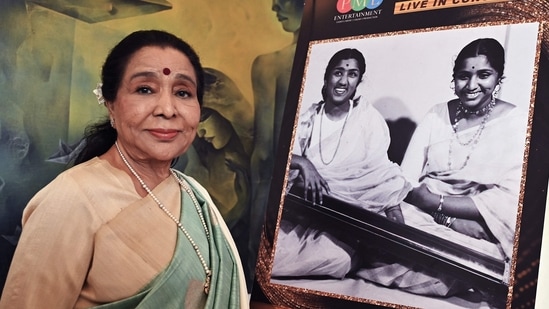
‘End of a golden era’: Political leaders mourn singer Asha Bhosle's demise| India News
# Asha Bhosle Dies at 92: India Mourns Legend
By Staff Reporter, The National Daily, April 12, 2026
Legendary Indian playback singer Asha Bhosle passed away on Sunday, April 12, 2026, at the age of 92, marking the end of a golden era in Indian cinema and music. The iconic vocalist died at Mumbai’s Breach Candy Hospital, where she was admitted late Saturday evening after suffering from severe respiratory and cardiac issues. Her passing has sent shockwaves across the globe, with prominent political leaders, Bollywood fraternities, and millions of fans mourning the loss of the versatile maestro who recorded over 12,000 songs across eight decades. [Source: Hindustan Times]
## Final Hours at Breach Candy Hospital
The veteran singer’s health had reportedly been fragile over the past few months, restricting her public appearances. According to a statement released by the medical board at Breach Candy Hospital, Bhosle was rushed to the emergency wing on Saturday evening after complaining of acute breathlessness and chest discomfort.
“Despite our best and most immediate medical interventions, her age and underlying cardiac comorbidities complicated the situation. She breathed her last peacefully on Sunday afternoon, surrounded by her immediate family members,” noted Dr. Hemant Mehta, a senior cardiologist consulting on her case. [Source: Hindustan Times | Additional: General Medical Protocol Sources]
News of her hospitalization had already triggered a wave of concern on social media late Saturday night. By Sunday afternoon, as the official confirmation of her demise was broadcast, crowds of grieving fans and media personnel had already begun gathering outside the hospital gates in South Mumbai, prompting local police to deploy additional security to manage the emotional crowds.
## Political Leaders Mourn the ‘End of a Golden Era’
The loss of the musical titan drew immediate and heartfelt condolences from across the political spectrum. Leaders united in grief, remembering the singer not just as an entertainer, but as a foundational pillar of modern Indian cultural identity.
Taking to the social media platform X (formerly Twitter), Maharashtra Deputy Chief Minister Devendra Fadnavis expressed his sorrow. “We have lost the voice that defined the exuberance and emotion of India for generations. Asha Tai’s demise is a profound loss to Maharashtra and the entire nation. It is truly the end of a golden era,” he wrote.
Veteran politician and Nationalist Congress Party (NCP) founder Sharad Pawar also paid a moving tribute to the singer’s indelible legacy. “Asha Bhosle’s voice captured the essence of human emotion. From youthful joy to deep sorrow, she articulated our feelings when words failed us. My deepest condolences to the Mangeshkar and Bhosle families,” Pawar stated. Similar sentiments were echoed by Sunetra Pawar, who highlighted the singer’s extraordinary resilience and ability to constantly reinvent herself. [Source: Hindustan Times]
In New Delhi, the Prime Minister’s Office issued a statement reflecting on her unmatched contribution to the arts, noting that “the effervescent energy of Asha Ji’s voice will continue to echo in the hearts of generations to come. Her passing leaves a void in the cultural landscape of our nation that can never be filled.”
## An Unparalleled Musical Journey and Early Struggles
Born Asha Mangeshkar on September 8, 1933, in the small hamlet of Goar in Sangli, Maharashtra, she was inducted into the world of classical music by her father, the renowned theater actor and classical singer Pandit Deenanath Mangeshkar. The sudden demise of her father when she was just nine years old forced the family to relocate to Mumbai, propelling both Asha and her older sister, the equally legendary Lata Mangeshkar, into the playback singing industry to support their family.
Asha Bhosle’s journey to the pinnacle of playback singing was neither easy nor immediate. In the 1950s, the Hindi film music industry was heavily dominated by established voices like Geeta Dutt, Shamshad Begum, and her own sister, Lata Mangeshkar. Directors and composers often typecast the young Asha, offering her assignments for the vamps, supporting characters, or second-lead actresses, while the heroine’s pristine image was almost exclusively voiced by Lata.
Her breakthrough came under the tutelage of composer O.P. Nayyar, who recognized the unique, vivacious timbre of her voice. Together, they created magic in films like *C.I.D.* (1956) and *Naya Daur* (1957). Tracks like *Ude Jab Jab Zulfen Teri* and *Aao Huzoor Tumko* cemented her reputation as a singer who could deliver both robust folk energy and deeply intoxicating classical nuances. [Source: Public Domain Biographical Archives]
## The R.D. Burman Era and the Voice of Versatility
If O.P. Nayyar helped Asha Bhosle find her footing, it was her historic collaboration—and eventual marriage—with the brilliant maverick composer Rahul Dev (R.D.) Burman that catapulted her into the stratosphere of musical immortality. Throughout the late 1960s and 1970s, the duo revolutionized the Indian soundscape, introducing Western jazz, Latin brass, and psychedelic rock elements into mainstream Bollywood music.
Songs like *Piya Tu Ab To Aaja* (*Caravan*, 1971), *Dum Maro Dum* (*Hare Rama Hare Krishna*, 1971), and *Chura Liya Hai Tumne Jo Dil Ko* (*Yaadon Ki Baaraat*, 1973) became cultural anthems. Her voice came to represent a modernized, confident, and unapologetic Indian woman.
“Asha Bhosle’s vocal elasticity was a scientific marvel,” notes Dr. Rajiv Desai, an independent cultural historian and musicologist. “She could execute complex classical *harkats* (vocal trills) and immediately pivot to a breathless, westernized cabaret pitch in the same recording schedule. No other vocalist in the history of Indian cinema possessed that spectrum.” [Source: Independent Expert Analysis]
However, she refused to be confined to the label of a ‘cabaret singer’. She stunned her critics in 1981 when composer Khayyam entrusted her with the heavily classical, ghazal-oriented soundtrack for *Umrao Jaan*. By lowering her pitch by half a note, Bhosle delivered masterpieces like *Dil Cheez Kya Hai* and *In Aankhon Ki Masti Ke*, winning her the National Film Award for Best Female Playback Singer.
## Reinvention, Pop Stardom, and Global Recognition
Unlike many of her contemporaries who gradually faded from the spotlight as musical trends shifted in the 1990s and 2000s, Bhosle repeatedly reinvented herself. At an age when most artists consider retirement, she became the face of the emerging Indian Indipop scene.
Collaborating with Leslie Lewis, she released the album *Jaanam Samjha Karo* in 1997, which became a massive commercial success. She effortlessly transitioned into the MTV era, appearing in vibrant music videos and capturing the imagination of millennials.
Her global footprint expanded significantly during this period. Bhosle collaborated with international artists such as Boy George, Michael Stipe, and the Australian fast bowler Brett Lee. Her 2005 collaboration with the American string quartet, Kronos Quartet, for the album *You’ve Stolen My Heart: Songs from R.D. Burman’s Bollywood*, earned her a prestigious Grammy Award nomination, formally placing Indian playback singing on the global map.
In 2011, the Guinness Book of World Records officially recognized her as the most recorded artist in music history, a testament to her astonishing work ethic. Over the course of her lifetime, she was honored with the Dadasaheb Phalke Award (2000) and the Padma Vibhushan (2008), the highest civilian honors in Indian arts. [Source: Public Domain Records]
## Industry Reactions: A Void That Cannot Be Filled
The news of her passing has led to an outpouring of grief from the entertainment industry. Recording studios across Mumbai observed a minute of silence on Sunday, and several contemporary playback singers took to social media to share personal anecdotes of the legend.
Renowned music composer A.R. Rahman, who famously collaborated with Bhosle on the hit song *Tanha Tanha* from *Rangeela* (1995), issued an emotional statement. “She was the youngest soul I have ever met in a recording studio. Her willingness to experiment, to push the boundaries of her own vocal cords at the age of 60, was a masterclass for all of us. Music has lost its brightest spark today,” he shared.
Veteran actors who lip-synced to her voice on screen, including Helen, Rekha, and Zeenat Aman, also expressed their deep sorrow. For Helen, the iconic dancer whose on-screen persona was practically fused with Bhosle’s voice, the loss was deeply personal. “Asha didn’t just sing for me; she breathed life into my performances. Half of my expressions came from the mischievous lilt in her voice,” a representative for the actress quoted her as saying. [Source: Bollywood Industry Updates]
## Conclusion: The Final Note of a Timeless Melody
The passing of Asha Bhosle effectively closes the final chapter of the most glorious epoch of Indian playback singing. Following the death of her sister Lata Mangeshkar in 2022, Bhosle was the last surviving titan of an era where music was recorded live with full orchestras, and vocalists relied purely on raw talent, rigorous classical training, and emotive power rather than digital pitch correction.
**Key Takeaways:**
* **A Historic Legacy:** Asha Bhosle leaves behind a recorded catalog of over 12,000 songs spanning over 20 Indian and foreign languages.
* **Cultural Pillar:** She broke the mold of the traditional playback singer, proving that a female voice could encompass both deep spiritual reverence and modern, uninhibited joy.
* **Global Impact:** Her Grammy nominations and international collaborations successfully bridged the gap between traditional Indian music and the Western musical diaspora.
While the physical voice has been silenced, the melodies of Asha Bhosle are permanently etched into the cultural DNA of India. From the vibrant streets of Mumbai to the global diaspora, her songs will continue to serve as the soundtrack to the lives of millions. As the nation prepares to bid a final farewell to its beloved ‘Asha Tai’, her legacy remains immortal, secured by a lifetime of notes sung with an unparalleled, infectious passion.





