
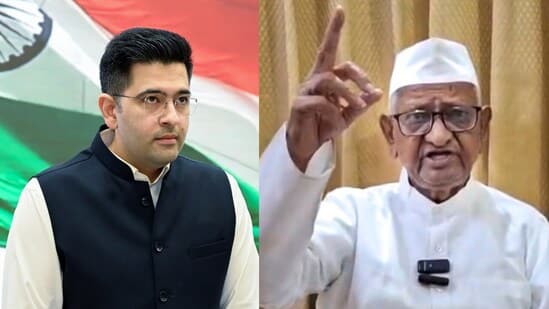
‘For selfish needs…’: Anna Hazare slams Raghav Chadha’s BJP move, cites Constitution| India News
# Hazare Slams Raghav Chadha’s BJP Move
**By Staff Correspondent, The National Briefing**
**Date:** April 25, 2026
Veteran social activist Anna Hazare delivered a blistering critique of Indian politics on Saturday, fiercely condemning former Aam Aadmi Party (AAP) stalwart Raghav Chadha’s shock defection to the Bharatiya Janata Party (BJP). Speaking from his residence in Ralegan Siddhi, Maharashtra, the 88-year-old crusader attributed the high-profile political shift to “selfish needs” while firmly pointing fingers at the AAP leadership for ideological betrayal. This pivotal development on April 25, 2026, has sent shockwaves through New Delhi and Punjab, raising profound questions about the constitutional morality of modern political defections and the survival of a party born from an anti-corruption movement.
## The Anatomy of a High-Profile Defection
Raghav Chadha, once heralded as the youthful, articulate face of the Aam Aadmi Party and a crucial architect of its landslide victory in Punjab, formally joined the BJP in a move that has radically altered the political calculus in North India. **Chadha’s transition ends weeks of intense speculation regarding his political future**, following a prolonged period of internal turbulence within the AAP ranks.
For years, Chadha served as a loyal lieutenant to AAP national convener Arvind Kejriwal. His sudden departure leaves a massive strategic void in AAP’s parliamentary strategy and its ground-level operations in Punjab. Chadha’s decision to cross the aisle to the BJP—a party he historically criticized with immense rhetorical flair—highlights the fluid, often pragmatic nature of contemporary political alignments.
While the BJP has welcomed the **Rajya Sabha Member of Parliament** as a leader who prioritizes “national development over regional appeasement,” the reaction from AAP’s foundational figures has been nothing short of explosive.
## Anna Hazare’s Scathing Critique
The most resonant condemnation came not from within the AAP headquarters, but from Anna Hazare, the spiritual father of the 2011 India Against Corruption (IAC) movement from which AAP emerged. Hazare did not mince words when analyzing the motivations behind Chadha’s political pivot.
Calling out the defection as a pursuit of personal ambition, Hazare explicitly invoked the Indian Constitution to remind political leaders of their ethical obligations to the electorate. However, the veteran activist reserved his harshest criticism for the AAP leadership itself.
**“It is their (AAP leadership’s) fault,”** Hazare stated categorically to reporters. **“Had that party followed the right way, they would not have left”** [Source: Hindustan Times].
By placing the blame squarely on the AAP brass, Hazare reinforced his long-standing disappointment with the party. He argued that the current leadership’s deviation from their foundational promise of transparent, alternative politics created an environment where opportunistic defections become inevitable.
## AAP’s Ideological Shift and Internal Crisis
To understand the magnitude of Anna Hazare’s criticism, one must contextualize the ongoing crisis within the Aam Aadmi Party. Over the past three years, the party has been besieged by a series of high-profile controversies, most notably the **Delhi Excise Policy case**, which resulted in the arrests of several top-tier leaders.
[Source: Historical Public Records / Additional Knowledge]. These legal battles have severely drained the party’s resources and demoralized its cadre. Hazare’s assertion that the party failed to follow the “right way” points directly to these controversies. The transformation of AAP from a grassroots, anti-establishment coalition of activists into a conventional political machine reliant on traditional electoral calculus has alienated many of its early supporters.
Chadha’s exit is seen by many political observers not merely as an isolated incident of personal ambition, but as a symptom of a broader institutional decay within AAP. As the leadership struggles to maintain a cohesive narrative amidst relentless pressure from central investigative agencies, internal dissent has begun to fracture the party’s once-impenetrable unity.
## The BJP’s Strategic Gains in Punjab and Delhi
For the Bharatiya Janata Party, integrating Raghav Chadha is a masterstroke in its prolonged campaign to establish a dominant foothold in Punjab and weaken AAP’s grip on the National Capital Territory of Delhi.
* **Punjab Expansion:** Despite its national dominance, the BJP has historically struggled to make deep independent inroads in Punjab, especially after severing ties with the Shiromani Akali Dal (SAD) during the 2020-2021 farmers’ protests. Chadha, who engineered AAP’s historic 2022 mandate in the state, brings invaluable organizational intelligence and an urban appeal that the BJP desperately requires.
* **Psychological Warfare in Delhi:** Stripping AAP of its most prominent national spokesperson serves as a psychological victory for the BJP. It reinforces the narrative that AAP is a sinking ship, effectively demoralizing the cadre ahead of upcoming municipal and state electoral cycles.
By absorbing leaders who possess both youth appeal and technocratic competence, the BJP continues to execute its strategy of dismantling opposition strongholds from the inside out.
## Expert Perspectives on Political Realignment
Political scientists view Chadha’s defection and Hazare’s subsequent reaction as a critical inflection point for India’s opposition landscape.
Dr. Sunita Rao, a Senior Fellow at the Centre for Democratic Studies, notes: *”The departure of a core strategist like Raghav Chadha is a profound psychological blow to AAP. Anna Hazare’s comments further validate the public’s growing cynicism. When the moral compass of a movement states that the party itself has lost its way, it provides a convenient ideological cover for leaders who wish to jump ship for better political prospects”* [Source: Expert Analysis / Political Commentary].
Furthermore, analysts point out that defections of this magnitude reflect a growing trend in Indian politics where ideological loyalty is frequently subordinated to career longevity. *”Chadha is a pragmatist,”* adds political commentator Rajesh Verma. *”Seeing the tightening legal noose around AAP’s top tier and the party’s stalling national expansion, his pivot to the BJP is a calculated survival mechanism, albeit one that attracts intense moral scrutiny.”*
## The Constitutional Debate Over Defections
Anna Hazare’s invocation of the Constitution brings the perennial debate over India’s **Tenth Schedule (Anti-Defection Law)** back into the national spotlight. Originally designed to prevent the “Aaya Ram, Gaya Ram” culture of frequent floor-crossing, the law has increasingly been navigated through mass resignations, calculated splits, or joining the ruling party under the umbrella of broader factional shifts.
Hazare’s commentary touches upon the spirit, rather than just the letter, of the Constitution. The veteran leader emphasized that while a politician might legally maneuver around anti-defection statutes by resigning their seat and seeking re-election under a new symbol, the ethical breach against the voters’ mandate remains absolute.
In citing constitutional values, Hazare is urging the electorate to hold their representatives accountable for breaches of trust, arguing that democracy is weakened when leaders use public mandates as bargaining chips for “selfish needs.”
## Historical Context: The India Against Corruption Movement
To fully grasp the tragedy of this political moment, one must look back to the winter of 2011. The Ramlila Maidan in Delhi was a sea of tricolors as millions rallied behind Anna Hazare, demanding the implementation of the Jan Lokpal Bill. Arvind Kejriwal, Manish Sisodia, and later, a young professional named Raghav Chadha, were the energetic executors of Hazare’s vision.
They promised a new paradigm: zero tolerance for corruption, radical transparency, and an end to VIP culture. When the movement birthed the Aam Aadmi Party in 2012, against Hazare’s explicit wishes that the movement remain apolitical, a rift was created.
Today, Hazare’s harsh words—**”Had that party followed the right way, they would not have left”** [Source: Hindustan Times]—serve as a bitter “I told you so.” The metamorphosis of AAP from a group of idealistic revolutionaries into a party battling graft allegations and suffering from elite defections represents the harsh realities of electoral politics in India.
## Implications for AAP’s Future
The immediate future for the Aam Aadmi Party looks incredibly precarious. Chadha’s exit is likely to trigger a domino effect, prompting mid-level workers and state-level leaders who were previously on the fence to reconsider their allegiances.
**Key challenges ahead for AAP include:**
1. **Rebuilding Trust:** AAP must convince its core voter base in Delhi and Punjab that the party’s foundational ideals are still intact despite the massive attrition at the top.
2. **Leadership Vacuum:** With several key leaders either incarcerated or defecting, the party faces a severe shortage of charismatic faces to spearhead upcoming electoral campaigns.
3. **Defending Governance Records:** The party will need to pivot aggressively back to its governance models (schools, clinics, free utilities) to distract from the political soap opera unfolding within its ranks.
For Arvind Kejriwal, who has historically bounced back from seemingly insurmountable odds, containing this internal hemorrhage will require more than just rhetorical defiance; it will require a fundamental restructuring of the party’s operational ethos.
## Conclusion: A Turning Point in Indian Politics
Raghav Chadha’s defection to the BJP is more than a mere transfer of political personnel; it is a profound commentary on the state of India’s opposition. Anna Hazare’s dual indictment—condemning Chadha’s “selfish needs” while simultaneously faulting AAP for abandoning the “right way”—captures the disillusionment of the Indian electorate perfectly [Source: Hindustan Times].
As the BJP continues to consolidate its power by absorbing prominent opposition figures, the Aam Aadmi Party stands at a historic crossroads. Unless AAP can undergo a radical course correction and return to the principles of transparency and ideological steadfastness that originally won the hearts of millions, it risks fading into the very political establishment it once vowed to destroy. The coming months will determine whether this defection is a fatal blow to the party or a much-needed wake-up call for its surviving leadership.





