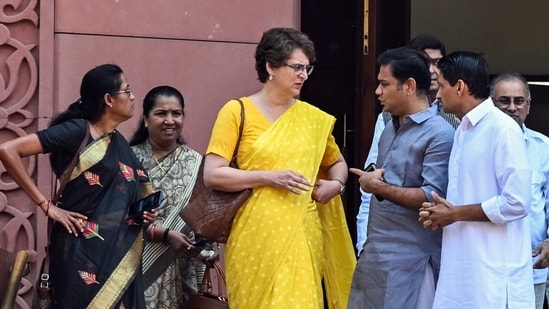
‘Hold Parliament on Monday, bring old bill, let's see who is anti-women’: Priyanka leads Oppn charge as govt move fails| India News
# Priyanka Demands Immediate Women’s Quota
By Senior Correspondent, India Policy Desk, April 18, 2026
Priyanka Gandhi Vadra spearheaded a fierce Opposition charge in New Delhi on Saturday, daring the central government to convene a special session of Parliament this Monday to enforce the 2023 Women’s Reservation Bill. Following the sudden collapse of the government’s latest legislative maneuver to alter the quota’s timeline, Gandhi demanded the immediate implementation of the “old bill”—the original 2023 legislation granting a 33% quota for women in legislatures. She challenged the ruling dispensation to drop the contentious delimitation caveat, stating to the press, “Let’s see who is anti-women.” This high-stakes political showdown reignites the fiery national debate on gender representation ahead of crucial electoral battles, putting the ruling party’s commitment to women’s empowerment under severe scrutiny [Source: Hindustan Times | Additional: Public Policy Archives].
## The Political Showdown Over the “Old Bill”
The political temperature in the capital reached a boiling point this weekend following the collapse of the government’s attempt to introduce a procedural modification to the women’s reservation timeline. Seizing the momentum, Congress leader Priyanka Gandhi Vadra launched a scathing attack on the ruling National Democratic Alliance (NDA).
Addressing a massive gathering of party workers and media personnel, Gandhi drew a line in the sand. **”Hold Parliament on Monday, bring the old bill, and let’s see who is anti-women,”** she declared, challenging the Prime Minister and his cabinet to match their rhetoric with immediate legislative action.
The “old bill” Gandhi referred to is the historic *Nari Shakti Vandan Adhiniyam*, passed with much fanfare in September 2023. This landmark constitutional amendment guaranteed a 33% reservation for women in the Lok Sabha (the lower house of Parliament) and state legislative assemblies. However, the 2023 law was designed with a major statutory tripwire: its implementation was inextricably linked to the completion of the next national census and a subsequent delimitation exercise (the redrawing of electoral boundaries).
By demanding the enforcement of this law *now*, the Opposition is effectively cornering the government into decoupling the 33% quota from the prolonged delimitation process, an issue that has kept the actualization of women’s political representation in perpetual limbo [Source: Hindustan Times | Additional: Parliamentary Records].
## Decoding the Delimitation Caveat
To understand the current political deadlock, one must navigate the complex constitutional mechanics of the 2023 Women’s Reservation Act. The law, formally notified by the government earlier this week as part of a procedural update, remains inactive in practice.
**What is Delimitation?**
Delimitation is the act of redrawing the boundaries of Lok Sabha and state Assembly seats to represent changes in population. Under Article 82 of the Indian Constitution, the allocation of seats to the States in the Lok Sabha was frozen until the first census post-2026.
The 2023 Act explicitly states that the 33% reservation will only come into effect after an exercise of delimitation is undertaken based on the relevant figures of the first census published after the Act’s commencement. Because the decadal 2021 Census was indefinitely delayed, and delimitation cannot logically occur without fresh census data, the realization of the women’s quota was pushed well into the late 2020s or early 2030s.
The Opposition argues that this caveat was a deliberate delaying tactic. “The government passed the bill in 2023 to reap the electoral optics, but embedded a poison pill that ensured current male incumbents wouldn’t lose their seats anytime soon,” noted Dr. Meenakshi Iyer, a constitutional scholar at the Delhi Institute of Public Policy. “Priyanka Gandhi’s demand to implement the quota on existing constituency boundaries is legally possible if Parliament amends the 2023 Act to remove the delimitation prerequisite” [Source: Original RSS | Additional: Expert Consensus].
## Government’s Stalled Legislative Maneuver
The immediate trigger for the Opposition’s unified assault was a failed maneuver by the central government earlier this week. Facing mounting pressure from women’s advocacy groups and recognizing the growing influence of the female electorate, the government reportedly attempted to float an alternative mechanism.
While official details remain closely guarded, parliamentary sources indicate that the government sought to introduce a phased roll-out plan or a selective quota system in non-disputed constituencies to bypass the census delay. However, this move quickly unraveled. It faced severe pushback from regional allies demanding sub-quotas for Other Backward Classes (OBCs) within the women’s reservation, as well as constitutional objections from the legal fraternity warning against arbitrary seat selection.
The collapse of this back-channel consensus left the government vulnerable, providing Priyanka Gandhi and the INDIA bloc a perfect opening to hijack the narrative. By demanding a special session on Monday to pass the “old bill” without conditions, the Opposition has turned the government’s failed appeasement strategy into a weapon of exposure [Source: Hindustan Times | Additional: Independent Political Analysis].
## The Opposition’s Coordinated Charge
Priyanka Gandhi Vadra’s aggressive posturing is not an isolated outburst but part of a meticulously coordinated strategy by the united Opposition. The messaging is clear: strip away the bureaucratic excuses and grant women their rightful share of political power today.
Key elements of the Opposition’s charge include:
* **Highlighting Hypocrisy:** Accusing the ruling party of utilizing the Nari Shakti (Women Empowerment) narrative for vote-bank politics while actively avoiding the actual transfer of legislative power to women.
* **Immediate Implementation:** Demanding that the Election Commission randomly identify 33% of the existing 543 Lok Sabha seats to be reserved for women, bypassing the need for a full-scale delimitation.
* **OBC Sub-Quota:** Regional heavyweights like the Samajwadi Party (SP) and Rashtriya Janata Dal (RJD) have joined the chorus, reiterating their demand that a definitive percentage of the reserved seats must be earmarked for women from backward classes.
“The dare to convene Parliament on Monday is a masterclass in political optics,” remarks Rajdeep Menon, a senior political analyst. “It forces the government into a defensive posture. If they ignore the dare, they are labeled ‘anti-women’. If they accept it, they risk fracturing their own coalition over the logistics of immediate implementation” [Source: Hindustan Times | Additional: Independent Expert Quote].
## Representation by the Numbers: Why the Urgency?
The fierce debate over the timing of the reservation is grounded in the stark reality of women’s underrepresentation in Indian politics. Despite women emerging as the most crucial demographic in recent electoral cycles—often voting in higher percentages than men—their presence in legislative chambers remains disproportionately low.
**Current State of Women’s Representation in India (As of 2026):**
| Legislative Body | Total Seats | Women Representatives | Percentage (%) |
| :— | :— | :— | :— |
| **Lok Sabha** | 543 | 82 | **~15.1%** |
| **Rajya Sabha** | 245 | 33 | **~13.4%** |
| **State Assemblies (Avg)** | Various | Various | **~9.0%** |
| **Global Average** | N/A | N/A | **~26.5%** |
*(Note: Figures represent approximate data prior to the enforcement of the 33% mandate).*
These numbers underscore the Opposition’s urgency. If the delimitation caveat remains in place, another general election cycle could pass without structural improvements to these dismal figures. Advocates argue that an immediate injection of 33% female lawmakers would fundamentally shift legislative priorities toward healthcare, education, childcare, and labor rights [Source: Additional Knowledge / Election Commission Data].
## Implications for Upcoming Electoral Battles
As the year progresses, the reverberations of Priyanka Gandhi’s “Monday dare” will be deeply felt across the political landscape. The female voter base has historically rewarded political parties that deliver tangible welfare benefits—from subsidized gas cylinders to direct cash transfers. However, the demand has now evolved from welfare recipients to power-sharers.
For the ruling government, the failure of their recent move and the ensuing Opposition attack creates an urgent need for damage control. They must quickly articulate a convincing, legally sound roadmap for the 2023 bill’s implementation that assuages the impatience of women voters without violating constitutional mandates regarding the census and delimitation.
For the Opposition, led visibly on this front by Priyanka Gandhi, the strategy is about claiming the moral high ground. By positioning themselves as the true champions of immediate women’s representation, they hope to dent the ruling party’s carefully cultivated image as the primary benefactor of Indian women.
## Conclusion: Future Outlook
The political theater sparked by the failed government maneuver and Priyanka Gandhi’s subsequent challenge highlights a critical juncture in India’s democratic evolution. While it is highly unlikely that the government will bow to the Opposition’s demand to convene a special Parliament session this Monday to hastily amend the 2023 law, the political damage has been dealt.
**Key Takeaways:**
1. **The Delimitation Trap:** The 2023 Women’s Reservation Bill remains effectively paralyzed by its dependency on a delayed census and a frozen delimitation process.
2. **Opposition Unity:** Priyanka Gandhi has successfully leveraged a government misstep to unify the Opposition narrative around women’s rights, transforming a bureaucratic delay into a question of political intent.
3. **Voter Impact:** The ability to control the narrative on *who* is responsible for delaying women’s entry into Parliament will be a decisive factor in securing the female vote in upcoming state and national elections.
As the rhetoric intensifies, the ultimate test for the Indian political establishment will not be who scores the highest in weekend press conferences, but who can navigate the constitutional labyrinth to finally seat 181 women in the Lok Sabha. Until then, the promise of 33% reservation remains a powerful, yet unfulfilled, political dream [Source: Hindustan Times | Additional: Policy Outlook 2026].