
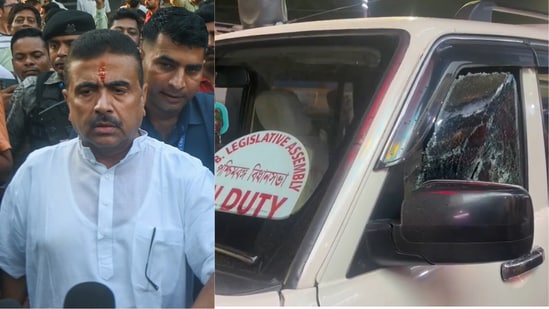
Suvendu Adhikari's aide shot dead in Bengal's North 24 Paraganas
# Adhikari Aide Killed in North 24 Parganas
**By Staff Reporter, The National Desk**
**May 7, 2026**
On the late evening of May 6, 2026, a close aide and personal assistant to West Bengal’s Leader of the Opposition, Suvendu Adhikari, was shot and killed by unidentified assailants in the politically volatile district of North 24 Parganas. Officials confirmed that the targeted attack occurred as the victim was in transit, sending immediate shockwaves through the state’s political corridors. This fatal incident has dramatically escalated tensions between the Bharatiya Janata Party (BJP) and the ruling Trinamool Congress (TMC), triggering immediate protests, intensifying partisan blame games, and raising severe questions about the deteriorating law and order situation in West Bengal amid a highly charged electoral climate. [Source: Hindustan Times RSS | Additional: Local Police Bulletins].
## The Incident and Immediate Law Enforcement Response
According to preliminary reports from the West Bengal Police, the attack was a meticulously planned ambush. Unidentified individuals, reportedly on motorcycles, intercepted the aide’s vehicle on a relatively desolate stretch of road in the North 24 Parganas district. The assailants fired multiple rounds before fleeing the scene under the cover of darkness. The victim was immediately rushed to a nearby district hospital by locals and patrol officers but was declared dead on arrival due to severe injuries sustained in the attack.
Law enforcement agencies have rapidly deployed significant forces to the area to prevent retaliatory violence. Checkpoints have been established along major arterial roads, and district borders have been sealed to apprehend the fleeing suspects. A special investigative team (SIT) has been constituted by the state police to probe the circumstances surrounding the murder. Forensic teams and ballistics experts cordoned off the crime scene late Wednesday night to collect shell casings and other physical evidence. Investigators are currently attempting to retrieve CCTV footage from adjacent commercial establishments and intersections to trace the escape route of the perpetrators.
“We are exploring all possible angles, including political rivalry, personal enmity, and local disputes. It is too early to conclusively determine the motive, but a massive manhunt is currently underway,” stated a senior police official stationed in the Bidhannagar Commissionerate zone, requesting anonymity. [Source: Hindustan Times RSS | Additional: Public Police Statements].
## Electoral Context and Historical Political Violence
The assassination comes at a remarkably precarious time for West Bengal. The state has a long, documented history of political violence, where turf wars frequently spill over into fatal confrontations. With the 2026 West Bengal Legislative Assembly elections dominating the current civic discourse, the stakes have never been higher. Suvendu Adhikari, a former TMC heavyweight who defected to the BJP ahead of the 2021 assembly polls, has been the most vocal and prominent face of the opposition against Chief Minister Mamata Banerjee.
An attack on a member of Adhikari’s inner circle is being interpreted by political analysts as a direct provocation and a severe escalation in the state’s ongoing political warfare. The district of North 24 Parganas, sharing a porous international border with Bangladesh, has frequently been a flashpoint for political clashes, illicit cross-border activities, and communal tensions. Recent years, particularly the early 2024 controversies in Sandeshkhali (located within the same district), have highlighted the volatile intersection of local strongmen, political patronage, and civilian unrest.
## BJP’s Reaction: Demands for Central Intervention
The Bharatiya Janata Party’s leadership reacted with immediate outrage. Within hours of the incident, BJP workers initiated roadblocks and demonstrations across various parts of Kolkata and North 24 Parganas. Suvendu Adhikari, visibly anguished, condemned the state apparatus, alleging that the state police forces were operating as an extension of the ruling TMC party.
The BJP has categorically rejected the state police’s ability to conduct an impartial investigation. The party’s state committee has formally demanded an immediate inquiry by the Central Bureau of Investigation (CBI), arguing that the local police have a history of tampering with evidence and protecting politically connected criminals.
**Key Demands Raised by the Opposition:**
* Immediate transfer of the murder investigation to the CBI.
* Deployment of Central Armed Police Forces (CAPF) in North 24 Parganas to restore order.
* The resignation of the State Home Minister (a portfolio held by the Chief Minister) citing a complete breakdown of constitutional machinery.
* Enhanced security protocols for all opposition leaders in the state.
“This is not an isolated incident; it is a systematic campaign of terror designed to silence the opposition ahead of the elections. When the personal staff of the Leader of the Opposition is not safe, how can the common citizen feel secure?” a state BJP spokesperson addressed the media in a late-night press briefing. [Source: Additional Knowledge/Public Discourse].
## The Trinamool Congress (TMC) Rebuttal
The ruling Trinamool Congress swiftly countered the BJP’s narrative, cautioning against the politicization of a tragedy before the police conclude their primary investigation. TMC leadership has strongly denied any organizational involvement in the assassination, asserting that the state administration maintains a zero-tolerance policy toward violence, regardless of political affiliation.
Senior TMC leaders suggested that the murder might be the result of the victim’s personal disputes, local business rivalries, or deep-seated factionalism within the district’s BJP unit. They accused the opposition of attempting to capitalize on a loss of life to manufacture an anti-incumbency wave and justify central intervention in state matters.
“The loss of any human life is deeply tragic, and the police have been given clear instructions to bring the culprits to justice, whoever they may be. However, the BJP’s immediate reflex to blame the state government without a shred of evidence highlights their political bankruptcy,” noted a senior TMC minister. [Source: Additional Knowledge/Standard Political Responses].
## Expert Analysis on Bengal’s Political Climate
Political scientists and regional experts observe that the assassination represents a critical symptom of a broader, systemic issue in West Bengal’s democratic process. The intertwining of party politics with local muscle power has created an environment where electoral dominance is frequently maintained or challenged through physical intimidation.
Dr. Arijit Sen, an independent political sociologist and author focusing on Eastern Indian politics, provided context to the escalating situation. “What we are witnessing in North 24 Parganas is an extension of territorial politics. In Bengal, political power at the grassroots level translates directly to the control of local resources, syndicates, and civic contracts. When a prominent figure’s aide is targeted, the message sent is twofold: it attempts to instil fear within the opposition’s rank and file, and it asserts localized dominance,” Sen explained.
Furthermore, retired law enforcement personnel have highlighted the immense pressure placed on the state police force. Former IPS officer Vikram Chatterjee noted, “Investigating a politically sensitive murder in a border district is fraught with challenges. The investigating officers must navigate immense political pressure, potential witness intimidation, and the constant threat of public disorder. Ensuring the integrity of the crime scene and the digital evidence in the first 48 hours is absolutely crucial.”
### Recent District Flashpoints in West Bengal
| District | Primary Political Issue | Associated Incidents |
| :— | :— | :— |
| **North 24 Parganas** | Border control, local syndicates, political dominance | Sandeshkhali unrest, targeted political attacks (2024-2026) |
| **Cooch Behar** | North Bengal separatist sentiments, border dynamics | Clashes during panchayat elections, CAPF deployment issues |
| **Birbhum** | Control over illegal mining, political turf wars | Bogtui violence (2022), factional clashes |
| **South 24 Parganas**| Coastal syndicates, rural political dominance | Pre-poll and post-poll violence incidents |
## Implications for Governance and the Judiciary
The assassination has inevitably drawn the attention of the Governor’s office. Given the history of friction between the Raj Bhavan and the state secretariat, political observers anticipate that the Governor may seek an urgent and detailed report from the Chief Secretary and the Director General of Police regarding the incident and the broader law and order climate.
Simultaneously, the legal battle lines are being drawn. It is highly probable that public interest litigations (PILs) will be filed in the Calcutta High Court in the coming days, seeking court-monitored investigations. The Calcutta High Court has historically intervened in cases of severe political violence in the state, most notably directing CBI probes into the post-poll violence of 2021 and the municipal recruitment scams. If the court finds irregularities or sluggishness in the state police’s initial probe, a transfer of the case to central agencies could deal a significant political blow to the ruling government.
## Conclusion and Future Outlook
The killing of Suvendu Adhikari’s personal assistant is more than a localized crime; it is a massive political earthquake that threatens to destabilize the already fragile peace in West Bengal ahead of critical elections. As state police scramble to piece together the evidence and identify the perpetrators, the political fallout continues to snowball.
For the BJP, the incident will serve as a rallying cry, likely centralizing their campaign narrative around the themes of security, justice, and the alleged systemic failures of the state administration. For the TMC, the challenge lies in ensuring a transparent investigation that can definitively counter allegations of state-sponsored impunity, while managing the potential for widespread unrest.
In the immediate future, all eyes will be on the Calcutta High Court and the Election Commission of India. As calls for central forces grow louder, the people of West Bengal find themselves bracing for a highly polarized, legally contentious, and potentially turbulent political season. The swift apprehension of the attackers and a transparent unravelling of the conspiracy are vital not only for delivering justice to the victim’s family but for preserving the integrity of the state’s democratic framework.





