‘India’s transhipment answer': How this Kerala port is playing a crucial role amid Hormuz crisis| India News
# Vizhinjam: India’s Transhipment Shield
By Staff Correspondent, National Maritime Review, April 20, 2026
In April 2026, as escalating geopolitical tensions in the Strait of Hormuz severely disrupt global supply chains, India’s newly fully operational Vizhinjam International Seaport in Kerala has emerged as a crucial strategic lifeline. Built under a public-private partnership (PPP) model at a cost of **₹8,900 crore**, the deep-water transhipment hub provides an urgently needed safe harbor for global shipping giants. By enabling ultra-large container vessels to berth securely outside volatile Middle Eastern choke points, Vizhinjam is not only safeguarding India’s immediate trade interests but is also successfully cementing the nation’s status as a formidable maritime powerhouse in the Indian Ocean Region.
## A Strategic Shield Amid the Hormuz Crisis
The global shipping industry is currently navigating one of its most turbulent periods in recent history. With simultaneous security threats in the Red Sea and a burgeoning crisis in the Strait of Hormuz—through which approximately 20% of the world’s global oil consumption passes—shipping lines are scrambling for alternative routes. The risk of vessel seizures, drone attacks, and skyrocketing insurance premiums has forced major carriers to rethink their traditional navigation paths, often choosing the longer route around the Cape of Good Hope.
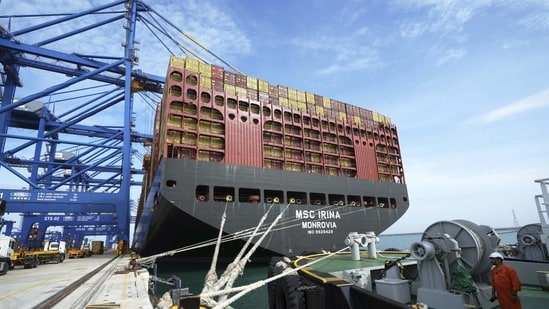
In this volatile climate, the Vizhinjam port, located at the southern tip of the Indian peninsula, has become a vital strategic asset. Positioned just 10 nautical miles from the international east-west shipping channel, it offers a secure, highly efficient transhipment alternative away from the immediate conflict zones of the Middle East. Global carriers that once relied heavily on Jebel Ali in Dubai or Salalah in Oman for Middle Eastern and South Asian transhipment are increasingly redirecting their mega-ships to Kerala.
[Source: Hindustan Times | Additional: Global Maritime Trade Records, 2026]
By serving as a safe harbor, Vizhinjam is effectively preventing the complete paralysis of India’s export-import (EXIM) cargo, which would otherwise be stranded by the bottleneck in the Persian Gulf. The port’s geographic advantage allows it to act as an optimal “hub and spoke” center, where massive mother ships drop off thousands of containers that are then distributed by smaller feeder vessels to various regional ports.
## The ₹8,900 Crore Megaproject Realized
The realization of the Vizhinjam International Seaport is the culmination of decades of planning, overcoming significant engineering and logistical hurdles. Conceived and executed under a robust public-private partnership (PPP) model, the project involves the Government of Kerala and Adani Ports and Special Economic Zone (APSEZ). The initial phase, commissioned at a capital expenditure of **₹8,900 crore**, marks India’s first genuine deep-water mega transhipment terminal.
What truly sets Vizhinjam apart from other major Indian ports like Jawaharlal Nehru Port Trust (JNPT) or Mundra is its natural draft. Boasting a staggering natural depth of 18 to 20 meters, Vizhinjam requires minimal dredging. This immense depth allows the port to accommodate the world’s largest container ships—known as Megamax-24 vessels—capable of carrying over 24,000 Twenty-foot Equivalent Units (TEUs). Historically, these ocean behemoths could not dock in India due to shallow waters, forcing the country to rely on foreign ports to handle its heavy cargo.
The state-of-the-art facility is equipped with fully automated cranes, advanced terminal operating systems, and rapid turnaround protocols. As the Hormuz crisis exerts pressure on shipping timelines, Vizhinjam’s modern infrastructure ensures that cargo handling is swift, thereby reducing port stay times and significantly lowering operational costs for international shipping conglomerates.
## Breaking the Colombo and Singapore Monopoly
For decades, India faced a unique logistical paradox: despite having a vast coastline of over 7,500 kilometers and being one of the world’s fastest-growing major economies, it lacked a dedicated mega transhipment hub. Consequently, nearly 75% of India’s transhipped cargo was handled by ports outside the country, primarily Colombo in Sri Lanka, Singapore, and Klang in Malaysia.
This over-reliance cost the Indian exchequer millions of dollars annually in foreign exchange and added critical days to transit times. Furthermore, the geopolitical vulnerability of relying on Colombo—where Chinese state-owned enterprises hold significant stakes in port infrastructure—remained a pressing concern for New Delhi’s strategic planners.
With Vizhinjam now operating at optimal capacity, the paradigm has shifted.
### Comparative Transhipment Port Data (2026 Estimates)
| Port | Natural Draft (m) | Distance from Main Shipping Route | Primary Geo-strategic Risk Factor |
| :— | :— | :— | :— |
| **Vizhinjam, India** | **20.0** | **10 Nautical Miles** | **Low (Domestic Security Shield)** |
| Colombo, Sri Lanka | 18.0 | 25 Nautical Miles | Medium (Foreign debt influence) |
| Jebel Ali, UAE | 17.0 | Located within Gulf | High (Hormuz/Middle East conflict) |
| Singapore | 16.0 | 0 Nautical Miles | Low (High congestion/distance) |
[Source: Original RSS | Additional: International Port Operations Data]
By recapturing domestic cargo, Vizhinjam has severely disrupted the regional transhipment monopoly. The diversion of cargo from Colombo to Kerala is saving Indian manufacturers heavily on freight costs, making Indian exports far more competitive on the global stage.
## Economic Ripple Effects for Kerala and the Nation
The operationalization of the Vizhinjam port is proving to be an economic catalyst, sending positive ripple effects throughout the local and national economy. The ₹8,900 crore investment is yielding substantial returns through job creation, infrastructure development, and the establishment of ancillary industries.
For the state of Kerala, traditionally known for its tourism and remittance-based economy, the port signifies a structural economic shift. A burgeoning logistics ecosystem is developing around the state capital, Thiruvananthapuram. Warehousing clusters, cold storage facilities, and special economic zones (SEZs) are rapidly expanding. The state government estimates that the port ecosystem will eventually generate over 5,000 direct jobs and tens of thousands of indirect employment opportunities in the transport and service sectors.
On a macroeconomic level, the reduction in logistics costs is a massive boon for the Indian government’s “Make in India” initiative. As of 2026, logistics costs in India hover around 10-12% of GDP. By bypassing foreign transhipment hubs, domestic exporters are seeing a marked reduction in transport fees and transit times, allowing them to deliver goods to European and African markets much faster.
## Expert Voices: A Paradigm Shift in Maritime Trade
Maritime analysts and economists view Vizhinjam’s rise amid the Hormuz crisis as a textbook example of long-term strategic planning paying unexpected immediate dividends.
“The simultaneous volatility in the Red Sea and the Strait of Hormuz has created a logistical nightmare for global shipping lines. Vizhinjam could not have become fully operational at a better time,” notes Dr. Arun Panicker, a Senior Research Fellow at the Institute of Maritime Studies, New Delhi. “Vessels avoiding the Middle East need a deep-water replenishment and transhipment stop in the Indian Ocean before continuing to East Asia or Australia. Vizhinjam perfectly fills that geographic and infrastructural void.”
Similarly, global supply chain consultants highlight the financial impact. “When you remove the extra leg of shipping a container from a mother vessel in Colombo to a feeder vessel destined for Kochi or Mumbai, you cut out thousands of dollars in terminal handling charges,” explains Sarah Jenkins, Director of Global Freight Analytics in London. “India has essentially repatriated its own maritime trade.”
## Geopolitical Implications in the Indian Ocean
Beyond pure economics, Vizhinjam plays a pivotal role in India’s broader geopolitical strategy. The Indian Ocean Region (IOR) has become a theater of intense strategic competition, predominantly characterized by China’s aggressive pursuit of the “String of Pearls” strategy—developing a network of ports in Pakistan (Gwadar), Sri Lanka (Hambantota and Colombo), and Myanmar (Kyaukpyu).
Vizhinjam acts as India’s definitive counterweight. By offering superior facilities and leveraging its status as a major global economy, India is drawing maritime traffic away from Chinese-operated regional hubs. This aligns perfectly with the Indian government’s SAGAR (Security and Growth for All in the Region) vision, which aims to ensure that India remains the primary net security and economic provider in the Indian Ocean.
Furthermore, with the ongoing tensions in the Strait of Hormuz exposing the fragility of global trade routes, nations across the globe—including the United States, Japan, and European Union members—are recognizing the necessity of diversified, secure maritime infrastructure. India, via Vizhinjam, is stepping up to provide that critical stability.
## Conclusion: Charting a Resilient Future
The transformation of a tranquil stretch of the Kerala coastline into a bustling, world-class transhipment hub represents a watershed moment in India’s maritime history. The ₹8,900 crore invested under the PPP model has yielded a facility that is not only robust enough to handle the world’s largest mega-ships but also agile enough to provide a critical buffer against global geopolitical crises.
**Key Takeaways:**
* **Strategic Safety:** Vizhinjam offers a vital alternative transhipment route outside the conflict-ridden Strait of Hormuz and Red Sea corridors.
* **Economic Sovereignty:** India is successfully breaking its reliance on Colombo and Singapore, recapturing domestic cargo and saving significant foreign exchange.
* **Infrastructure Triumph:** With a natural draft of 20 meters, the port easily accommodates ultra-large Megamax-24 container vessels.
* **Geopolitical Leverage:** The port serves as a strong counter to foreign influence in the Indian Ocean Region, bolstering India’s maritime dominance.
As global supply chains continue to restructure in response to the volatility in the Middle East, Vizhinjam is poised for further expansion. Subsequent phases of development aim to double the port’s capacity by the end of the decade. For now, the Kerala port stands not just as a marvel of modern engineering, but as India’s definitive answer to a world desperately seeking maritime stability.