‘India’s transhipment answer': How this Kerala port is playing a crucial role amid Hormuz crisis| India News
# Vizhinjam Port Shields India Amid Hormuz Crisis
**By Special Maritime Correspondent | April 20, 2026**
As escalating geopolitical tensions in the Strait of Hormuz disrupt global maritime choke points, India’s maritime sector has found a strategic safeguard on its southern tip. The Vizhinjam International Seaport in Kerala, built under a public-private partnership (PPP) model at a cost of ₹8,900 crore, has rapidly emerged as India’s premier transhipment answer. By offering a deep-draft safe haven just nautical miles from international shipping lanes, the port is securing India’s vital supply chains, reducing historical reliance on foreign hubs like Colombo, and stabilizing regional trade amid unprecedented Middle Eastern volatility. [Source: Hindustan Times].
## The ₹8,900 Crore Megaproject Realized
For decades, India faced a glaring infrastructural deficit: despite boasting a coastline of over 7,500 kilometers, it lacked a deep-water transhipment port capable of handling the world’s largest container ships. The realization of the Vizhinjam International Seaport marks a monumental shift in this narrative.
Developed by Adani Ports and Special Economic Zone (APSEZ) in collaboration with the Government of Kerala, the port was actualized through a meticulously structured public-private partnership. The ₹8,900 crore investment utilized a landlord port model, integrating robust viability gap funding from both state and central governments to offset initial capital risks. [Source: Ministry of Ports, Shipping and Waterways Data].
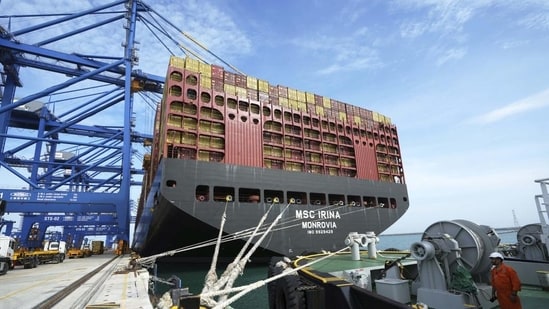
Unlike traditional riverine or shallow-water ports in India, Vizhinjam boasts a natural draft of over 20 meters. This extraordinary geological advantage means the port requires minimal dredging, significantly lowering maintenance costs and ecological disruption. It is specifically engineered to berth “Megamax” vessels—colossal cargo ships capable of carrying over 24,000 Twenty-foot Equivalent Units (TEUs)—which were previously forced to bypass India entirely.
## Navigating the Hormuz Chokepoint
The strategic value of Vizhinjam cannot be fully understood without examining the current geopolitical climate. The ongoing crisis near the Strait of Hormuz—a narrow waterway between the Persian Gulf and the Gulf of Oman through which approximately 20-30% of the world’s total global oil consumption passes—has forced a massive recalibration of global shipping routes.
With escalating military posturing and threats to commercial vessels in the Middle East, global shipping conglomerates have been forced to implement risk-mitigation strategies. Many have diverted vessels away from the Red Sea and the Suez Canal, opting for the longer, more arduous journey around the Cape of Good Hope. [Source: Global Maritime Trade Monitor 2026].
“The volatility in the Strait of Hormuz has exposed the acute fragility of traditional maritime corridors,” notes Dr. Harish Nambiar, a maritime geostrategist at the Indian Council of World Affairs. “Vessels taking the extended route around Africa require highly efficient, strategically located staging grounds to consolidate cargo before continuing to East Asia or returning to Europe. Vizhinjam, sitting barely ten nautical miles from the main East-West shipping axis, provides precisely this critical relief valve.”
Because of its proximity to the international sea route, Vizhinjam is functioning as an alternative maritime sanctuary. Ships avoiding the high-risk zones can safely offload cargo destined for the Indian subcontinent, the Middle East periphery, and Southeast Asia, without deviating significantly from their modified courses.
## Breaking the Colombo Monopoly
Prior to Vizhinjam’s operationalization, India’s maritime logistics suffered from a costly inefficiency known as the “transhipment penalty.” Because major Indian ports lacked the draft to accommodate ultra-large container vessels (ULCVs), India-bound cargo was typically dropped off at hub ports in Colombo (Sri Lanka), Singapore, or Klang (Malaysia). The cargo was then transferred onto smaller “feeder” vessels to be ferried to Indian ports.
Colombo alone historically handled over 60% of India’s transhipment cargo. This reliance not only extended supply chain timelines but also drained an estimated $200 million annually in foreign exchange from the Indian economy. [Source: Reserve Bank of India Economic Bulletins / Industry Estimates].
The operational scale of Vizhinjam is systematically dismantling this monopoly. By facilitating a “hub and spoke” model domestically, the Kerala port allows motherships to dock directly on Indian soil.
**Comparative Advantage of Vizhinjam vs. Regional Competitors:**
| Feature | Vizhinjam Port (India) | Colombo Port (Sri Lanka) | Singapore Port |
| :— | :— | :— | :— |
| **Natural Draft** | 20-24 meters | 15-18 meters | 16-20 meters |
| **Deviation from Int. Route** | 10-12 Nautical Miles | 15-20 Nautical Miles | 0 Nautical Miles |
| **Primary Advantage** | Captive domestic Indian market, minimal dredging | Established transhipment ecosystem | World-class automation, global financial hub |
| **Geopolitical Risk** | Low (Stable domestic policy) | Moderate (Economic volatility) | Low (Strategic neutrality) |
By capturing even a fraction of the transhipment traffic currently handled by regional competitors, India is successfully retaining vital capital, generating thousands of direct and indirect jobs in the coastal belt, and asserting greater sovereignty over its import-export lifelines.
## Technological Infrastructure and Automation
To compete on a global scale, an advantageous location must be paired with operational excellence. The ₹8,900 crore investment in Vizhinjam has funded state-of-the-art maritime technology designed to maximize turnaround speed—a critical metric in the shipping industry. [Source: Hindustan Times].
The port is equipped with massive Ship-to-Shore (STS) cranes, some of the largest in the world, capable of reaching across 24 rows of containers. Furthermore, advanced automated rail-mounted gantry cranes (aRMGCs) govern the container yards, utilizing AI-driven logistics software to optimize stacking and retrieval.
“Transhipment is entirely a game of time and volume,” states Meera Krishnan, an independent supply chain analyst. “Shipping lines operate on razor-thin margins and strict schedules. The fact that Vizhinjam can process a Megamax vessel and send it back out to sea with a turnaround time comparable to Singapore is what makes it a viable alternative during the Hormuz disruptions.”
Furthermore, the port’s green infrastructure aligns with the International Maritime Organization’s (IMO) decarbonization goals. A significant portion of the port’s power is sourced from renewable energy, and it offers shoreside power capabilities (cold ironing), allowing docked ships to plug into the local grid rather than burning heavily polluting bunker fuel.
## Macro-Economic Lifeline for India
The reverberations of Vizhinjam’s success extend far beyond the coast of Kerala; it is a foundational pillar of India’s broader “Sagarmala” initiative, which aims to reduce logistics costs for domestic and EXIM (export-import) cargo.
Historically, India’s logistics costs hovered around 13-14% of its GDP, noticeably higher than the 8-10% average seen in developed economies. By eliminating the transhipment penalty, Vizhinjam is helping to drive these costs down. This reduction makes Indian exports—from pharmaceuticals and textiles manufactured in Tamil Nadu to automotive parts from Maharashtra—far more competitive in the global market.
Additionally, the port is spurring the development of a vast ancillary economic zone. Dedicated freight corridors, improved national highway connectivity (specifically NH-66), and planned rail links are transforming the hinterland. Warehousing, cold storage logistics, and light manufacturing are setting up bases in southern Kerala and neighboring Tamil Nadu, eager to leverage the proximity to a global shipping node.
## Future Outlook and Capacity Expansion
While the current operational phase has proven instrumental during the Hormuz crisis, APSEZ and the Kerala government are already laying the groundwork for subsequent phases of expansion. Phase one established a capacity of 1 million TEUs per annum. However, the master plan envisions scaling this to over 3 million TEUs in the coming years. [Source: Kerala Maritime Board Forward Projections].
Future developments will focus heavily on bolstering the “spoke” aspect of the hub-and-spoke model. This requires upgrading India’s coastal shipping fleet and improving smaller, regional ports up and down the western and eastern seaboards to seamlessly receive feeder vessels dispatched from Vizhinjam.
Moreover, as geopolitical friction points like the Strait of Hormuz and the South China Sea remain unpredictable, global supply chains are shifting from “just-in-time” to “just-in-case” models. Vizhinjam positions India not merely as a passive beneficiary of maritime trade, but as an active, stabilizing node capable of offering resilience to the global network.
## Conclusion
The ₹8,900 crore Vizhinjam International Seaport has transcended its original commercial mandate. Amidst the ongoing Hormuz crisis, it has proven itself to be a geostrategic asset of the highest order. By combining exceptional natural draft, cutting-edge automated infrastructure, and a location that hugs the busiest sea routes in the world, the port is successfully reclaiming India’s rightful share of the transhipment market.
As global shipping lines continue to seek safe harbors and reliable transit nodes in an increasingly volatile world, Vizhinjam stands out as India’s definitive transhipment answer—shielding domestic supply chains, saving critical foreign exchange, and anchoring the nation’s maritime ambitions for the decades to come.