
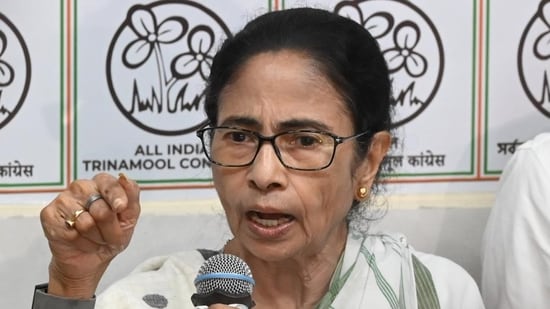
‘Let them dismiss me, impose President’s Rule’: Mamata still refuses to resign amid BJP sweep in Bengal
# Mamata Refuses Resignation Amid BJP Bengal Sweep
By Senior Political Correspondent, National News Desk, May 7, 2026
**Kolkata/New Delhi:** In an unprecedented political showdown, West Bengal Chief Minister Mamata Banerjee has categorically refused to step down following early projections of a Bharatiya Janata Party (BJP) sweep in the 2026 state assembly elections. Speaking from Kolkata on Wednesday, May 6, Banerjee alleged massive irregularities during the vote-counting process, claiming the BJP “looted” the mandate. Daring the central government to invoke Article 356, she declared, “Let them dismiss me, impose President’s Rule,” and announced that the Trinamool Congress (TMC) will petition the Supreme Court of India to halt the final certification of the results. [Source: Hindustan Times].
## The Defiance and the Allegations
The political climate in West Bengal reached a boiling point late Wednesday evening as the Election Commission of India (ECI) data indicated a decisive majority for the opposition BJP. Despite trailing significantly in the seat tally, the Trinamool Congress leadership struck a defiant posture. In a hastily convened press conference at her Kalighat residence, Mamata Banerjee rejected the electoral outcome outright.
“This is not a democratic defeat; this is a manufactured mandate. The election has been looted by manipulating electronic voting machines (EVMs) and utilizing central forces to intimidate counting agents,” Banerjee asserted. Her refusal to tender her resignation to the Governor—a standard constitutional practice for a defeated incumbent—has plunged the state into a severe constitutional crisis.
The TMC supremo insisted that her party possesses “undeniable video evidence” of counting discrepancies, unauthorized personnel inside strongrooms, and systematic exclusion of TMC agents from key tallying centers in North Bengal and the Jangalmahal region. By daring the central government to dismiss her government, Banerjee is effectively drawing a battle line that moves the conflict from the ballot box to the highest constitutional offices in the country.
## Electoral Context: The 2026 Bengal Assembly Polls
The 2026 West Bengal Legislative Assembly election was anticipated to be a watershed moment in Indian politics. Following the TMC’s historic retention of power in 2021, the BJP spent the subsequent five years rigorously overhauling its grassroots organization in the state. [Additional Source: Public Political Records].
**Key factors leading up to the 2026 elections included:**
* **Anti-Incumbency:** The TMC faced mounting pressure over an ongoing series of alleged recruitment and municipal corruption scandals that dominated headlines between 2023 and 2025.
* **Law and Order Debates:** The BJP capitalized heavily on narratives surrounding state security, alleged political violence, and border infiltration.
* **Economic Promises:** Both parties engaged in high-stakes welfare populism, with the BJP promising centralized industrial investment against the TMC’s expanded state-funded cash transfer schemes.
As the counting unfolded on May 6, early trends quickly solidified into a commanding BJP lead. If certified, this result would mark the first time the saffron party has formed a government in West Bengal, ending 15 years of uninterrupted TMC rule. However, the abrupt halt in the standard democratic transition process has left the state’s administrative machinery in limbo.
## Legal Recourse: Moving the Supreme Court
Rather than filing standard election petitions in the Calcutta High Court—which is the traditional legal route for contesting individual constituency results under the Representation of the People Act, 1951—the TMC has indicated it will approach the Supreme Court directly.
Legal experts suggest the TMC may file a writ petition under Article 32 of the Constitution, arguing that the alleged mass manipulation of the electoral process violates the “basic structure” of the Constitution, specifically the guarantee of free and fair elections.
Dr. Arindam Mukherjee, a senior constitutional lawyer based in New Delhi, explains the complexity of this maneuver: *”Typically, the Supreme Court is highly reluctant to interfere in the electoral process once counting has commenced, citing Article 329(b) of the Constitution. For the apex court to entertain a plea to freeze the entire state’s results, the Trinamool Congress will need to produce extraordinary, incontrovertible evidence of systemic institutional fraud, rather than isolated localized irregularities.”* [Source: Constitutional Law Expert Analysis].
The TMC’s legal team is reportedly compiling a comprehensive dossier detailing anomalous polling station turnouts, sudden surges in votes during the final rounds of counting, and instances where the ECI’s central server allegedly experienced localized blackouts.
## The BJP’s Reaction and Demands
The Bharatiya Janata Party has dismissed Mamata Banerjee’s allegations as the “desperate rhetoric of a defeated leader.” BJP state leadership, flanked by victorious candidates, held celebratory press briefings in Kolkata, urging the Governor to intervene immediately.
**”The people of West Bengal have given a decisive, historic mandate to the BJP,”** stated a senior BJP national spokesperson. **”Mamata Banerjee’s refusal to resign is a direct insult to the mandate of the voters and a mockery of the Constitution. She cannot hold the state hostage because she failed to win.”**
The BJP has formally petitioned the Governor of West Bengal, demanding that Banerjee be dismissed if she does not voluntarily submit her resignation by the end of the week. They have also requested the deployment of additional central paramilitary forces to prevent potential post-poll violence, citing the volatile history of political transitions in the state.
### Contested Regions Highlighted by TMC
The Trinamool Congress has specifically flagged several key districts where they claim the counting process was compromised:
| District / Region | Nature of TMC Allegation | Early ECI Trend |
| :— | :— | :— |
| **North 24 Parganas** | Unauthorized personnel in counting centers. | Heavy BJP Gains |
| **Hooghly** | EVM mismatch with VVPAT slips in 5 constituencies. | Mixed (BJP leading) |
| **Purulia** | Forced eviction of TMC counting agents. | BJP Sweep |
| **Nadia** | Unexplained delays in updating ECI portal data. | BJP Sweep |
## Constitutional Crisis Looming: The Threat of Article 356
Mamata Banerjee’s challenge—”Let them dismiss me, impose President’s Rule”—forces a delicate constitutional mechanism into the spotlight. Under Article 356 of the Indian Constitution, President’s Rule can be imposed in a state if a situation has arisen in which the government of the state cannot be carried on in accordance with the provisions of the Constitution.
If an incumbent Chief Minister unequivocally loses their majority in a newly elected assembly but refuses to resign, the Governor has the constitutional prerogative to dismiss the Chief Minister.
Prof. Meenakshi Sanyal, a political scientist at a premier institute, notes the strategic nature of Banerjee’s defiance: *”By forcing the Center or the Governor to dismiss her, Banerjee is attempting to transform an electoral defeat into a narrative of democratic martyrdom. She is baiting the central government into utilizing Article 356, an action that invariably sparks intense federal pushback and allows her to claim victimhood on a national stage.”* [Source: Political Science Academic Analysis].
However, invoking President’s Rule in this scenario would be a stopgap. Once the Election Commission officially notifies the constitution of the new Legislative Assembly, the Governor is obligated to invite the leader of the single largest party—in this case, the BJP—to form the new government.
## Implications for National Politics
The impasse in West Bengal has sent shockwaves through the national political ecosystem. Regional parties across India are watching the situation closely. Several leaders of the national opposition bloc have expressed cautious solidarity with Banerjee, demanding absolute transparency from the Election Commission, though they have stopped short of fully endorsing her refusal to resign.
If the Supreme Court agrees to hear the TMC’s plea, it could set a monumental precedent for how electoral disputes are handled in the modern era of electronic voting. Conversely, if the apex court dismisses the petition, Banerjee will be left with no legal standing to occupy the Chief Minister’s office, paving the way for the BJP’s inaugural administration in the eastern powerhouse.
Beyond the legalities, the situation presents a severe risk to public order. West Bengal has a tragic history of post-poll violence. With the administrative apparatus caught between a defiant caretaker Chief Minister and an incoming majority party, the police and civil bureaucracy are navigating exceptionally turbulent waters.
## Conclusion and Future Outlook
The political stalemate in West Bengal represents one of the most severe tests of India’s electoral and constitutional frameworks in recent memory. Mamata Banerjee’s explosive allegations that the BJP “looted” the election and her absolute refusal to resign have paused the democratic transition of power. [Source: Hindustan Times].
**Key Takeaways:**
1. **Unprecedented Standoff:** Mamata Banerjee is actively defying the early mandate, demanding the Center dismiss her rather than offering her resignation.
2. **Legal Battle Ahead:** The TMC’s decision to bypass the High Court and directly move the Supreme Court signals a high-risk legal strategy aimed at freezing the election results.
3. **Constitutional Pressure:** The Governor of West Bengal is now under immense pressure from the BJP to dismiss the incumbent government and facilitate the formation of a new administration based on the final ECI tally.
4. **Security Concerns:** As political tensions peak, the threat of civil unrest looms large, necessitating strict vigilance by state and central security forces.
As India waits for the Supreme Court’s response to the TMC’s impending legal challenge, the immediate future of West Bengal’s governance hangs in the balance. Whether this standoff ends in a dramatic legal intervention, the imposition of President’s Rule, or the eventual swearing-in of a BJP government, the 2026 Bengal elections have already etched themselves into history as deeply controversial and fiercely contested.





