
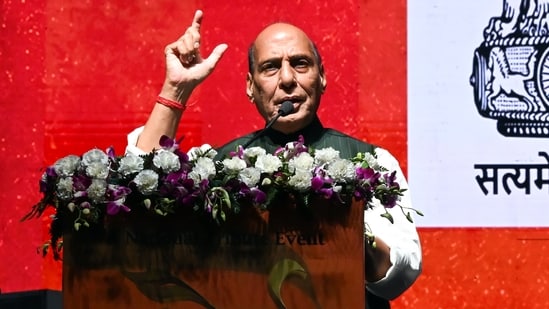
Operation Sindoor anniversary: Rajnath to lead national security review in Jaipur
# Operation Sindoor: Rajnath Leads Security Review
**By Special Defense Correspondent | May 7, 2026**
On the first anniversary of Operation Sindoor—India’s unprecedented precision missile campaign targeting terror infrastructure across the western border—Defence Minister Rajnath Singh is scheduled to lead a comprehensive national security review in Jaipur today. Undertaken in the early hours of May 7, 2025, the military operation saw Indian forces launch a synchronized barrage of standoff weapons against nine identified terror launchpads and training camps operating in Pakistan and Pakistan-occupied Kashmir (PoK). Marking this pivotal shift in New Delhi’s strategic deterrence doctrine, the Jaipur conclave brings together the National Security Advisor (NSA), the Chief of Defence Staff (CDS), and top military brass to evaluate the post-strike geopolitical landscape, assess current border readiness, and blueprint the future of India’s integrated defense matrix.
## The Jaipur Security Conclave: Charting the Path Forward
Choosing Jaipur, the headquarters of the Indian Army’s South Western Command, as the venue for this high-level security review is highly significant. The Sapta Shakti Command plays a crucial role in safeguarding India’s western frontiers, making it an ideal backdrop for evaluating the operational successes and strategic takeaways of last year’s military action.
Defence Minister Rajnath Singh will be joined by NSA Ajit Doval, CDS General Anil Chauhan, and the Chiefs of the Army, Navy, and Air Force. According to defense ministry insiders, the primary agenda of the conclave is not merely retrospective. While the brass will review the classified battle damage assessments (BDA) of the May 7 strikes, the core focus remains squarely on the future.
The review will examine the current intelligence apparatus along the Line of Control (LoC) and the International Border (IB), the integration of space-based surveillance assets, and the acceleration of India’s theaterisation drive. [Source: Hindustan Times | Additional: Defense Ministry Public Records]. Furthermore, the leadership will deliberate on Pakistan’s military posture over the past twelve months, assessing how Operation Sindoor has impacted cross-border infiltration matrices and proxy warfare strategies.
## Anatomy of Operation Sindoor: A Paradigm Shift
To understand the weight of the Jaipur review, it is essential to contextualize the events of May 7 last year. Operation Sindoor was triggered by a documented escalation in covert hostilities and intelligence intercepts indicating an imminent, coordinated influx of heavily armed non-state actors into Jammu and Kashmir.
Unlike the 2016 Uri surgical strikes (which relied on Special Forces crossing the LoC) or the 2019 Balakot airstrikes (which utilized manned Mirage 2000 fighter jets penetrating hostile airspace), Operation Sindoor represented a leap in India’s tactical execution. In the pre-dawn hours, the Indian armed forces utilized a network of indigenous surface-to-surface tactical missiles and air-launched cruise missiles to obliterate nine specific targets.
By relying entirely on standoff precision-guided munitions (PGMs)—including advanced variants of the BrahMos cruise missile and the Pralay tactical ballistic missile—India minimized the risk to its own personnel while inflicting maximum infrastructural damage on the terror camps.
“Operation Sindoor was a masterclass in the utilization of asymmetric deterrence,” notes Dr. Arvind Mathur, a senior fellow in strategic studies at a New Delhi-based think tank. “By neutralizing nine targets simultaneously without a single Indian boot or jet crossing the border, New Delhi sent a chilling message. It proved that India’s domestic defense manufacturing, coupled with precise satellite intelligence, has reached a level where cross-border terrorism can be punished instantaneously and remotely.”
## Evolution of India’s Deterrence Doctrine
The success of the operation fundamentally altered the unwritten rules of engagement on the subcontinent. For decades, Islamabad’s strategic umbrella of nuclear deterrence was perceived as a shield under which proxy actors could operate with relative impunity. Operation Sindoor shattered this threshold, establishing what military analysts now term “proactive standoff deterrence.”
During today’s review in Jaipur, Defence Minister Rajnath Singh is expected to highlight how this doctrine has stabilized the region. By demonstrating the capability and political will to execute precision deep-strikes without triggering a full-scale conventional war, India has effectively shrunk the operational space for anti-India militant outfits.
The defense establishment has spent the last year refining this doctrine. The focus has shifted toward building a robust inventory of conventional missiles, enhancing the C4ISR (Command, Control, Communications, Computers, Intelligence, Surveillance, and Reconnaissance) capabilities, and ensuring that any future provocation is met with an equally swift and calibrated kinetic response.
## Geopolitical Shockwaves and Regional Stability
The international reaction to the May 2025 strikes was a testament to India’s growing diplomatic heft. Unlike historical instances where subcontinental skirmishes resulted in global panic and heavy-handed Western intervention, the global response to Operation Sindoor was largely measured.
Major global powers, including the United States, France, and Russia, implicitly acknowledged India’s right to self-defense in the face of verifiable terror threats. The swift nature of the strikes, combined with a transparent post-operation briefing by the Ministry of External Affairs—which presented irrefutable satellite imagery of the destroyed camps—ensured that the narrative remained firmly in New Delhi’s control. [Source: Hindustan Times | Additional: Global Geopolitical Analysis 2025-2026].
However, the diplomatic fallout within Pakistan was profound. The precision strikes triggered intense domestic scrutiny of the military establishment in Rawalpindi, further straining an already volatile political and economic climate. Faced with international pressure and the looming threat of further FATF (Financial Action Task Force) strictures, Islamabad was forced to quietly dismantle several auxiliary launchpads along the LoC in the months following the operation.
The Jaipur review will closely analyze this geopolitical fallout. Defense strategists will evaluate the status of back-channel communications and the durability of the current, albeit tense, localized ceasefire mechanisms that have managed to hold post-Sindoor.
## Technological Leap and Atmanirbhar Bharat
A pivotal chapter of the Jaipur security review will focus on defense technology. Operation Sindoor was as much a triumph of indigenous engineering as it was of military strategy. The heavy reliance on domestically produced missile systems validated the government’s long-standing ‘Atmanirbhar Bharat’ (Self-Reliant India) initiative in the defense sector.
Since the strikes, the Ministry of Defence has aggressively fast-tracked the procurement of next-generation standoff weapons, swarm drone technologies, and loitering munitions. The integration of artificial intelligence (AI) in threat-assessment algorithms and target-acquisition systems has dramatically reduced the sensor-to-shooter loop.
“What we are seeing now is the modernization of the Indian military at an unprecedented pace,” explains former Army commander Lt. Gen. (Retd.) R.K. Sawhney. “The data collected from the Sindoor strikes has been fed back into our defense R&D. The focus at the Jaipur conclave will undoubtedly be on scaling up these indigenous capabilities to ensure we maintain a permanent technological overmatch along the western and northern borders.”
Furthermore, India has significantly upgraded its border surveillance infrastructure over the past twelve months. The deployment of high-altitude long-endurance (HALE) UAVs and real-time feeds from ISRO’s dedicated military satellites ensures round-the-clock monitoring of hostile territory, denying any element of surprise to adversarial forces.
## Implications for Internal Security in Jammu and Kashmir
One of the most tangible outcomes of Operation Sindoor, which will be prominently featured in the NSA’s presentation today, is the marked improvement in the internal security dynamic of Jammu and Kashmir.
By systematically degrading the logistical hubs and training facilities across the border, the strikes severely choked the supply lines of arms, narcotics, and finances that fuel localized militancy. Internal security reports indicate a steep decline in successful infiltration bids over the past year.
This reduction in external interference has provided crucial breathing room for administrative and democratic processes to flourish within the Union Territory. The period following May 2025 has witnessed accelerated infrastructure development, record-breaking tourism footfalls, and a deeper integration of the local youth into the national economic mainstream. Defense officials at the review will strategize on how to cement these gains and prevent any resurgence of proxy networks attempting to fill the vacuum left by the strikes.
## Future Outlook: Readiness for a Multi-Front Reality
As Defence Minister Rajnath Singh concludes the national security review in Jaipur today, the overarching message will be one of resolute vigilance. While Operation Sindoor successfully neutralized immediate threats on the western front, India’s defense establishment remains acutely aware of the broader regional complexities, particularly the enduring border friction with China in the north and east.
The strategic takeaways from last year’s precision strikes are already being adapted to fit a potential two-front threat matrix. The push toward integrated theater commands—a major structural reform within the Indian military—is designed to ensure that the rapid decision-making and seamless inter-service coordination witnessed during Operation Sindoor become the permanent operational standard.
## Conclusion: A Resolute Posture
The first anniversary of Operation Sindoor marks a watershed moment in India’s military history. It signifies the transition from a posture of strategic restraint to one of definitive, calibrated retaliation. As Rajnath Singh and the top military brass deliberate in Jaipur, their focus extends far beyond the successes of May 7, 2025.
The key takeaway from this high-level conclave is clear: India’s tolerance for cross-border terrorism has permanently evaporated. Backed by expanding indigenous technological prowess, robust international diplomacy, and an integrated military command structure, New Delhi is uniquely positioned to enforce peace through strength. As geopolitical fault lines continue to shift, the legacy of Operation Sindoor serves as a stark, enduring deterrent against any force attempting to destabilize the region.





