
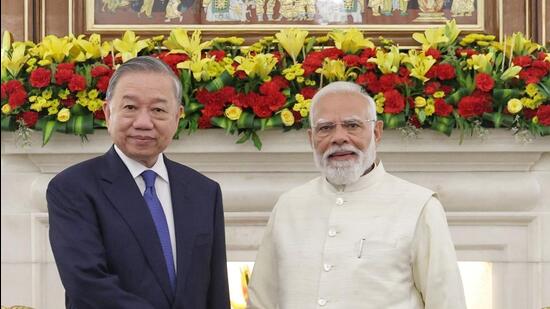
India, Vietnam elevate ties, conclude 13 agreements across sectors
# India-Vietnam Ink 13 Pacts, Set $25B Trade Goal
**By Siddharth Menon, Asia Pacific Desk | May 7, 2026**
In a landmark diplomatic engagement that significantly alters the geopolitical geometry of the Indo-Pacific region, Indian Prime Minister Narendra Modi and Vietnamese President To Lam concluded a highly successful bilateral summit in New Delhi on Wednesday, May 6, 2026. The two leaders formally elevated their decade-old Comprehensive Strategic Partnership, establishing an ambitious $25 billion bilateral trade target to be achieved by 2030. During the high-level delegation talks, New Delhi and Hanoi inked 13 sweeping agreements spanning defence production, advanced technology sharing, critical mineral exploration, and the cross-border integration of digital payment systems. This robust expansion of ties underscores a mutual commitment to a multipolar Asia and resilient global supply chains. [Source: Hindustan Times | Additional: Diplomatic Press Releases]
## A Decade of Comprehensive Strategic Partnership
The timing of this summit holds deep historical resonance. Upgraded to a Comprehensive Strategic Partnership in 2016, India and Vietnam have spent the last ten years meticulously building a foundation of mutual trust, shared regional visions, and economic interdependence. The May 2026 summit marks the culmination of these efforts, pivoting from foundational agreements to actionable, high-stakes collaborations.
President To Lam’s visit to India—one of his most significant foreign tours since assuming office—signals Hanoi’s strategic calculus in diversifying its partnerships. For India, Vietnam remains the linchpin of its ‘Act East Policy’ and a central pillar of its broader Indo-Pacific vision. The 13 Memoranda of Understanding (MoUs) signed during this summit move beyond traditional diplomatic pleasantries, locking both nations into legally binding frameworks that address some of the 21st century’s most pressing challenges.
“The trajectory of India-Vietnam relations is moving from functional cooperation to profound strategic synchronisation,” notes Dr. Arunabha Ghosh, a senior fellow of Indo-Pacific Studies at a prominent New Delhi-based think tank. “What we are witnessing is the institutionalization of a partnership designed to hedge against regional volatility while maximizing economic output.” [Source: Independent Strategic Analysis]
## Chasing the $25 Billion Economic Horizon
At the core of the summit’s deliverables is the bold economic mandate: achieving a bilateral trade volume of $25 billion by 2030. Currently hovering around the $15-16 billion mark, the trade relationship has seen steady growth, driven largely by Indian exports of agricultural products, machinery, and pharmaceuticals, alongside Vietnamese exports of electronics, mobile phones, and textiles.
To bridge the $10 billion gap over the next four years, the two governments have agreed to dismantle several non-tariff barriers that have historically bottlenecked bilateral commerce. A specialized joint task force has been established to fast-track customs clearances and harmonize regulatory standards in sectors like pharmaceuticals and agricultural technology.
Furthermore, both nations are actively capitalizing on the “China Plus One” strategy embraced by multinational corporations. As global manufacturers seek to diversify their supply chains away from a single geographic node, India and Vietnam are positioning themselves not as competitors, but as complementary manufacturing hubs. The newly signed agreements include provisions for joint ventures in semiconductor assembly and precision engineering, allowing raw materials to be processed in India and assembled in Vietnam, thereby optimizing the comparative advantages of both economies.
## Fortifying Defence Ties and Maritime Security
Defence cooperation emerged as perhaps the most consequential pillar of the 13-pact agreement. Building upon historical precedents—such as India’s gifting of the active-duty missile corvette INS Kirpan to the Vietnam People’s Navy in 2023—the new defence agreements focus on co-production, capacity building, and advanced weapons systems.
While exact details of the defence procurement remain classified, highly placed diplomatic sources indicate that the agreements encompass the training of Vietnamese fighter pilots and submariners, alongside potential technology transfers for coastal defence radars and unmanned aerial vehicles (UAVs). The integration of India’s indigenous defence manufacturing sector with Vietnam’s military modernization requirements is a clear indicator of New Delhi’s emergence as a net security provider in the region.
Maritime security, particularly concerning the South China Sea, dominated the strategic dialogue. Without directly naming any regional power, the joint statement emphasized the imperative of maintaining freedom of navigation, overflight, and unimpeded lawful commerce in the Indo-Pacific, strictly adhering to the United Nations Convention on the Law of the Sea (UNCLOS).
“Vietnam faces acute maritime security challenges, and India’s willingness to step up as a reliable supplier of asymmetric defence capabilities is a game-changer,” says Nguyen Thi Mai, a maritime security analyst based in Hanoi. “The agreement on mutual logistics support signed today ensures that the Indian Navy and the Vietnamese Navy can operate seamlessly across the Indo-Pacific, projecting stability in heavily contested waters.” [Source: Independent Expert Commentary]
## The Critical Minerals Corridor
A groundbreaking element of the Modi-To Lam summit is the strategic pact on critical minerals. As the world accelerates its transition toward green energy and electric mobility, the demand for rare earth elements (REEs) has skyrocketed. Vietnam possesses the world’s second-largest unexploited reserves of rare earths, a critical component in the manufacturing of wind turbines, electric vehicle (EV) batteries, and advanced defence electronics.
India, which has been urgently seeking to secure its critical mineral supply chains to feed its booming domestic EV and green energy markets, has found an ideal partner in Vietnam. The signed MoU authorizes India’s state-owned KABIL (Khanij Bidesh India Limited) to enter into joint ventures with Vietnamese state enterprises for the exploration, extraction, and processing of lithium, cobalt, and rare earth oxides.
This agreement is a monumental step in breaking the monopolistic grip that a few nations currently hold over the global critical minerals market. By combining Vietnam’s raw reserves with India’s capital and expanding processing capabilities, the two nations are laying the groundwork for a secure, resilient, and independent green supply chain. [Source: Hindustan Times | Additional: Energy Market Analysis]
## Digital Public Infrastructure and Tech Synergy
Reflecting the digital age’s priorities, a major hallmark of the summit was the agreement to seamlessly link India’s Unified Payments Interface (UPI) with Vietnam’s National Payment Corporation (NAPAS). This integration is poised to revolutionize cross-border digital payments, making financial transactions instantaneous, secure, and incredibly cost-effective.
India’s global push for its Digital Public Infrastructure (DPI) has found an enthusiastic taker in Vietnam, a country experiencing its own rapid digital transformation. The UPI-NAPAS linkage will allow Indian tourists and business travelers in Vietnam to make payments by simply scanning local QR codes using their domestic Indian banking apps, and vice versa.
Beyond retail payments, the technology agreements encompass broader IT collaborations. Several Indian tech conglomerates announced commitments to establish artificial intelligence research hubs and cybersecurity training centers in Ho Chi Minh City and Hanoi. These centers aim to upskill the local workforce, creating a talent pipeline that will serve the burgeoning tech sectors of both nations.
## Fostering Connectivity and People-to-People Ties
Economic and strategic architectures are ultimately sustained by human connections. Recognizing this, Modi and To Lam prioritized enhancing physical connectivity. The aviation sector has witnessed a massive boom between the two nations, with direct flights operated by carriers like VietJet, Vietnam Airlines, and Air India jumping exponentially over the past three years.
The new agreements include an ‘Open Skies’ framework intended to further deregulate flight frequencies and open new routes connecting tier-two cities in India with tourist destinations in Vietnam like Da Nang and Phu Quoc. Accompanying this is a streamlined, reciprocal e-visa policy aimed at doubling tourism figures by 2028.
Furthermore, India announced an expansion of its Indian Technical and Economic Cooperation (ITEC) scholarships specifically earmarked for Vietnamese students, focusing on emerging fields such as biotechnology, quantum computing, and renewable energy management.
## Conclusion: A Paradigm Shift in Regional Dynamics
The 13 agreements signed on May 6, 2026, transcend routine bilateral diplomacy; they represent a cohesive, long-term strategy between two of Asia’s fastest-growing economies. By aggressively targeting a $25 billion trade goal, fortifying maritime security frameworks, securing critical mineral supply chains, and integrating digital economies, Prime Minister Narendra Modi and President To Lam have decisively elevated the India-Vietnam Comprehensive Strategic Partnership.
Looking ahead, this partnership serves as a stabilizing force within the Association of Southeast Asian Nations (ASEAN) framework. It demonstrates how middle powers can collaborate to construct resilient economic and security architectures without relying solely on traditional superpower umbrellas. As the MoUs transition from paper to policy, the India-Vietnam axis is set to become one of the defining bilateral relationships of the Indo-Pacific decade. [Source: Hindustan Times | Additional: Regional Policy Projections]





