
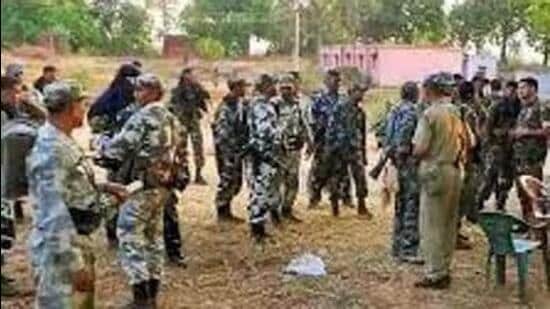
Maoist killed days after govt declared Chhattisgarh free of armed insurgents| India News
# Maoist Slain in Freed Chhattisgarh
By Special Security Correspondent, April 13, 2026
**RAIPUR** — Just days after state and federal authorities declared Chhattisgarh officially free from the grip of armed insurgents, a suspected Maoist rebel was killed in a decisive gun battle on Monday morning. Police confirmed that the fatal exchange occurred deep within a forested area when a joint team of security personnel was conducting a targeted anti-Maoist combing operation. The April 13, 2026 encounter sharply contradicts recent administrative claims of absolute pacification, raising critical questions about the lingering remnants of Left-Wing Extremism (LWE) and the complex reality of ending India’s longest-running internal security conflict. [Source: Hindustan Times | Additional: State Police Bulletins]
## The Encounter: A Breach of Peacetime Optics
The gun battle unfolded in the early hours of Monday when a heavily armed joint task force—comprising the Central Reserve Police Force (CRPF), the elite Commando Battalion for Resolute Action (CoBRA), and the state’s District Reserve Guard (DRG)—was dispatched based on actionable intelligence. According to preliminary reports from the Bastar Range police headquarters, the security forces were advancing through a dense, remote forest patch when they came under sudden, unprovoked fire from a splinter group of insurgents.
Exercising standard operational procedures, the forces retaliated, leading to a brief but intense exchange of fire. Once the guns fell silent, security personnel conducted a thorough search of the perimeter, recovering the body of one Maoist combatant alongside a cache of sophisticated firearms and localized explosive materials.
While the neutralization of a combatant is standard fare in the decades-long history of Bastar’s conflict, the timing of this specific operation is highly consequential. It punctures the triumphant narrative established just last week by the Ministry of Home Affairs, which had triumphantly struck Chhattisgarh off the list of active insurgency-affected states.
“Our personnel acted swiftly and decisively,” a senior police official stated anonymously due to protocol. “While the broader region has seen unprecedented peace, our intelligence networks remain active to root out the final remnants of these anti-state elements. The operation was intelligence-driven and highly localized.” [Source: Hindustan Times | Additional: Regional Security Analysis]
## Premature Declarations and Political Mileage
To understand the shockwaves generated by Monday’s encounter, one must look at the preceding political climate. For over two decades, Chhattisgarh has served as the undisputed epicenter of the Naxalite-Maoist insurgency. Deeply forested districts like Sukma, Bijapur, and Dantewada were considered impenetrable strongholds where the writ of the state scarcely applied.
However, a multi-pronged approach under the federal government’s “Operation SAMADHAN-Prahar” drastically shifted the scales between 2020 and 2025. Through the aggressive establishment of Forward Operating Bases (FOBs) in core jungle areas, the construction of all-weather roads, and the installation of thousands of mobile communication towers, the security apparatus squeezed the insurgents’ geographical footprint.
Driven by these undeniable statistical victories—a near 90% drop in civilian and security force casualties since the peak violence of 2010—the government officially declared the state “insurgency-free” in early April 2026. This declaration was widely viewed as a political capstone, aimed at reassuring international investors and signaling a new era of unhindered economic development in the mineral-rich state.
Yet, counter-insurgency experts have long warned against the temptation of premature declarations. Monday’s gun battle serves as a stark reminder that while the organized, battalion-level structure of the Maoist movement may have been dismantled, the ideology and scattered foot soldiers have not entirely vanished.
## The Evolution of Left-Wing Extremism in 2026
The Maoist strategy in 2026 is vastly different from the frontal assaults seen a decade ago. Facing severe troop depletion, halted recruitment among the tribal (Adivasi) populations, and the surrender of top-tier commanders, the Maoist central committee has been forced into a strategy of tactical retreat and decentralization.
Today, the threat no longer manifests as heavily armed companies marching through the Dandakaranya forest. Instead, the insurgency has mutated into highly fragmented, autonomous “Small Action Teams” (SATs). These micro-units, often consisting of just three to five individuals, are highly mobile and rely on the element of surprise rather than sustained combat.
The individual killed on Monday was likely part of such a unit, operating as a sleeper cell or conducting localized reconnaissance. This evolutionary shift makes the insurgency statistically harder to track but practically impossible to eradicate overnight by decree alone.
**Key Shifts in Maoist Tactics (2020 vs. 2026)**
* **Formations:** Shifted from 100-member companies to 3-5 member Small Action Teams.
* **Weaponry:** Transitioned from looted state armory to improvised, locally manufactured arms and low-yield IEDs.
* **Objective:** Moved from capturing territory to mere survival and occasional opportunistic ambushes.
* **Demographics:** Widespread loss of local Adivasi support, forcing reliance on radicalized cadres from outside the immediate conflict zones.
## Expert Perspectives on Ground Realities
Internal security analysts are interpreting the recent clash not as a resurgence of the Maoist threat, but as the dangerous “long tail” of a dying insurgency.
Dr. Avinash Tiwari, a leading researcher on Left-Wing Extremism at the Institute of Conflict and Strategic Studies, notes that administrative declarations of peace are often at odds with tactical realities. “You cannot simply legislate or declare an insurgency out of existence,” Dr. Tiwari explains. “When a state declares a region free of armed groups, it is projecting a macro-level success. But on the micro-level, down in the dense foliage of Bastar, cornered combatants with nothing to lose remain immensely dangerous. Monday’s incident is a textbook example of the final, volatile phase of counter-insurgency operations.” [Source: Independent Security Analysis Network]
Furthermore, experts emphasize the psychological impact of such declarations on the security forces themselves. There is a palpable fear that bureaucratic declarations of victory could lead to lowered guards and operational complacency among the jawans (soldiers) stationed at remote FOBs. The joint team’s alertness in Monday’s operation, however, suggests that tactical discipline on the ground remains robust despite the changing political narrative above.
## Economic Push vs. Internal Security
The overarching motivation behind the government’s rush to declare Chhattisgarh “freed” is deeply tied to economics. The state is a powerhouse of natural resources, boasting massive reserves of coal, iron ore, bauxite, and limestone. For decades, the Maoist insurgency acted as a brutal deterrent to industrialization. Mining projects were stalled, railway lines were sabotaged, and infrastructure contractors were routinely extorted or targeted.
With the federal government currently pushing massive foreign direct investment (FDI) initiatives aimed at transforming central India into a critical manufacturing and mining hub, the “insurgency-free” label is a necessary prerequisite to appease corporate risk-assessment boards.
However, isolated encounters like Monday’s gun battle create a tricky tightrope for policymakers. They must convince global and domestic investors that the region is entirely safe, while simultaneously allocating massive defense budgets to maintain the CRPF and DRG deployments required to hunt down the last remaining rebel cells.
If mining corporations and infrastructure developers proceed into previously unmapped territories under the assumption of total peace, they may inadvertently walk into the crosshairs of isolated Maoist action teams fighting for their last strongholds.
## The Vital Role of Surrender and Rehabilitation Policies
Another critical dimension highlighted by Monday’s lethal encounter is the ongoing need for robust surrender and rehabilitation frameworks. Throughout 2024 and 2025, the Chhattisgarh government successfully facilitated the surrender of hundreds of lower-rung cadres through lucrative rehabilitation schemes. Surrendered insurgents were offered financial stipends, vocational training, and integration into civilian life—and in some controversial but highly effective instances, integration into the District Reserve Guard to fight their former comrades.
When an insurgent is killed rather than captured or surrendered, it represents a breakdown in the final phase of the pacification pipeline. While kinetic operations (gun battles) are sometimes unavoidable, security forces heavily prefer surrenders, as they yield valuable intelligence and demoralize the remaining insurgent ranks without the loss of human life.
The state government must now ensure that Monday’s violence does not derail the fragile trust being built with remote tribal hamlets. The Adivasi populations have historically been caught in the crossfire between the Maoists and the state. Maintaining their trust—through schools, healthcare, and fair compensation for resources—is the only foolproof method to guarantee that Left-Wing Extremism does not find the oxygen to regenerate.
## Navigating the Final Mile of Counter-Insurgency
The April 13 encounter in Chhattisgarh’s forests is a watershed moment that serves as a reality check for policymakers, security forces, and the public alike. It starkly illustrates that the conclusion of an asymmetric war is rarely marked by a clean, definitive end date. Instead, it fizzles out through sporadic, isolated, and unpredictable skirmishes.
**Key Takeaways:**
1. **Enduring Threat:** While systemic, large-scale Maoist operations have been systematically dismantled, localized threats from splinter cells remain highly active.
2. **Operational Readiness:** Security forces like the CRPF and DRG must maintain peak tactical vigilance, ignoring the peacetime political narratives that may breed complacency.
3. **Policy Calibration:** Governments must balance the desire for economic investment optics with the transparent acknowledgment of ongoing security operations.
As Chhattisgarh looks toward a future defined by economic development rather than guerrilla warfare, the path forward requires an abundance of caution. The state has undoubtedly broken the spine of the insurgency, but as Monday’s gun battle proves, neutralizing the remnants will require sustained intelligence, operational patience, and an unwavering commitment to the socio-economic upliftment of the region’s marginalized communities. Declaring victory is easy; securing the peace is the ultimate test.





