
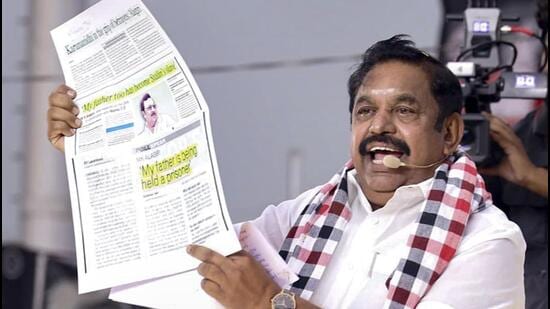
Not even 20% of 525 promises fulfilled by DMK: Palaniswami to HT| India News
# EPS Slams DMK: Under 20% Promises Met
**By Senior Political Correspondent, India News Desk | April 13, 2026**
**Chennai:** With the Tamil Nadu Assembly elections looming on the horizon, the political climate in the state has reached a fever pitch. On Monday, AIADMK General Secretary and Leader of the Opposition, Edappadi K. Palaniswami (EPS), launched a blistering attack on the ruling DMK government, accusing it of fulfilling less than 20% of its 525 electoral promises. In a candid interview, the former Chief Minister alleged that the state, which had accumulated a total debt of ₹5 lakh crore over the 73 years since independence, has been pushed to the brink of financial ruin due to the DMK’s reckless spending and fiscal mismanagement over the past five years. [Source: Hindustan Times | Additional: Tamil Nadu Political Context 2026].
***
## The Weight of Unkept Promises
When the Dravida Munnetra Kazhagam (DMK) swept to power in May 2021 under the leadership of M.K. Stalin, it did so on the back of a voluminous manifesto containing 525 specific promises. These ranged from overarching structural reforms to immediate populist relief measures. However, as the government completes its five-year tenure, the opposition has seized upon the gap between rhetoric and reality.
According to Palaniswami, the ruling dispensation has failed to deliver on its core commitments, leaving the electorate disillusioned. “They printed a book of 525 promises to capture power, but if you conduct an honest audit today, not even 20% of those assurances have seen the light of day,” Palaniswami stated.
The AIADMK has consistently highlighted several major unfulfilled or partially fulfilled pledges, including:
* **The Abolition of NEET:** A highly emotional issue in Tamil Nadu, the DMK promised to secure an exemption for the state from the National Eligibility cum Entrance Test. Despite passing legislative bills, the exemption remains unrealized.
* **Old Pension Scheme (OPS):** Government employees, a crucial voting bloc, were promised a reversion to the Old Pension Scheme. This has been repeatedly delayed citing financial constraints.
* **Fuel Price Reductions:** While minor cuts were made early in the tenure, the promised substantial reduction in petrol and diesel prices has not materialized to the extent advertised.
* **Educational Loan Waivers:** Total waivers for student educational loans remain largely unimplemented.
The opposition argues that the DMK’s much-touted “Dravidian Model” of governance has merely been a masterclass in public relations, masking a fundamental failure in administrative delivery.
## The Escalating Debt Crisis
Beyond broken promises, the crux of Palaniswami’s critique centers on the macroeconomic stability of Tamil Nadu. The AIADMK leader presented a stark historical comparison to illustrate his point regarding state finances.
“From independence until the end of our tenure, over a span of roughly 73 years, the cumulative debt of Tamil Nadu was contained at approximately ₹5 lakh crore. In stark contrast, the past five years have witnessed unprecedented, reckless spending that has crippled the state’s exchequer,” Palaniswami remarked. [Source: Hindustan Times | Additional: Reserve Bank of India State Finances Report].
The financial trajectory of Tamil Nadu has indeed been a subject of intense debate among economists. While the state remains one of India’s most industrialized and economically vibrant regions, its outstanding liabilities have surged. The post-pandemic economic recovery was immediately followed by heavy expenditure on welfare schemes, which, without matched revenue generation, has necessitated massive market borrowings.
Dr. Arumugam Rajendran, a Chennai-based political economist, explains the predicament: “Tamil Nadu is caught in a structural trap. The state has a high committed expenditure—salaries, pensions, and interest payments—which eats up the lion’s share of its revenue receipts. When you add expansive universal welfare schemes to this mix without a proportional increase in tax revenues or support from the Union Government, debt is the only mathematical outcome. The AIADMK is accurately pointing out the symptom, though both Dravidian parties share historical responsibility for the culture of freebies.”
## Welfare Schemes vs. Fiscal Prudence
The DMK government has vigorously defended its economic policies, arguing that what the opposition terms “reckless spending” is, in fact, vital social investment.
The flagship **Kalaignar Magalir Urimai Thittam** (women’s basic income scheme), which provides ₹1,000 monthly to eligible women heads of households, alongside free bus travel for women, has been a massive drain on the treasury, costing thousands of crores annually. However, the ruling party asserts these are not mere freebies but crucial interventions that increase female labor force participation and stimulate the grassroots economy.
Yet, the opposition counters that these schemes are poorly targeted and often funded by cutting capital expenditure. “Borrowing money to build highways, ports, or industrial parks yields long-term dividends. Borrowing simply to fund revenue deficits and distribute cash is a recipe for generational bankruptcy,” Palaniswami argued during his media interaction.
The AIADMK has accused the DMK of indulging in “event management governance,” where vast sums are spent on publicity, statues, and centenary celebrations of party icons, rather than focusing on pressing infrastructure needs and industrial growth.
## Evaluating the Fiscal Trajectory
To understand the gravity of the allegations made by the AIADMK, it is essential to look at the numbers. While exact final audit figures for the 2025-2026 fiscal year are pending, the trend over the DMK’s tenure reveals a steep climb in borrowings.
| Fiscal Year | Total Outstanding Liabilities (Est. ₹ in Lakh Crore) | Fiscal Deficit as % of GSDP | Key Economic Pressure Points |
| :— | :— | :— | :— |
| **2020-21 (AIADMK)** | 4.85 | 4.61% | COVID-19 Pandemic Impact |
| **2022-23 (DMK)** | 6.53 | 3.46% | Post-COVID recovery, initiation of new welfare schemes |
| **2024-25 (DMK)** | 8.33 | 3.44% | Rollout of Kalaignar Magalir Urimai Thittam |
| **2025-26 (Projected)** | 9.15+ | 3.50%+ | Election year spending, increased interest burdens |
*Note: Data represents aggregated estimates based on state budget documents and RBI publications up to early 2026.* [Source: Additional: TN Budget Documents 2021-2026].
The table illustrates that while the fiscal deficit as a percentage of the Gross State Domestic Product (GSDP) has been brought down from the pandemic highs, the absolute quantum of debt has nearly doubled. The state’s interest payments alone now consume an alarming percentage of its total revenue, leaving precious little for meaningful infrastructure development.
## The DMK’s Counter-Narrative
In response to these allegations, the DMK has historically maintained a strong counter-narrative, shifting the blame to the Union Government and historical burdens inherited from the previous AIADMK regime.
Chief Minister M.K. Stalin and his cabinet have frequently pointed out that Tamil Nadu receives only 29 paise for every rupee it contributes to the central tax pool, calling it a gross injustice to high-performing states. Furthermore, the cessation of the GST compensation shortfall has severely dented the state’s revenue streams over the past few years.
“The Leader of the Opposition is suffering from selective amnesia,” a senior DMK spokesperson recently retorted in a local press briefing. “It was under the AIADMK that the state’s transport and electricity boards were driven into massive debts. We have fulfilled over 80% of our key promises despite step-motherly treatment from the central government and back-to-back natural disasters like the devastating Michaung cyclone floods in late 2023.”
The ruling party insists that its welfare measures are the bedrock of social justice, directly contributing to Tamil Nadu ranking highest in various national multi-dimensional poverty indices and health metrics.
## Political Ramifications Ahead of 2026
The timing of Palaniswami’s aggressive posture is undeniably linked to the impending 2026 Tamil Nadu Legislative Assembly elections. Having consolidated his grip over the AIADMK after a protracted internal power struggle, EPS is now positioning his party as the sole credible alternative to the DMK, distancing himself from former ally BJP to reclaim minority and centrist vote banks.
By focusing on the dual pillars of **unkept promises** and **economic mismanagement**, the AIADMK is attempting to channel anti-incumbency sentiments. The strategy relies heavily on appealing to the middle class, government employees, and youth—demographics that are increasingly feeling the pinch of inflation, lack of white-collar job creation, and unfulfilled pledges like the Old Pension Scheme.
Political analyst Meenakshi Iyer observes, “EPS is striking at the core of Stalin’s ‘Dravidian Model’ pitch. If the AIADMK can successfully convince the electorate that the DMK’s welfare is actually a debt-trap that future generations will pay for, it could swing the fence-sitters. However, fighting against a highly organized DMK machinery, which successfully distributes direct cash benefits to millions of women, is an uphill electoral battle.”
## Conclusion and Future Outlook
As Tamil Nadu gears up for a highly polarized electoral showdown in 2026, the narrative war is clearly defined. Edappadi K. Palaniswami’s assertion that the DMK has failed on 80% of its manifesto promises and plunged the state into unprecedented debt sets the stage for a bitter campaign centered on fiscal responsibility versus social welfare.
**Key Takeaways:**
1. **Trust Deficit:** The AIADMK is weaponizing the DMK’s 2021 manifesto, highlighting key failures like NEET abolition and the Old Pension Scheme to establish a narrative of betrayal.
2. **Debt Crisis:** The staggering rise of state debt—projected to cross ₹9 lakh crore—raises legitimate concerns about Tamil Nadu’s long-term economic sustainability.
3. **Welfare Justification:** The DMK continues to bank on its direct benefit transfers, arguing that social equity supersedes rigid fiscal austerity.
The ultimate judge will be the voters of Tamil Nadu. In May 2026, they will have to decide whether the immediate relief provided by the DMK’s welfare schemes outweighs the looming shadow of an escalating multi-lakh crore state debt.





