
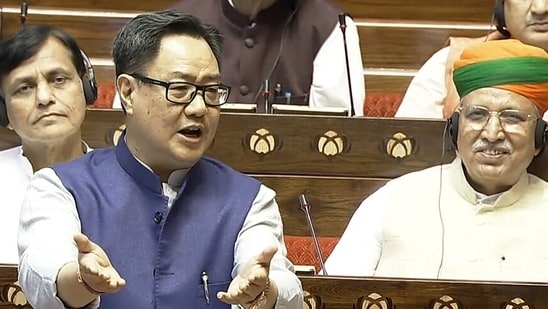
‘Proportional representation of states won’t change': Kiren Rijiju amid delimitation concerns| India News
# State Seat Ratios Will Not Change
By Senior Political Correspondent, National Desk
April 16, 2026
Amid escalating political anxiety over the impending national delimitation exercise, Union Minister Kiren Rijiju has definitively assured the nation that the proportional representation of all Indian states in the Lok Sabha will remain unchanged. In an exclusive interview on April 16, 2026, Rijiju clarified that the central government will not penalize southern states for their successful population control measures. This critical intervention aims to quell opposition fears regarding a potential shift in India’s parliamentary balance of power, confirming that the upcoming constituency redrawing will preserve the existing federal equilibrium while accommodating domestic democratic growth.
## The Core Assurance Amid Demography Debates
The debate surrounding the 2026 delimitation mandate has arguably been the most contentious constitutional issue of the decade. Delimitation—the act of redrawing boundaries of Lok Sabha and state Assembly seats to represent changes in population—has historically sparked intense regional anxieties.
Speaking to the Hindustan Times, Union Minister Kiren Rijiju offered the clearest indication yet of the central government’s strategy. He emphatically stated that the proportional representation of states in the lower house of Parliament will not be altered [Source: Hindustan Times]. This effectively means that the ratio of Members of Parliament (MPs) allocated to states like Kerala and Tamil Nadu compared to populous northern states like Uttar Pradesh and Bihar will be safeguarded through legislative or constitutional mechanisms.
“The bedrock of our democracy is federal trust,” noted Dr. Arvind Raghunathan, a New Delhi-based constitutional scholar. “Minister Rijiju’s statement is not merely a political platitude; it is a vital constitutional commitment. If proportional representation remains unchanged, the government must be drafting a novel constitutional amendment that divorces the raw population metrics from inter-state seat allocation.” [Source: Additional Expert Analysis].
## Understanding the 2026 Delimitation Deadline
To fully grasp the magnitude of Rijiju’s clarification, one must look back at India’s constitutional history. The allocation of Lok Sabha seats to states was originally based on the population figures from the 1971 Census.
In 1976, during the Emergency, the 42nd Amendment froze this allocation. The primary objective was to encourage state governments to implement aggressive family planning and population control programs without the fear of losing their political clout in Parliament. In 2001, the Atal Bihari Vajpayee government extended this freeze for another 25 years through the 84th Constitutional Amendment, establishing the 2026 deadline.
As 2026 dawned, the constitutional embargo on altering the number of seats finally expired. Without a new intervention, Article 82 of the Constitution would mandate a fresh allocation based on the most recent census, threatening to drastically tilt the scales of power toward the Hindi heartland.
## The Southern Anxiety: Population vs. Representation
The anxiety surrounding the unfreezing of Lok Sabha seats is rooted in stark demographic divergences between India’s northern and southern regions. Over the past five decades, southern states—Tamil Nadu, Kerala, Karnataka, Andhra Pradesh, and Telangana—have successfully brought their Total Fertility Rates (TFR) down to replacement levels or lower. Conversely, northern states have seen continued, albeit slowing, population growth.
**Demographic Divergence (Estimated Impact Context):**
* **Southern States:** High socio-economic development, lower population growth, high per capita contribution to the national GST pool.
* **Northern States:** Slower initial socio-economic development, higher population growth, historically larger representation in the Lok Sabha.
If delimitation were to proceed strictly on current population figures without safeguarding proportional ratios, southern states stood to lose dozens of parliamentary seats in relative terms. Political leaders from the South have repeatedly argued that they should not face a “democratic penalty” for successfully executing national family planning policies and driving economic growth.
Rijiju’s comments directly address this friction point, signaling that the Union government recognizes the validity of the southern argument and is prepared to ensure that demographic success does not result in political marginalization [Source: Hindustan Times].
## Proposed Formulas for Balancing Power
How can the Election Commission and the impending Delimitation Commission redraw boundaries reflecting current realities while maintaining inter-state proportional representation?
The answer likely lies in the architectural foresight of the new Parliament building, inaugurated in 2023. The new Lok Sabha chamber was explicitly built with a seating capacity of 888 members, significantly higher than the current strength of 543.
Political analysts project that the government may implement a “Scale-Up Formula.” Under this framework, the total number of Lok Sabha constituencies would be increased nationally to lower the average population per constituency (currently hovering around 2.5 to 3 million voters per MP).
1. **Intra-State Redrawing:** Constituency boundaries *within* a state will be redrawn to ensure equal population distribution per MP inside that specific state.
2. **Inter-State Parity:** The formula assigning the *number* of seats to each state will be artificially weighted to reflect historical proportional representation, essentially locking in the 1971 or 2001 ratios, even as the absolute number of MPs increases across the board.
“Increasing the pie ensures that no state loses its absolute number of MPs, while maintaining the ratio ensures that the relative power dynamic remains stable,” explains Dr. Meenakshi Sundaram, a senior fellow in federal studies. “Rijiju’s statement effectively confirms that the government is leaning toward this hybrid model.” [Source: Additional Public Policy Analysis].
## Political Reactions and Bipartisan Consensus
The clarification by the Union Minister has elicited cautious optimism across the political spectrum. Regional parties in the South, which had been preparing for an aggressive political confrontation regarding the delimitation exercise, have welcomed the assurance while demanding that it be codified into law swiftly.
Chief Ministers of various southern states have previously written to the Prime Minister, urging that the terms of reference for any future Delimitation Commission must explicitly prohibit the reduction of proportional state power. Rijiju’s interview is being viewed as the first definitive administrative response to these letters.
However, the opposition insists on transparency regarding the mathematical models the government plans to use. “Verbal assurances are welcome, but the devil lies in the constitutional details. We need a formal constitutional amendment bill presented in Parliament that legally binds the Delimitation Commission to these proportional guarantees,” stated a senior opposition spokesperson following the publication of Rijiju’s remarks.
## The Role of the Decadal Census
A critical prerequisite for any delimitation exercise is an updated national census. The decadal census, originally scheduled for 2021, faced unprecedented delays due to the global pandemic and subsequent logistical hurdles.
As the nation navigates 2026, the completion and publication of these updated demographic data sets are paramount. The Delimitation Commission relies entirely on official census figures to draw geographic boundaries.
If proportional representation remains static, as Minister Rijiju promises, the census data will primarily be utilized to address internal state migrations—such as the massive shift of populations from rural areas to urban metropolises like Bengaluru, Mumbai, Chennai, and Delhi. Urban constituencies have swelled massively over the last two decades, and internal delimitation is desperately needed to ensure equal representation of urban voters.
## Future Outlook: A Delicate Federal Balancing Act
The road ahead remains complex. Fulfilling the promise articulated by Kiren Rijiju will require navigating a constitutional labyrinth. The government must introduce a constitutional amendment bill, which will require a two-thirds majority in Parliament and ratification by at least half of the state legislatures.
Given that this move protects the interests of multiple states across political divides, achieving a bipartisan consensus is highly probable. Yet, the drafting of the specific legal language will be heavily scrutinized to ensure no loopholes allow for demographic penalization.
By stepping forward to clarify the government’s stance, Union Minister Kiren Rijiju has diffused a potential federal crisis [Source: Hindustan Times]. His statement underscores a maturing democratic framework—one that attempts to honor the core tenet of “one person, one vote” locally, while simultaneously honoring the federal pact that binds a remarkably diverse subcontinent together globally.
As India moves closer to expanding its parliamentary democracy, the commitment to maintaining the current proportional representation stands as a testament to the country’s unique, cooperative federalism. The nation now awaits the formal legislative mechanisms that will turn Rijiju’s vital assurance into constitutional law.





