
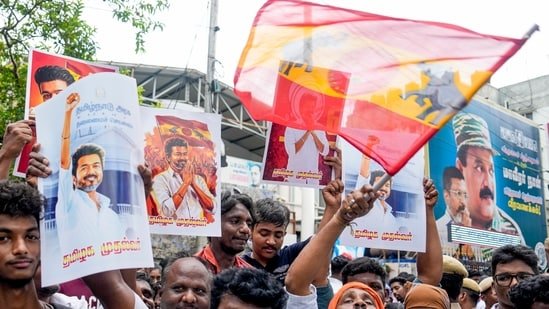
Tamil Nadu government formation suspense continues; VCK yet to declare its stand
# TN Govt Suspense: TVK Awaits VCK Stand
**By Senior Political Correspondent, National Desk**
**May 9, 2026**
**Chennai:** Suspense over the formation of the next Tamil Nadu government intensified on Saturday as the Tamilaga Vettri Kazhagam (TVK) scrambled to secure the numbers required for a majority. Having won a historic 108 seats in the 234-member assembly, the actor-turned-politician Vijay-led party falls 10 seats short of the 118-seat magic mark. All eyes are now on the Viduthalai Chiruthaigal Katchi (VCK), which emerged as a crucial kingmaker but remains undecided on its political alignment. As TVK emissaries engage in frantic backroom negotiations with smaller camps, the state faces an unprecedented political gridlock, marking a turbulent end to decades of Dravidian duopoly.
## A Historic Mandate and an Incomplete Victory
The May 2026 assembly elections will be remembered as a watershed moment in Tamil Nadu’s political history. Disrupting a fifty-year duopoly alternating between the Dravida Munnetra Kazhagam (DMK) and the All India Anna Dravida Munnetra Kazhagam (AIADMK), the nascent Tamilaga Vettri Kazhagam (TVK) emerged as the single largest party. Riding on a massive anti-incumbency wave, promises of systemic anti-corruption measures, and overwhelming support from first-time voters, the TVK captured 108 seats.
However, the spectacular debut stopped just short of an absolute majority. In the 234-seat Tamil Nadu Legislative Assembly, a party or coalition requires a minimum of 118 seats to form the government. Currently facing a deficit of 10 seats, the TVK leadership has spent the days following the May vote counting desperately reaching out to independent candidates and smaller regional outfits.
According to reports, the TVK has “sought support from several smaller camps to secure 118 seats” [Source: Hindustan Times]. While they have reportedly managed to secure the conditional backing of three independent MLAs and a minor regional outfit, pushing their tentative tally to 112, the numbers remain critically insufficient to approach the Raj Bhavan and stake a claim.
## The Kingmaker: VCK’s Calculated Silence
In this fractured mandate, the Viduthalai Chiruthaigal Katchi (VCK), led by Thol. Thirumavalavan, holds the absolute key to Fort St. George. The VCK, which traditionally aligned with the DMK-led Secular Progressive Alliance, performed exceptionally well in the northern and delta districts, securing a critical bloc of 12 seats.
If the VCK throws its weight behind the TVK, the coalition would comfortably cross the majority mark with 120 seats. However, the VCK leadership has maintained a calculated and stoic silence regarding its stand. The hesitation stems from deep-rooted ideological and strategic considerations. The VCK is staunchly rooted in Ambedkarite and Periyarist ideologies, championing social justice and Dalit empowerment. While the TVK campaigned on an inclusive “Tamil identity” platform, the VCK’s core committee is reportedly seeking concrete assurances regarding policy alignment, representation of marginalized communities, and power-sharing.
Historically, Tamil Nadu has never witnessed a true coalition government. Both the DMK and AIADMK have historically formed single-party governments, occasionally accommodating allies with ministerial berths at the central level but never sharing cabinet positions in the state. The VCK’s current leverage presents a historic opportunity to demand a share in the state’s governance—potentially even a Deputy Chief Minister post or key cabinet portfolios.
## Frantic Backroom Negotiations
Behind closed doors, the political maneuvering in Chennai is at a fever pitch. Senior TVK strategists have reportedly held multiple rounds of talks with VCK second-in-command leaders at an undisclosed location in Guindy. Sources suggest that the TVK is willing to offer significant concessions, including key cabinet positions related to social welfare, education, and rural development, to bring the VCK on board.
“The TVK leadership understands that a minority government supported from the outside will be inherently unstable,” noted a senior journalist familiar with the developments. “They want the VCK inside the cabinet to ensure a full five-year term without the constant threat of a no-confidence motion.” [Additional Source: Public Political Analysis].
Meanwhile, the established Dravidian parties are not sitting idle. The DMK, which suffered severe electoral setbacks but remains a formidable opposition bloc, is allegedly attempting to keep the VCK within its fold. If the DMK successfully prevents the VCK from aligning with the TVK, it could force a hung assembly scenario, potentially leading to President’s Rule or an unstable minority government.
## Expert Analysis: The Dawn of Coalition Politics
Political analysts view this ongoing suspense as the inevitable maturation of Tamil Nadu’s democracy, transitioning from personality-driven monolithic governments to a more representative coalition era.
**Dr. K. Malini, Professor of Political Science at Madras University**, explains the ideological friction at play: “The TVK’s appeal was largely centrist and populist, capitalizing on voter fatigue. The VCK, on the other hand, is highly ideological. For Thirumavalavan, endorsing a brand-new party without a proven legislative track record on social justice is a massive risk. He cannot afford to alienate his core base by writing a blank cheque to the TVK.”
**S. Ramaswamy, a veteran political commentator based in Chennai**, highlighted the structural shift: “What we are witnessing is the dismantling of the Dravidian majoritarianism. For 50 years, the winner took all. Today, a party with 108 seats is paralyzed because it lacks 10. This forces consensus-building. If the TVK agrees to a power-sharing formula with the VCK, it will fundamentally rewrite the unwritten rules of Tamil Nadu politics.”
The implications of these negotiations extend far beyond the immediate formation of the government. A successful coalition could pave the way for other smaller, caste-based, and regional parties (such as the PMK or NTK) to demand greater administrative roles in future electoral cycles, permanently altering the state’s political equilibrium.
## Economic Implications of the Political Gridlock
While the political theater unfolds, the administrative and economic machinery of Tamil Nadu is beginning to feel the strain. As the “Detroit of India” and a crucial hub for IT, manufacturing, and renewable energy, Tamil Nadu relies heavily on policy stability to attract and retain foreign direct investment.
Major industrial associations have privately expressed concerns over the prolonged suspense. Key infrastructural projects, including the phase-two expansions of the Chennai Metro and several foreign-backed semiconductor manufacturing proposals initiated in early 2026, are currently in bureaucratic limbo awaiting the formation of a new cabinet.
“Investors despise uncertainty,” warned an executive from the Confederation of Indian Industry (CII) Southern Region, speaking on the condition of anonymity. “The mandate clearly rejected the previous administration, but an inability to form a stable government sends the wrong signals to global boardrooms. We need a swift resolution and a functioning Chief Minister’s Office.”
## Constitutional Mechanics and the Raj Bhavan’s Role
The constitutional ball is currently in the court of the political parties, but the Governor’s office is closely monitoring the situation. Under Article 164 of the Indian Constitution, the Governor is obligated to invite the leader of the single largest party or coalition to form the government, provided they can demonstrate a viable path to proving their majority on the floor of the house.
Because the TVK is the single largest party with 108 seats, the Governor may invite the TVK leadership to form a minority government and grant them a stipulated window—usually 10 to 15 days—to prove their majority through a floor test.
However, the TVK leadership is reportedly hesitant to accept an invitation without formally securing the required 118 letters of support. Attempting a floor test and failing would be a politically disastrous start for a newly minted party that promised robust, decisive governance. Hence, the frantic efforts to officially lock in the VCK’s 12 MLAs before submitting the final list of supporters to Raj Bhavan.
## Conclusion: The Road Ahead for Tamil Nadu
As of May 9, 2026, the political landscape of Tamil Nadu remains in a state of suspended animation. The TVK has undeniably captured the imagination and the mandate of the populace, successfully breaking the long-standing DMK-AIADMK binary. Yet, the brutal arithmetic of parliamentary democracy dictates that popularity must translate into numerical legislative superiority.
**Key Takeaways:**
* **The TVK’s Shortfall:** With 108 seats, the TVK is 10 seats shy of the 118-seat majority in the 234-member assembly.
* **The VCK’s Power:** Holding 12 crucial seats, the VCK has the numbers to single-handedly push the TVK past the majority mark, but remains ideologically hesitant.
* **A Shift in Culture:** The state may be on the verge of witnessing its first genuine power-sharing coalition government, marking an end to single-party dominance.
* **Economic Anxieties:** The delay in government formation is causing minor ripples in Tamil Nadu’s vital industrial and investor sectors.
The coming 48 to 72 hours will be critical. If the TVK and VCK manage to find common ground—balancing the TVK’s populist, reformist agenda with the VCK’s stringent demands for social justice and power-sharing—Tamil Nadu will witness the dawn of a fundamentally new political era. Should the talks collapse, the state could face prolonged instability, forcing new alliances and testing the resilience of its democratic institutions. All of Tamil Nadu waits with bated breath for the VCK’s final declaration.





