
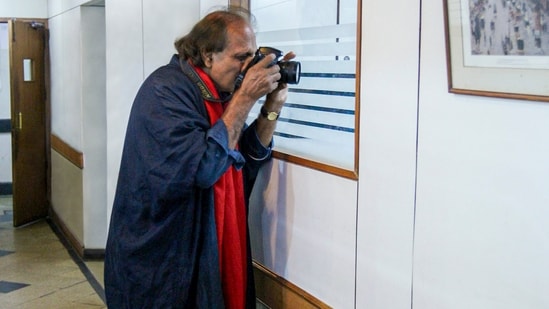
Remembering Raghu Rai through a personal lens| India News
# Remembering Raghu Rai: India’s Lens
**By Special Correspondent, India News Desk, April 27, 2026**
On April 27, 2026, the international art and journalism communities paused to remember Raghu Rai, the maestro who served as the definitive visual chronicler of modern India. As the world reflects on a monumental career spanning over six decades, tributes have poured in globally, celebrating his unmatched ability to capture the soul of the subcontinent. Yet, amidst the grand retrospectives of his Magnum Photos portfolio, a touching tribute published in the Hindustan Times offered a profoundly intimate perspective. Highlighting the duality of the global icon, the piece noted: “Much will be said about his extraordinary body of work, his visual record of our times, remarkable eye and charisma. But to me, he was simply my Raghuuncle.” This deeply personal lens provides a fitting starting point to explore the life, legacy, and enduring impact of India’s most celebrated photojournalist. [Source: Hindustan Times | Additional: Magnum Photos Archives]
## The Duality of an Icon: ‘Raghu Uncle’
To the world, Raghu Rai was a towering figure in photojournalism—a man whose camera functioned as a mirror reflecting India’s triumphs, tragedies, and daily contradictions. However, the recent Hindustan Times reflection pulls back the curtain on the man behind the formidable reputation.
For a photographer whose gaze was often fixed on the monumental—prime ministers, saints, and sweeping landscapes—Rai possessed a disarming warmth in his personal life. Friends and family recount his infectious laugh, his booming voice, and his ability to make anyone feel seen. This intrinsic empathy was not merely a personal trait; it was the very foundation of his professional genius. He did not photograph subjects as distant objects; he engaged with them, dissolving the barrier between the observer and the observed.
“The reason Raghu Rai’s photographs resonate so deeply is because of his profound humanity,” notes Dr. Meera Swaminathan, a historian of South Asian visual arts. “The same charisma that captivated his family as ‘Raghu uncle’ is what allowed him to disarm a Naga sadhu, a grieving mother, or a powerful politician. He photographed people with the familiarity of a neighbor.” [Source: Independent Art Analysis]
## A Journey Begun by Chance
Born in 1942 in Jhang (in present-day Pakistan), **Raghu Rai** did not initially set out to become a photographer. His early ambitions were rooted in civil engineering. However, the trajectory of his life shifted in 1965 when he picked up a camera under the guidance of his elder brother, S. Paul, who was himself an acclaimed photographer.
His rise was meteoric. By 1966, he had joined *The Statesman* as its chief photographer. It was here that he began to develop his signature style: a sprawling, panoramic view of Indian life that found order within the apparent chaos of the streets. His early black-and-white work captured the transition of a newly independent nation struggling with its ancient roots and modern aspirations.
In 1971, his haunting and visceral coverage of the Bangladeshi refugee crisis caught the eye of the legendary French photographer **Henri Cartier-Bresson**. Recognizing a kindred spirit who understood the “decisive moment,” Cartier-Bresson nominated Rai to join **Magnum Photos** in 1977. This nomination not only elevated Rai to the global stage but also cemented his status as the preeminent visual ambassador of India to the world.
## Chronicler of the Nation’s Soul
Raghu Rai’s portfolio reads like a visual encyclopedia of modern Indian history. As the picture editor for *India Today* from 1982 to 1992, he shaped the visual narrative of the country’s most prominent news magazine. He possessed a unique ability to capture the essence of India’s most complex figures.
His extended photo essays on **Mother Teresa** and the **Dalai Lama** are masterclasses in portraiture. Rai did not merely capture their likenesses; he captured their auras. His frames of Mother Teresa in prayer, surrounded by the stark poverty of Kolkata, remain some of the most definitive images of the saint. Similarly, his candid portraits of Prime Minister **Indira Gandhi** peeled back the layers of the “Iron Lady,” revealing moments of contemplation, vulnerability, and immense power.
Beyond the famous, Rai was intimately obsessed with the everyday. His lifelong fascination with the city of Delhi—resulting in numerous books—captured the juxtaposition of Mughal ruins, British colonial architecture, and teeming modern street life. He saw the divine in the dust of the Indian streets, framing cows, cyclists, and holy men in compositions that felt almost cinematic. [Source: Public Archive Analysis]
## The Tragedy of Bhopal: A Haunting Masterpiece
While much of Rai’s work celebrates the vibrant tapestry of Indian life, his most globally recognized photograph is one of profound sorrow. On December 3, 1984, a pesticide plant owned by Union Carbide in Bhopal leaked deadly methyl isocyanate gas, killing thousands in what remains one of the world’s worst industrial disasters.
Rai arrived on the scene the next morning. Amidst the apocalyptic horror, he captured the image of a dead child being buried by a grieving man, the child’s sightless eyes peering out from the rubble. The photograph, titled *”Burial of an unknown child,”* shocked the conscience of the world.
“That image transcended photojournalism; it became an irrefutable indictment of corporate negligence,” explains Vikram Sethi, a veteran photojournalist. “Rai’s lens gave a face to an unfathomable statistic. It is a painful image to look at, yet impossible to look away from—a testament to his remarkable eye for framing human tragedy with dignity.” [Source: Journalistic Commentary]
The image catalyzed international outrage and became the defining symbol of the Bhopal Gas Tragedy, proving that a single photograph can alter the course of history and demand accountability where words fail.
## The Evolution of Style: From Film to Digital
One of the most remarkable aspects of Raghu Rai’s career was his willingness to evolve. Unlike many of his contemporaries who fiercely clung to analogue film, Rai embraced the digital revolution with open arms. He transitioned seamlessly from black-and-white film to rich, saturated color photography, and eventually to digital cameras and even smartphones.
For Rai, the medium was always secondary to the vision. He often stated that digital photography liberated him from the darkroom, allowing him to shoot with greater agility and see his results instantaneously. He applied his classic Magnum-trained eye—waiting patiently for the elements of a chaotic street scene to align into perfect geometric harmony—to modern technology.
His later works, including sweeping panoramic shots of the Maha Kumbh Mela and the shifting landscapes of rural India, demonstrated that his “remarkable eye” had not dimmed with age. He remained an active, prolific creator well into his twilight years, continually pushing the boundaries of documentary photography.
## A Legacy Cemented in History
Raghu Rai’s contributions to the arts have been heavily recognized both domestically and internationally. He is among the few photographers to have been awarded the **Padma Shri** (1972), one of India’s highest civilian honors, given to him when he was just 30 years old.
His published works are monumental. A brief look at his bibliographic legacy includes:
* *A Day in the Life of Indira Gandhi* (1974)
* *Taj Mahal* (1986)
* *India: A Mystic Journey* (2011)
* *Picturing Time: The Greatest Photographs of Raghu Rai* (2020)
Furthermore, the establishment of the **Raghu Rai Center for Photography** has ensured that his philosophy of seeing is passed down to future generations. He mentored countless young photographers, instilling in them the belief that taking a good photograph requires one to feel deeply connected to the environment.
As archivists and museums now begin the monumental task of preserving his complete body of work, the implications for historical research are immense. Rai’s negatives and digital files constitute a primary historical source, documenting the sociological, political, and environmental metamorphosis of South Asia over a half-century.
## Conclusion: The Immortal Lens
As the world remembers Raghu Rai today, the sentiments echoed in the Hindustan Times serve as a poignant anchor. The public will forever analyze his extraordinary visual record of our times. Museum curators will continue to hang his striking black-and-white prints in global galleries, studying his use of light, shadow, and geometry. Environmentalists will still point to his Bhopal archives as crucial historical evidence.
Yet, the legacy of Raghu Rai is perhaps best summarized by the intersection of his professional genius and his personal charisma. He was a man who loved India in all its broken, beautiful, and bewildering forms. Through his lens, he taught millions how to look at their own country with a deeper sense of empathy and wonder. Whether remembered as the towering Magnum photographer or simply as “Raghu uncle,” his vision has been permanently imprinted onto the cultural retina of the world. His physical presence may be gone, but his photographs ensure that his remarkable eye will continue to bear witness to the unfolding story of humanity for generations to come.





