
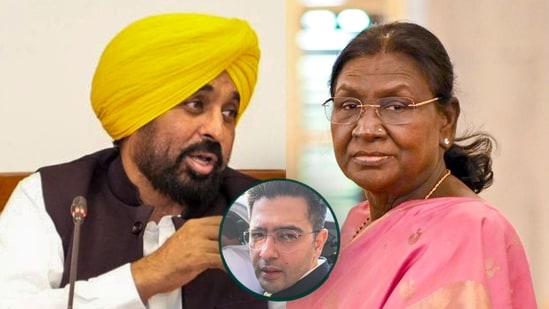
Punjab CM Bhagwant Mann to meet President Murmu over Chadha-led AAP MPs' switch to BJP, gets May 5 appointment
# Mann Pushes Recall of Defecting AAP MPs
By Special Correspondent, National Politics Desk, April 29, 2026
Punjab Chief Minister Bhagwant Mann is scheduled to meet President Droupadi Murmu on May 5, 2026, in New Delhi to formally request the unprecedented “recall” of several Rajya Sabha Members of Parliament. This dramatic constitutional maneuver comes in the wake of a massive political upheaval wherein a breakaway faction of AAP MPs, allegedly led by prominent leader Raghav Chadha, defected to join the BJP-aligned New Janata Party (NJP). While Mann seeks to terminate their parliamentary tenure on moral and democratic grounds, legal experts highlight a glaring obstacle: the Indian Constitution contains no provision for recalling elected or nominated Members of Parliament. [Source: Hindustan Times | Additional: Constitutional Law Archives]
## The Defection Shockwave
The political landscape of North India was irrevocably altered late last week when a contingent of Aam Aadmi Party (AAP) Rajya Sabha members announced their departure from the party. Led by Raghav Chadha—once considered the quintessential strategist and a core pillar of AAP’s inner circle—the MPs formed a splinter group, the New Janata Party (NJP), before swiftly merging their interests with the ruling Bharatiya Janata Party (BJP).
This defection represents one of the most severe blows to AAP since its inception. The Rajya Sabha, the upper house of India’s bicameral Parliament, is a critical arena where opposition parties attempt to check the legislative power of the ruling government. AAP’s sudden loss of key voices significantly weakens the broader opposition bloc’s numerical strength.
For the Bhagwant Mann-led government in Punjab, the sting is particularly personal. Most of the defecting MPs were nominated to the Council of States based on AAP’s overwhelming mandate in the 2022 Punjab Legislative Assembly elections. According to AAP leadership, these MPs were sent to New Delhi to represent the interests of Punjab’s electorate. Their sudden pivot to the BJP-led National Democratic Alliance (NDA) is being framed by AAP as a deep betrayal of the state’s voters.
## The May 5 Presidential Intervention
In an attempt to circumvent traditional, often protracted parliamentary disqualification proceedings, Chief Minister Bhagwant Mann has opted for a high-profile escalation. Securing an appointment with President Droupadi Murmu for May 5, Mann is preparing to present a detailed memorandum demanding the immediate “recall” of the defecting MPs.
Historically, cases of political defection are handled by the Chairman of the Rajya Sabha (the Vice President of India) under the Tenth Schedule of the Constitution, commonly known as the Anti-Defection Law. However, Mann’s decision to bypass the Chairman and directly approach the President underscores a strategic shift.
“The mandate was given by the people of Punjab to the Aam Aadmi Party, not to individuals to auction their seats to the highest political bidder,” an AAP spokesperson noted during a press briefing in Chandigarh earlier this week. “We are going to the Honorable President because this is no longer just a procedural matter of the Tenth Schedule; it is a fundamental crisis of democratic representation.” [Source: Public Statements, April 2026]
By invoking the concept of “recall,” Mann is attempting to spark a nationwide debate on democratic accountability, effectively arguing that the legislative assembly that elected these MPs should hold the sovereign right to revoke their tenure if they violate the mandate.
## Constitutional Vacuum: The ‘Recall’ Dilemma
Chief Minister Mann’s demand, while politically resonant, faces an insurmountable legal hurdle under the current constitutional framework. The Indian Constitution does not grant citizens or state legislatures the “Right to Recall” their elected representatives.
Dr. Meenakshi Sundaram, a senior constitutional lawyer and former parliamentary advisor, explains the legal friction: “In India, once an MP is elected, they hold their seat for the full term unless they resign, die, or are disqualified under specific constitutional provisions such as Article 102 or the Tenth Schedule. The concept of a ‘recall’—where an electoral college or constituency can vote to remove a sitting representative—exists in some local panchayat laws, but it is completely absent at the parliamentary level.”
If Raghav Chadha and his peers voluntarily gave up their AAP membership to join the NJP/BJP, they are technically subject to disqualification under the Anti-Defection Law. AAP’s designated Chief Whip in the Rajya Sabha would need to file a formal petition before the Chairman. The Chairman would then review the evidence, hear the defense, and issue a ruling.
However, by demanding a “recall” from the President, Mann is attempting to establish a new constitutional precedent. He argues that because Rajya Sabha MPs are elected by State Legislative Assemblies (under Article 80), a formal resolution passed by a two-thirds majority in the Punjab Vidhan Sabha should theoretically empower the President to withdraw those MPs. Legal scholars heavily dispute this interpretation, warning that it would effectively turn the Rajya Sabha into a hyper-partisan revolving door, destroying the House’s intended stability.
## Anti-Defection Law vs. Right to Recall
To understand the complexity of Mann’s May 5 agenda, it is essential to distinguish between the existing legal remedy and the proposed political remedy.
| Feature | Tenth Schedule (Anti-Defection Law) | Proposed “Right to Recall” |
| :— | :— | :— |
| **Authority** | Chairman of the Rajya Sabha | The President / State Legislative Assembly |
| **Trigger Mechanism** | Petition filed by a party member/whip | Resolution passed by the electing body (MLAs) |
| **Grounds** | Voluntarily giving up party membership or violating a party whip | Loss of confidence, ideological betrayal, or constituent demand |
| **Legal Status in India**| Explicitly codified in the Constitution (1985) | Non-existent for MPs; requires a Constitutional Amendment |
| **Process Length** | Often delayed; can take months or years | Proposed to be immediate upon Assembly resolution |
[Source: Constitution of India / Legal Analysis]
## Political Ramifications in Punjab and Delhi
Beyond the constitutional debates, the AAP crisis carries profound political implications for both Punjab and the National Capital Territory of Delhi. Raghav Chadha’s departure strips AAP of one of its most articulate and nationally recognized faces. Chadha was instrumental in AAP’s historic 2022 victory in Punjab, managing the state’s complex caste and regional dynamics to secure a landslide win.
His pivot to the BJP fold signals an aggressive expansion strategy by the ruling national party into Punjab—a state where the BJP has historically struggled to gain a significant foothold without its former ally, the Shiromani Akali Dal (SAD). By integrating high-profile AAP defectors into their ranks, the BJP is attempting to build a localized leadership vacuum within AAP while simultaneously strengthening its own roster ahead of future electoral contests.
For Bhagwant Mann, the stakes could not be higher. Allowing the defecting MPs to comfortably retain their Rajya Sabha seats while switching allegiances would project weakness. By leading the charge to the Rashtrapati Bhavan, Mann is signaling to his remaining MLAs and party cadres in Punjab that defection will be met with absolute, uncompromising resistance. It is a necessary display of political strength designed to prevent any potential domino effect within the Punjab Legislative Assembly.
## The Role of the President
When Chief Minister Mann meets President Murmu on May 5, the interaction will be largely symbolic but heavily consequential. The President of India is a constitutional head bound by the aid and advice of the Council of Ministers (Article 74). The President cannot unilaterally dismiss or recall Members of Parliament outside the established constitutional boundaries.
If a question arises regarding the disqualification of an MP under Article 103 (for reasons like office of profit or insolvency), the President refers the matter to the Election Commission of India and acts on its binding advice. However, matters of defection are the exclusive domain of the presiding officer of the House (the Rajya Sabha Chairman).
Therefore, the President is likely to receive Mann’s memorandum and forward it to the appropriate constitutional authorities—either the Ministry of Home Affairs, the Ministry of Law and Justice, or the Rajya Sabha Secretariat—for further examination. Nonetheless, the visual of a sitting Chief Minister petitioning the Head of State for the right to recall parliamentary representatives guarantees front-page coverage and keeps the issue firmly in the public consciousness.
## Conclusion: A Test for India’s Democracy
The May 5 meeting between Punjab Chief Minister Bhagwant Mann and President Droupadi Murmu will serve as a fascinating stress test for India’s parliamentary democracy. While the demand for an unprecedented “recall” of Raghav Chadha and other defecting MPs is legally fraught and constitutionally unsupported, it successfully highlights the ongoing vulnerabilities within the Anti-Defection Law.
Critics have long argued that the Tenth Schedule is easily manipulated through resignations, mergers, and delayed rulings by partisan presiding officers. By demanding a direct recall power, AAP is tapping into a populist sentiment that demands immediate accountability from elected representatives who change their political stripes post-election.
Whether this constitutional gambit results in actual legislative reform or remains a strategic piece of political theater, the upcoming Rashtrapati Bhavan summit will undoubtedly shape the discourse surrounding political defections, the sanctity of electoral mandates, and the future trajectory of the Aam Aadmi Party’s national ambitions. All eyes are now on New Delhi as India awaits the President’s response to an extraordinary democratic challenge.





