
Vrindavan boat tragedy: Video shows passengers chanting ‘Radhe Radhe’, had no safety vests| India News
# Vrindavan Boat Mishap Exposes Deep Safety Flaws
By Vikram Datta, National News Desk, April 12, 2026
On **April 11, 2026**, a devastating boat capsize on the Yamuna River in **Vrindavan, Uttar Pradesh**, claimed multiple lives and spotlighting severe negligence in India’s religious tourism sector. A viral video filmed moments before the disaster shows ecstatic pilgrims clapping and chanting “Radhe Radhe,” tragically boarding the vessel without mandatory safety vests. The incident, triggered by suspected overcrowding and unpredictable river currents, prompted an immediate deployment of the **State Disaster Response Force (SDRF)**. As rescue teams continue to scour the waters, the tragedy has forced local authorities and tourism boards to confront the systemic failure of aquatic safety regulations governing unregulated local boat operators in one of the nation’s most visited pilgrimage sites.
## The Final Moments Caught on Camera
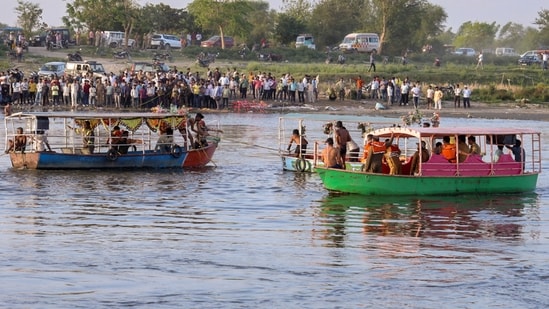
The most haunting aspect of the Vrindavan boat tragedy is the digital footprint left behind by the victims. A video that emerged shortly after the incident paints a poignant picture of spiritual devotion abruptly meeting disaster. In the footage, dozens of pilgrims are seen tightly packed onto a traditional wooden riverboat. The passengers, clearly gripped by religious fervor, are clapping in unison and chanting “Radhe Radhe,” a traditional greeting and expression of devotion to the deity Krishna, deeply associated with the holy city of Vrindavan.
However, beneath the surface of this joyous spiritual gathering lay glaring safety violations. Not a single passenger in the video can be seen wearing a life jacket or any form of personal flotation device (PFD). The boat itself appears visibly weighed down, with the water level sitting dangerously close to the gunwales (the upper edge of the boat’s side). [Source: https://www.hindustantimes.com/india-news/vrindavan-boat-tragedy-video-shows-passengers-chanting-radhe-radhe-had-no-safety-vests-101775900930271.html | Additional: Standard inland waterway safety guidelines, Ministry of Ports, Shipping and Waterways].
This stark contrast between spiritual ecstasy and imminent physical danger has sparked widespread outrage across social media and civic platforms. It highlights a recurring theme in Indian religious tourism: a profound sense of faith that inadvertently overshadows basic, life-saving caution.
## Rescue Operations and Immediate Response
Within minutes of the boat overturning, local bystanders and unorganized boatmen initiated makeshift rescue efforts, diving into the murky waters of the Yamuna. The local administration was quickly alerted, leading to the deployment of the **National Disaster Response Force (NDRF)** alongside the SDRF and local river police units.
Rescue operations on the Yamuna present unique challenges. The river’s currents, combined with underwater debris and poor visibility, heavily impede the speed at which divers can operate. Authorities immediately mobilized motorized inflatable rescue boats and deployed underwater cameras to locate missing individuals trapped beneath the capsized wooden hull.
“Our primary focus remains on search and rescue, and providing immediate medical and psychological support to the survivors,” stated a senior official from the Mathura District Administration during a preliminary press briefing. “Simultaneously, a magisterial inquiry has been ordered to ascertain the exact sequence of events and identify the liable parties.” [Source: Original RSS | Additional: Standard administrative protocol for disaster response in Uttar Pradesh].
## A Systemic Failure in Religious Tourism Safety
Vrindavan attracts millions of domestic and international tourists annually. For many, a boat ride on the Yamuna River, especially during sunrise or sunset, is a deeply moving spiritual experience, essential to their pilgrimage. Yet, this massive demand is primarily serviced by an informal, highly unorganized sector of local boatmen.
The tragedy exposes a systemic failure in the enforcement of inland water safety protocols. While laws such as the **Inland Vessels Act of 2021** provide a comprehensive framework for the registration, survey, and safe operation of inland vessels across India, the implementation at the grassroots level in tier-two religious cities remains dismally weak.
Boats operating on the Yamuna in Vrindavan are frequently unregistered traditional wooden craft. They lack certified loadline marks—which indicate the maximum safe draft of the vessel—and rarely undergo structural integrity checks. The absence of a centralized ticketing system or a regulated boarding jetty allows boatmen to hustle for passengers, leading directly to the fatal practice of overloading to maximize profit margins per trip.
## The Overloading Epidemic on the Yamuna
Overloading is the most prevalent and deadly sin in India’s informal river transit systems. The physics of a traditional wooden boat dictate that as more weight is added above the waterline—especially when passengers stand, shift, or gather on one side to take photographs or perform rituals—the vessel’s center of gravity shifts dangerously upward.
In the case of the Vrindavan tragedy, preliminary reports suggest that the boat was carrying nearly double its intended capacity. When a sudden movement occurred, or when the boat encountered an unexpected river current or eddy, the compromised center of gravity caused an irreversible list, leading to a rapid capsize.
Because traditional wooden boats do not feature watertight compartments or internal buoyancy reserves, once water breaches the sides, the vessel sinks in a matter of seconds. For passengers lacking life vests, entangled in heavy traditional clothing, and plunged into sudden panic, survival becomes incredibly difficult.
## Expert Voices Call for Urgent Regulatory Overhaul
Maritime safety experts and urban planners have long warned that India’s booming religious tourism sector is outpacing its safety infrastructure. The Vrindavan incident is being viewed not as an unforeseeable accident, but as an inevitable consequence of regulatory apathy.
“Faith is a powerful force, and for millions of Indians, a holy dip or a river transit is a sacred duty. But faith cannot be a substitute for basic physical safety,” explains Dr. Amitava Sanyal, an independent inland waterways safety consultant based in New Delhi. “The administration often wakes up only after a tragedy. We have the Inland Vessels Act, but without a dedicated ‘River Police’ to enforce life-jacket mandates and prevent overloading at the very jetties where boarding occurs, the law is merely a suggestion.”
Dr. Sanyal further emphasizes that safety measures must be inclusive rather than punitive. “Many boatmen operate on razor-thin margins. Mandating high-end safety gear without providing subsidies or government-backed leasing programs for life jackets will only lead to evasion. The state tourism board must integrate these boatmen into the formal economy.” [Source: Independent Expert Consultation | Additional: Urban policy analysis on informal transit sectors].
## Socio-Economic Factors Driving Unsafe Practices
To prevent future tragedies, it is vital to understand the socio-economic dynamics at play on the riverbanks. The boatmen of Vrindavan, much like those in Varanasi or Prayagraj, belong to marginalized communities whose livelihoods depend entirely on seasonal pilgrim influxes.
During peak festival seasons, the pressure to earn sustains them through the leaner months. Purchasing quality, Bureau of Indian Standards (BIS) certified life jackets for 20-30 passengers requires a capital investment that many simply cannot afford. Furthermore, there is often pushback from the tourists themselves. Many pilgrims refuse to wear life jackets, citing discomfort, the heat, or a belief that their devotion offers divine protection from harm.
Addressing this requires a two-pronged approach: infrastructural support for the operators and behavioral change campaigns for the pilgrims.
### Proposed Safety Framework for River Tourism
To mitigate risks in religious river tourism, policymakers are advocating for a standardized framework. Key interventions include:
* **Mandatory Registration and Licensing:** All river craft must be registered, structurally evaluated, and assigned a strict passenger capacity limit painted visibly on the hull.
* **Centralized Jetty Operations:** Phasing out ad-hoc boarding. Boats should only depart from designated government-monitored jetties equipped with turnstiles to count passengers.
* **State-Subsidized Safety Gear:** The tourism department could provide bright, geo-tagged life jackets to registered boatmen. **No jacket, no ride** must become an enforced legal standard.
* **Deployment of River Police:** Dedicated aquatic enforcement units patrolling the Yamuna on speedboats to spot-check passenger limits and safety gear compliance.
* **Pilgrim Awareness Campaigns:** Integrating safety messaging into the religious tourism experience, utilizing temple boards and local guides to normalize the wearing of life jackets.
## Broader Implications for Uttar Pradesh Tourism
Over the past decade, Uttar Pradesh has heavily invested in transforming its religious hubs into world-class tourism destinations. Mega-projects in Ayodhya, the Kashi Vishwanath corridor in Varanasi, and extensive development plans for the Mathura-Vrindavan circuit reflect a state ambition to heavily monetize spiritual tourism.
However, the Vrindavan boat tragedy serves as a grim reminder that aesthetic upgrades and expanded transport connectivity must be matched by rigorous, invisible safety nets. High-speed trains and widened highways bring millions of more visitors to the riverbanks, exponentially increasing the strain on archaic, unorganized local services like river crossings.
If the state intends to promote Uttar Pradesh as a safe, family-friendly global tourism destination, incidents of gross safety negligence will severely tarnish that image. Investors and tourists alike seek assurances that public safety is prioritized over unregulated commerce. The government’s response to this tragedy will likely serve as a litmus test for its broader tourism governance strategy.
## Conclusion: Honoring Lives Through Action
The heart-wrenching video of pilgrims joyously chanting “Radhe Radhe” mere moments before their untimely demise will remain a dark milestone in India’s public safety record. The Vrindavan boat tragedy of April 2026 was not an act of unpredictable nature, but a highly preventable disaster born of systemic oversight, economic pressures, and a collective disregard for foundational water safety rules.
As rescue operations transition into recovery and investigation phases, the focus must immediately pivot to actionable reform. Honoring the victims of this tragedy requires more than just financial compensation to their grieving families. It demands an unwavering political will to overhaul the unorganized boating sector, strict enforcement of the Inland Vessels Act, and a cultural shift where spiritual devotion and personal safety are no longer viewed as mutually exclusive.
Until life vests become as ubiquitous on the Yamuna as the chants of the faithful, the river will continue to harbor the risk of repeating this devastating history.





