
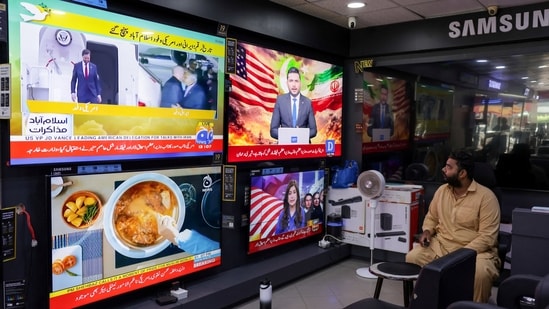
Cong terms Modi's foreign policy ‘Vishwaguru's huglomacy’ as Pakistan plays US-Iran peacemaker| India News
# Congress Slams Modi’s ‘Huglomacy’ Over Pak Role
**By Diplomatic Correspondent, New Delhi, April 11, 2026**
On Saturday, the Indian National Congress launched a scathing attack on Prime Minister Narendra Modi’s foreign policy, mocking it as “Vishwaguru’s huglomacy” following reports of Pakistan successfully mediating backdoor talks between the United States and Iran. Congress General Secretary in-charge of Communications, Jairam Ramesh, publicly questioned whether PM Modi’s highly publicized personal rapport with US President Donald Trump has yielded any tangible strategic returns for New Delhi. As Islamabad steps into a critical peacemaker role in the Middle East, opposition leaders and geopolitical analysts are asking if India’s focus on diplomatic optics has inadvertently led to strategic marginalization in its immediate neighborhood. [Source: Hindustan Times].
## The Anatomy of the ‘Huglomacy’ Critique
The term “huglomacy”—a portmanteau of “hug” and “diplomacy”—has long been utilized by the opposition to describe Prime Minister Modi’s penchant for embracing world leaders during high-level state visits. While the ruling Bharatiya Janata Party (BJP) has historically projected these optics as evidence of India’s rising global stature and Modi’s status as a “Vishwaguru” (teacher to the world), the Congress party argues that these gestures lack substantive policy dividends.
Addressing the media in New Delhi, Jairam Ramesh posed a rhetorical but politically charged question regarding the renewed Trump-Modi dynamic. “We have witnessed the mega-events, the holding of hands, and the diplomatic embraces,” Ramesh stated. “But as the ‘self-declared Vishwaguru’ touts his personal rapport with Donald Trump, we must ask: where are the strategic returns? Pakistan is currently playing the peacemaker between the US and Iran in Islamabad, while India watches from the sidelines.” [Source: Hindustan Times].
This critique targets the core of the government’s foreign policy narrative, suggesting an over-reliance on personality-driven diplomacy at the expense of institutional, hard-nosed strategic maneuvering. By drawing attention to Pakistan’s sudden elevation in Washington’s geopolitical playbook, Congress is attempting to puncture the BJP’s narrative of an isolated Pakistan and a globally dominant India.
## Islamabad’s Surprise Diplomatic Coup
To understand the weight of the opposition’s critique, one must examine the shifting geopolitical sands of early 2026. Tensions between Washington and Tehran reached near-boiling points earlier this year, threatening global energy supplies and stability in the Strait of Hormuz. In a surprising turn of events, Pakistan emerged as the primary conduit for de-escalation talks.
Islamabad’s geographic proximity to Iran, combined with its historical military ties to the United States, positioned it uniquely to host backchannel negotiations. For Pakistan, a country grappling with severe economic crises and reliant on International Monetary Fund (IMF) bailouts, proving its strategic utility to the United States is a matter of economic survival.
By facilitating dialogue between the Trump administration and Iranian officials, Pakistan has successfully echoed its historic 1971 diplomatic maneuver, when Islamabad served as the secret bridge between the Nixon administration and Mao Zedong’s China. This renewed relevance threatens to undo years of Indian diplomatic efforts aimed at isolating Pakistan on the global stage due to its record on cross-border terrorism. [Source: Global Geopolitical Analysis, 2026].
## Re-evaluating the Modi-Trump Rapport
The central pillar of Jairam Ramesh’s argument revolves around the transactional nature of US foreign policy under Donald Trump. During Trump’s previous tenure, India invested heavily in the bilateral relationship, culminating in mega-events like “Howdy, Modi!” in Texas and “Namaste Trump” in Gujarat.
However, Trump’s “America First” doctrine dictates that Washington will partner with whichever nation offers the most immediate solution to its pressing foreign policy hurdles. If Pakistan can deliver a de-escalation with Iran—allowing the US to pivot its focus back to the Indo-Pacific and China—Washington is likely to reward Islamabad. Such rewards could manifest as unblocked military aid, favorable terms at the IMF, or a softening of the US stance on the Kashmir issue, all of which represent direct diplomatic setbacks for New Delhi.
“The Congress party’s assertion highlights a genuine vulnerability in New Delhi’s strategic outlook,” notes Dr. Arunima Rao, a former diplomat and senior fellow at a New Delhi-based strategic think tank. “Personal chemistry between leaders can open doors, but it cannot override the cold, hard interests of a superpower. If Pakistan proves more immediately useful to Washington in the Middle East, India’s ‘huglomacy’ will yield diminishing returns.” [Source: Independent Strategic Commentary].
## Strategic Fallout for New Delhi’s Middle East Policy
India has traditionally maintained a delicate balancing act in the Middle East, cultivating strong ties with the Arab states and Israel while maintaining historical and energy-related connections with Iran. A key cornerstone of India’s Iran policy is the Chabahar Port project, designed to bypass Pakistan and provide India direct access to Afghanistan and Central Asia.
If Pakistan successfully embeds itself as the primary mediator between the US and Iran, Islamabad could leverage this position to undermine India’s interests in Tehran. Furthermore, if US sanctions on Iran are eased through Pakistani mediation rather than Indian advocacy, Tehran may feel more indebted to Islamabad, altering the regional balance of power.
The Congress party has seized upon this potential fallout to argue that India’s foreign affairs apparatus has been asleep at the wheel. The opposition claims that by moving increasingly closer to the US-Israel axis in recent years, India may have alienated traditional partners in Tehran, inadvertently creating a vacuum that Pakistan was all too eager to fill.
## Broader Context: India’s Neighborhood Challenges
The attack on “Vishwaguru’s huglomacy” does not exist in a vacuum. It is part of a broader, sustained critique by the Congress party regarding India’s waning influence in its immediate neighborhood. Over the past few years, New Delhi has faced complex diplomatic challenges with several neighboring nations:
* **Maldives:** Managing the fallout from the “India Out” campaigns and navigating the archipelago’s tilt toward Beijing.
* **Nepal:** Border disputes and shifting political allegiances in Kathmandu that frequently challenge Indian diplomatic supremacy.
* **Bangladesh:** Economic disruptions and border management complexities.
* **China:** The unresolved military standoff in Eastern Ladakh, which the opposition frequently cites as the government’s most glaring national security failure.
By linking the current US-Iran-Pakistan triangle to these broader regional issues, the Congress party is attempting to paint a picture of a government that is excellent at event management but failing at core geopolitical strategy.
“The opposition is strategically pivoting from domestic economic critiques to foreign policy, an area usually dominated by PM Modi’s larger-than-life persona,” explains political analyst Vikram Mehta. “By coining catchy, critical phrases like ‘huglomacy’, they are trying to break through the government’s formidable communication machinery to tell the average voter that India is losing its neighborhood.” [Source: Independent Expert Analysis].
## The Perspective from South Block
While the opposition’s attacks dominate the headlines, officials within the Ministry of External Affairs (MEA) and the ruling government maintain a starkly different view. Sources close to South Block dismiss the Congress party’s claims as domestic political opportunism that ignores the complexities of multipolar diplomacy.
Government defenders argue that India’s relationship with the United States has never been stronger, pointing to advanced defense agreements, technology transfers under the iCET (Initiative on Critical and Emerging Technology), and robust cooperation within the Quad alliance aimed at countering China in the Indo-Pacific.
From the government’s perspective, Pakistan’s involvement in US-Iran talks is a temporary, transactional arrangement born out of geographic necessity, not a strategic realignment by Washington. Furthermore, Indian diplomats argue that New Delhi intentionally stayed out of the US-Iran mediation to avoid being entangled in a volatile Middle Eastern conflict, preferring instead to secure its energy supplies and protect its diaspora independently.
## Conclusion: Optics Versus Pragmatism
The verbal sparring over “Vishwaguru’s huglomacy” highlights a critical inflection point in India’s domestic political discourse surrounding foreign affairs. As the world transitions into a highly volatile geopolitical era defined by transactional alliances, the debate over how India should project power has never been more pertinent.
**Key Takeaways:**
1. **Opposition Strategy:** The Congress party is aggressively challenging the BJP’s foreign policy narrative, demanding tangible strategic outcomes rather than relying on the optics of personal relationships between world leaders.
2. **Pakistan’s Resurgence:** Islamabad’s role as a mediator between the US and Iran demonstrates its enduring geopolitical utility, posing a renewed challenge to India’s efforts to isolate its neighbor.
3. **The Trump Factor:** The transactional nature of a renewed Trump administration requires New Delhi to offer constant, pragmatic value to Washington, as historical goodwill and personal rapport are easily overridden by immediate American interests.
4. **Regional Balancing:** India faces an urgent need to recalibrate its Middle East policy to ensure that its strategic interests, such as the Chabahar Port, are not undermined by the evolving US-Pakistan-Iran dynamic.
Moving forward, New Delhi will need to demonstrate that its foreign policy is grounded in more than just high-profile photo opportunities. Whether the government can effectively counter the Congress party’s narrative will depend on its ability to leverage its growing economic and military clout to secure undeniable diplomatic victories in a rapidly shifting world order. Until then, the debate between the pragmatism of traditional statecraft and the spectacle of “huglomacy” will continue to echo through the halls of Indian politics.





