
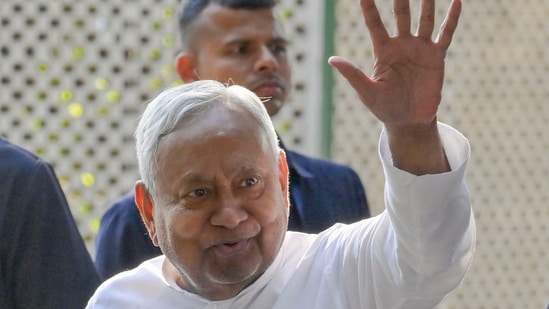
‘Felt ashamed to say we are Bihari before Nitish Kumar’: What JD(U) said about outgoing CM| India News
# JD(U) Honors Outgoing CM Nitish Kumar’s Legacy
By Staff Reporter, Political Observer, April 14, 2026
On Tuesday, April 14, 2026, the Janata Dal (United) leadership profoundly reflected on a pivotal political transition in Bihar, delivering a glowing tribute to outgoing Chief Minister Nitish Kumar. During a high-level party address in Patna, JD(U) national working president Sanjay Kumar Jha encapsulated the emotional and administrative impact of Kumar’s tenure, stating that before his rise to power, citizens “felt ashamed to say we are Bihari.” As the state’s longest-serving Chief Minister prepares to step aside, Jha firmly asserted that Bihar’s governance and developmental framework will continue to center around Kumar’s visionary policies for many years to come. [Source: Original RSS | Additional: Hindustan Times].
## The Transformation of Bihari Identity
The statement made by Sanjay Kumar Jha strikes at the heart of a profound psychological and socio-economic shift that Bihar has undergone over the last two decades. To understand the gravity of the claim that people were once “ashamed” of their regional identity, one must look back at the late 1990s and early 2000s. During that era, Bihar was nationally perceived as the epicenter of lawlessness, often pejoratively referred to as the era of “Jungle Raj.” Economic stagnation, rampant organized crime, mass kidnappings for ransom, and severe infrastructural decay forced millions of Biharis to migrate to other states for education and employment, where they frequently faced regional prejudice.
When Nitish Kumar assumed the office of Chief Minister with a decisive mandate in November 2005, his administration inherited a fractured state apparatus. His immediate priority was not just physical rebuilding, but the restoration of civilizational pride. By systematically dismantling criminal syndicates through fast-track courts and prioritizing basic law and order, Kumar brought a sense of normalcy that had been absent for over a decade.
“The comment by Sanjay Jha is not mere political rhetoric; it reflects a genuine socio-cultural rehabilitation,” notes Dr. Rajesh Prasad, a Patna-based political analyst and Senior Fellow at the Centre for Policy Studies. “Nitish Kumar gave the diaspora and the resident population a reason to reclaim their identity. He transformed Bihar from a national punchline into a state that was finally striving for administrative accountability.” [Source: Independent Political Analysis].
## A Two-Decade Era of Infrastructure and Law & Order
Nitish Kumar’s early years in power earned him the moniker *Sushasan Babu* (Mr. Good Governance). The core of this reputation was built on visible, tangible infrastructural progress. Under his administration, the state witnessed a massive road construction boom. The objective was clear and effectively executed: ensuring that any citizen from the remotest village in Bihar could reach the capital city of Patna within a six-hour drive.
Furthermore, the electrification of rural Bihar stands as one of his government’s most undeniable triumphs. Villages that had never seen a lightbulb since Independence were connected to the grid. The reliable supply of electricity fundamentally altered the rural economy, allowing small businesses to thrive, children to study after dusk, and agricultural productivity to increase through the use of electric tube wells.
**Key Policy Milestones Under Nitish Kumar:**
* **Infrastructure:** Extensive state highway development and rural road connectivity under the Mukhyamantri Gram Sampark Yojana.
* **Electrification:** Achieving near 100% household electrification across rural and urban divisions.
* **Law and Order:** Establishment of fast-track courts resulting in thousands of convictions of organized criminals and bahubalis (strongmen).
* **Public Services:** Introduction of the Right to Public Services Act (RTPS), ensuring time-bound delivery of government services to citizens.
## Women’s Empowerment and Social Engineering
Beyond bricks and mortar, Nitish Kumar’s legacy is deeply intertwined with his quiet but aggressive social engineering. He recognized early on that to dismantle the entrenched political monopolies of his rivals, he needed to cultivate a new, loyal voter base. He achieved this through the empowerment of women and marginalized castes.
The introduction of the *Mukhyamantri Balika Cycle Yojana*—a scheme providing free bicycles to school-going girls—was a masterstroke. It not only drastically reduced the female dropout rate in high schools but also became a symbol of newly found female mobility and independence in a deeply patriarchal society. He followed this with a pioneering move to reserve 50% of seats for women in Panchayati Raj institutions, bringing hundreds of thousands of women into grassroots governance.
Perhaps his most polarizing yet impactful decision was the imposition of total liquor prohibition in 2016. Driven primarily by demands from rural women whose households were being destroyed by alcoholism and domestic violence, the policy solidified his support among female voters. [Source: Public Records / Electoral Analysis].
Additionally, his creation of the Extremely Backward Classes (EBC) and Mahadalit categories ensured that the most marginalized sections of society received targeted welfare schemes, permanently altering the caste arithmetic of Bihar.
## The Political Pivot: Surviving Coalition Dynamics
While his governance record boasts significant highs, Nitish Kumar’s political trajectory has been characterized by extreme pragmatism, often earning him criticism from ideological purists. He has remained the Chief Minister for the better part of two decades despite his party, the JD(U), rarely holding an absolute majority on its own.
His ability to navigate complex coalition dynamics has been unparalleled in contemporary Indian politics. Kumar seamlessly transitioned between alliances with the Bharatiya Janata Party (NDA) and the Rashtriya Janata Dal and Congress (Mahagathbandhan). Whether he was snapping ties with the BJP in 2013, forging a grand alliance in 2015, returning to the NDA in 2017, pivoting back to the Mahagathbandhan in 2022, or realigning with the NDA ahead of the 2024 general elections, his maneuvers were always calculated to keep the JD(U) at the helm of power.
Critics have frequently labeled these shifts as opportunistic. However, Sanjay Kumar Jha and the JD(U) cadre have consistently defended these realignments as necessary sacrifices made to protect the developmental trajectory of Bihar from stalling. The overarching party line remains that Kumar’s allegiance has never been to an ideology, but rather to the state of Bihar itself.
## Expert Perspectives on the Outgoing Chief Minister
As Nitish Kumar prepares to transition from his role as Chief Minister, political historians and sociologists are actively debating his final place in India’s political pantheon.
“Nitish Kumar represents the last of the socialist-era titans who managed to successfully blend Mandal politics with a modernization agenda,” says Neha Singh, a political sociologist specializing in the Hindi heartland. “While his frequent coalition changes alienated some urban voters, his core constituency—women and the EBCs—remained largely forgiving because he delivered on basic survival needs: safety, roads, and welfare.”
Economists point out that while Kumar rescued Bihar from the brink of fiscal ruin, the state still struggles with heavy industrialization and private sector investment. Despite the massive strides in basic infrastructure, Bihar remains heavily dependent on central funds and continues to face challenges in generating adequate white-collar employment for its burgeoning youth population.
## What Lies Ahead for JD(U) and Bihar?
Sanjay Kumar Jha’s statement that “the governance system in Bihar would continue to centre around Nitish Kumar for many years” is a strong indicator of the JD(U)’s future strategy. Even as an outgoing Chief Minister, Kumar is expected to transition into a patriarchal, guiding role—a *Margdarshak* for the state and his party.
The immediate challenge for the JD(U) is navigating the succession crisis. The party has been tightly controlled by Kumar, and a secondary line of pan-Bihar leadership has yet to be fully battle-tested. Sanjay Kumar Jha himself, alongside other senior leaders, will have the monumental task of holding the party’s diverse social coalition together in the absence of Kumar’s direct administrative control.
Furthermore, the state’s political vacuum will undoubtedly energize rival factions. The BJP, which has steadily expanded its footprint in Bihar, will likely view this transition as an opportunity to finally claim the Chief Minister’s chair for itself. Conversely, Tejashwi Yadav’s RJD, representing the younger demographic and heavily relying on the traditional Muslim-Yadav formula supplemented by promises of employment, will sense an opening to capture the state.
## Conclusion: A Complicated but Undeniable Legacy
As Bihar stands at the precipice of a new political era in April 2026, the reflection offered by the JD(U) leadership serves as both a retrospective and a rallying cry. Nitish Kumar’s tenure as Chief Minister is a complex tapestry of administrative brilliance, social empowerment, and relentless political pragmatism.
While debates will continue regarding the ultimate economic status of Bihar and the ethics of his coalition hopping, the fundamental assertion made by Sanjay Kumar Jha is historically validated: Nitish Kumar redefined what it means to be from Bihar. By pulling the state out of a dark period of violence and despair, he laid down a modern infrastructural and social foundation. Whoever succeeds him will inherit a state with challenges, certainly, but it is no longer a state defined by shame. The “Sushasan” model has irrevocably altered the expectations of the Bihari electorate, ensuring that Nitish Kumar’s shadow will indeed loom large over the state’s governance for generations.





