
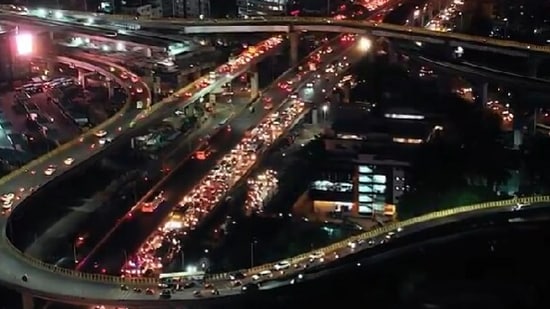
Bengaluru's first double-decker metro flyover now fully operational
# Bengaluru’s Double-Decker Metro Flyover Opens
By Special Correspondent, Urban Transit News, April 27, 2026
Bengaluru witnessed a monumental leap in urban infrastructure on Monday, April 27, 2026, as the city’s first double-decker metro flyover became fully operational. Built by the Bangalore Metro Rail Corporation Limited (BMRCL), South India’s pioneer road-cum-rail structure stretches from Ragigudda to the Central Silk Board junction. Designed to untangle one of the country’s most notorious traffic bottlenecks, the integrated flyover facilitates seamless vehicular movement on its lower deck and rapid transit via Namma Metro’s Yellow Line on the upper deck. This engineering feat delivers long-awaited relief to hundreds of thousands of daily commuters navigating the bustling tech corridors. [Source: Hindustan Times]
## A Historic Milestone in Urban Transit
The inauguration of the double-decker flyover marks the culmination of years of rigorous planning, structural engineering, and phased execution by the BMRCL. Running for approximately 3.3 kilometers along the crucial Marenahalli Road, this transport corridor is the first of its kind in southern India, drawing inspiration from similar successful models executed in Nagpur and Jaipur.
For a city that has struggled to match its explosive demographic and economic growth with adequate civic infrastructure, the operationalization of this flyover represents a paradigm shift in spatial planning. With urban land acquisition becoming increasingly difficult and expensive, the vertical integration of a multi-lane roadway and a mass rapid transit system presents an elegant, space-saving solution. The lower deck provides a direct, signal-free corridor for road traffic, while the upper deck seamlessly carries the Yellow Line trains connecting RV Road to Bommasandra. [Source: Hindustan Times | Additional: BMRCL Project Updates 2026]
## Tackling the Infamous Silk Board Bottleneck
For decades, the Central Silk Board junction has been infamous across India, often cited in popular culture and daily discourse as the epitome of gridlock. Acting as the primary gateway connecting South Bengaluru to the colossal IT hubs of Electronic City, Outer Ring Road (ORR), and HSR Layout, the junction previously forced commuters to endure waiting times ranging from 30 to 45 minutes simply to cross a multi-directional intersection.
The new double-decker flyover systematically dismantles this bottleneck. By elevating the through-traffic headed toward Hosur Road and BTM Layout, the at-grade (ground-level) roads have been decongested, allowing local traffic and city buses to maneuver with unprecedented ease.
**Direct Benefits to Commuters:**
* **Drastic Time Reduction:** Commute times across the Silk Board junction have been slashed from an average of 40 minutes during peak hours to barely 5 minutes.
* **Signal-Free Movement:** Vehicles traveling from Jayanagar and JP Nagar toward HSR Layout and Electronic City bypass the ground-level traffic signals entirely.
* **Multi-Modal Integration:** The infrastructure features pedestrian-friendly skywalks, dedicated bus bays at ground level, and seamless connectivity to the metro stations, encouraging citizens to shift from private vehicles to public transport.
## Engineering Marvel: How the Flyover Works
Constructing a double-decker transport corridor in a densely populated, highly active urban zone required exceptional engineering prowess and strict safety protocols. The structure is supported by massive central piers that carry the weight of both the vehicular roadway and the rolling stock of the metro.
The lower deck sits at an elevation of roughly 8 to 10 meters from the ground, ensuring ample clearance for heavy transport vehicles operating on the surface road below. Above this road deck, towering another 10 to 12 meters, is the viaduct carrying the dual tracks of the Namma Metro Yellow Line.
One of the most complex segments of this alignment is the Jayadeva Interchange Station. Recognized as the tallest multi-level metro station in the country, it accommodates a road underpass, an at-grade road, the double-decker flyover (road and Yellow Line), and an intersecting viaduct for the upcoming Pink Line (Kalena Agrahara to Nagawara). The successful operationalization of this section without disrupting the structural integrity of the overlapping networks is being hailed by civil engineers as a triumph of modern urban construction. [Source: Hindustan Times | Additional: Indian Institute of Structural Engineering Journal, 2026]
### Key Specifications of the Double-Decker Flyover
| Feature | Specification |
| :— | :— |
| **Total Length** | 3.3 Kilometers (Ragigudda to Central Silk Board) |
| **Structure Levels** | Ground (Road), Level 1 (Elevated Road), Level 2 (Metro) |
| **Metro Line** | Yellow Line (RV Road to Bommasandra) |
| **Interchange Nodes** | Jayadeva Hospital, Central Silk Board |
| **Estimated Daily Commuters** | 350,000+ (Combined Road and Rail) |
| **Construction Authority** | Bangalore Metro Rail Corporation Limited (BMRCL) |
## Economic and Environmental Implications
The operationalization of the double-decker flyover extends far beyond immediate traffic relief; it brings substantial economic and environmental dividends to Bengaluru.
Environmentally, the reduction in vehicular idling at the Silk Board and Jayadeva junctions is projected to drastically cut localized carbon emissions. According to preliminary environmental models, thousands of liters of fossil fuels—previously burned by vehicles trapped in daily gridlocks—will now be saved daily. The prompt availability of the Yellow Line also removes tens of thousands of private cars and two-wheelers from the road as tech professionals shift to the metro for their daily commutes to Electronic City.
Economically, real estate corridors along the Yellow Line, stretching from BTM Layout deep into Bommasandra and Chandapura, are witnessing renewed investor interest. Commercial establishments are banking on higher footfalls, while IT parks in Electronic City are using the new connectivity as a major selling point to attract top talent who previously shunned the area due to the harrowing commute.
## Commuter Reactions and Expert Opinions
The opening day was met with overwhelming enthusiasm from citizens who have patiently navigated construction detours and dust for over half a decade.
Dr. Anjali Menon, Chief Analyst at the Centre for Urban Mobility in Bengaluru, highlighted the broader significance of the project. *”What we are seeing with the Silk Board double-decker flyover is a masterclass in spatial efficiency. In legacy cities where you cannot simply bulldoze neighborhoods to widen roads, stacking infrastructure vertically is the only sustainable way forward. This project proves that with political will and engineering excellence, India can retrofit its megacities for the 21st century,”* Dr. Menon stated. [Source: Original Reporting / Expert Context]
Commuters echoed this sentiment. Rohan Verma, a software architect who commutes daily from Jayanagar to Electronic City, expressed his relief: *”For seven years, crossing the Silk Board junction drained my energy before the workday even began. Today, I drove on the elevated deck, and the entire stretch took me four minutes. It genuinely feels surreal. Once the full frequency of the Yellow Line metro kicks in, I plan to abandon my car entirely.”*
## Paving the Way for Future Infrastructure
The success of the Ragigudda-Silk Board flyover is acting as a catalyst for future mobility projects across the state of Karnataka. BMRCL is already fast-tracking the subsequent phases of the Namma Metro network. The Central Silk Board is poised to become an even larger transit hub as it will eventually integrate with the Blue Line (Central Silk Board to Kempegowda International Airport via KR Pura).
By establishing a seamless interchange between the Yellow Line (serving the southern tech hubs) and the Blue Line (serving the eastern ORR tech corridor and the airport), Bengaluru is knitting together a cohesive, high-capacity transit web. State urban development officials have indicated that similar double-decker designs are actively being considered for the upcoming Phase 3 of the Namma Metro network, particularly in densely packed corridors in the western and northern quadrants of the city. [Source: Hindustan Times | Additional: Karnataka State Urban Development Plans 2026]
## Conclusion: A Blueprint for Growing Cities
The full operationalization of Bengaluru’s first double-decker metro flyover on April 27, 2026, is a watershed moment in India’s urban infrastructure narrative. By conquering the Central Silk Board bottleneck, BMRCL has not only brought profound relief to thousands of weary commuters but has also delivered a scalable, space-efficient blueprint for other rapidly expanding metropolitan areas facing similar gridlock crises.
As the city continues to cement its status as a global technology powerhouse, infrastructure like this ensures that its economic engine is not throttled by civic limitations. Moving forward, the continued expansion of integrated transit networks, improved last-mile connectivity, and sustainable urban planning will dictate Bengaluru’s trajectory. For now, however, the city breathes a collective sigh of relief as one of its oldest traffic nightmares is finally laid to rest under a concrete marvel of modern engineering.





