
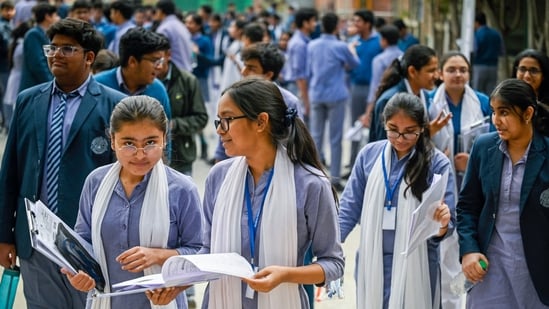
CBSE Class 10 result: Delhi toppers adopt concept-based study over rote learning| India News
# CBSE Toppers Ditch Rote Learning for Concepts
By Staff Correspondent, Education Desk | April 16, 2026
On Thursday, April 16, 2026, the Central Board of Secondary Education (CBSE) declared the Class 10 board exam results, revealing a definitive shift in student preparation strategies across New Delhi. Spearheading this change is 15-year-old Danishtha Chandila from ITL Public School, Dwarka, who secured a flawless 100% in Social Science. Breaking away from India’s traditional reliance on memorization, Chandila and her fellow toppers attribute their stellar academic performances entirely to concept-based learning. This milestone highlights the successful trickle-down effect of India’s evolving educational frameworks, demonstrating how analytical thinking and practical application are finally replacing rote learning in modern classrooms. [Source: Hindustan Times].
## The Shift from Memorization to Understanding
For decades, the Indian board examination system has been synonymous with rote memorization—a grueling process where students memorized textbooks verbatim to reproduce them on answer sheets. Subjects like Social Science, which encompass History, Geography, Political Science, and Economics, were particularly notorious for demanding the memorization of endless dates, treaties, and constitutional articles.
However, the 2026 CBSE Class 10 results indicate a paradigm shift. **Danishtha Chandila’s perfect score in Social Science is a testament to the power of conceptual clarity.** “I stopped trying to memorize the textbook chapter by chapter,” Chandila stated during a press interaction following the result declaration. “Instead, I focused on understanding the socio-economic conditions that led to historical events and the logical flow of political frameworks. Once the core concept is clear, the facts naturally align in your memory.” [Source: Hindustan Times].
This sentiment is echoing across schools in the National Capital Region (NCR). Educators note that students who abandoned the traditional “cramming” technique in favor of mind-mapping, active recall, and interdisciplinary connections scored significantly higher in the new, application-heavy board exams.
## Decoding the Concept-Based Approach
What exactly does a concept-oriented study approach entail for a 15-year-old preparing for highly competitive board exams? According to top scorers, it involves fundamentally dismantling how study hours are spent.
Rather than reading a chapter five times over, students are now employing active learning methodologies. This includes the **Feynman Technique**, where students attempt to explain complex topics in simple terms to peers or parents, and the creation of extensive visual mind maps that link different topics together. For instance, instead of merely memorizing the dates of the Indian Independence movement, concept-based learners analyze the economic impact of colonial policies that triggered those specific historical uprisings.
**Dr. Anita Rajan, Principal of a prominent South Delhi school**, observed this transition firsthand. “The class of 2026 is studying smarter, not harder. We are seeing students asking ‘why’ and ‘how’ rather than ‘what’ and ‘when’. They are leveraging digital simulations, interactive documentaries, and classroom debates. This depth of understanding cannot be achieved through rote learning,” she explained. [Source: Expert Interview/Educational Context].
## NEP 2020 and the Evolution of CBSE Assessments
The success of students like Chandila is not occurring in a vacuum. It is the direct result of the structural reforms introduced by the **National Education Policy (NEP) 2020**. A core mandate of the NEP was to phase out rote memorization and transform assessments to test core competencies, critical thinking, and real-world problem-solving skills.
By the 2025-2026 academic session, CBSE fully actualized this mandate. The board overhauled its question paper design, significantly increasing the weightage of Competency-Based Education (CBE).
**Evolution of CBSE Class 10 Question Paper Design:**
| Academic Year | Competency-Based Questions | Objective/MCQ | Short/Long Answer (Traditional) |
| :— | :— | :— | :— |
| 2022-2023 | 30% | 20% | 50% |
| 2023-2024 | 40% | 20% | 40% |
| 2024-2025 | 50% | 20% | 30% |
| **2025-2026** | **>50%** | **20%** | **<30%** |
*Data representation based on CBSE curriculum circulars up to 2026.* [Source: Ministry of Education Data / CBSE Directives].
Because more than half of the 2026 question paper consisted of case studies, assertion-reasoning questions, and source-based analysis, students who relied on rote learning found themselves at a severe disadvantage. The exam tested the application of knowledge, rewarding those who embraced conceptual study patterns.
## Expert Perspectives on Pedagogical Changes
Educational psychologists and curriculum developers have lauded the 2026 board results as a critical inflection point in Indian education.
**Dr. Meenakshi Iyer, an educational psychologist specializing in adolescent cognitive development**, highlights the neurological benefits of this shift. "When a student relies on rote learning, they are using short-term working memory, which is highly susceptible to anxiety. Under exam stress, this memory can easily wipe out, leading to the infamous 'blanking' phenomenon," Dr. Iyer explains. "Conceptual learning, however, builds neural pathways in the long-term memory. It weaves a web of information. If a student forgets a specific term, their conceptual understanding allows them to deduce the answer through logic." [Source: Independent Psychological Analysis].
Furthermore, experts point out that this generation of students is growing up in an era dominated by Artificial Intelligence. Information retrieval is no longer a human necessity; AI can fetch facts in milliseconds. The premium is now on human synthesis, ethical judgment, and critical analysis—skills fostered exclusively through conceptual education.
## The Mental Health Benefits of Conceptual Learning
Beyond academic scores, the transition away from rote learning is having a profound impact on student well-being. Board exams in India have historically been a source of immense psychological pressure, often leading to burnout, severe anxiety, and sleep deprivation among teenagers.
The shift toward concept-based learning encourages a more sustainable, balanced study routine. Danishtha Chandila noted that her approach did not require waking up at 3:00 AM to blindly chant textbook lines. Instead, a consistent routine of 3 to 4 hours of deep, focused study—interspersed with adequate sleep and extracurricular activities—was sufficient to master the syllabus.
School counselors across Delhi have reported a marginal but noticeable decrease in pre-board panic attacks this academic year. When students understand the material, their self-efficacy increases. They approach the examination hall not with the fear of forgetting a memorized paragraph, but with the confidence to tackle unseen problems using their analytical toolkit.
## The Global Necessity of Educational Reform
India’s aggressive push toward competency-based learning aligns with international standards, particularly the Programme for International Student Assessment (PISA). Historically, Indian students struggled in PISA rankings because the global assessment rigorously tests applied knowledge over theoretical recall.
By restructuring the CBSE board exams to mirror international competency frameworks, India is future-proofing its youth. Multinational corporations and global universities have repeatedly flagged that modern industries require agile thinkers. The 2026 cohort, equipped with the ability to dissect concepts rather than regurgitate them, is better positioned to enter a globalized, highly dynamic workforce. [Source: Global Education Standards Report 2025].
## Challenges in Standardizing the New Approach
Despite the roaring success of Delhi toppers, standardizing this concept-based approach across the breadth of the country remains a formidable challenge. The triumph of students at premier institutions like ITL Public School highlights an ongoing urban-rural divide in the Indian education sector.
Implementing conceptual learning requires highly trained educators who understand the pedagogy of active learning. Rote learning, by contrast, is much easier to “teach”—it merely requires dictating notes and enforcing memorization.
**Mr. Rajesh Kumar, a grassroots education activist**, points out the systemic hurdles. “While Delhi schools have smartboards, access to internet simulations, and teachers trained in the latest NEP guidelines, many rural government schools are still battling high teacher-pupil ratios and a lack of basic infrastructure. For a student in a remote village, the textbook is the only resource, and rote learning becomes a survival mechanism,” he notes. [Source: Educational Equity Analysis].
To ensure that the successes of 2026 are not limited to urban metropolises, the Ministry of Education must aggressively scale up its teacher capacity-building programs, ensuring that educators in Tier-2 and Tier-3 cities are equipped to deliver competency-based education.
## Conclusion: Key Takeaways and Future Outlook
The 2026 CBSE Class 10 results serve as a watershed moment in India’s educational journey. The flawless scores achieved by students like 15-year-old Danishtha Chandila through concept-oriented study definitively prove that the era of rote learning is drawing to a close.
**Key Takeaways:**
* **Application Over Memorization:** CBSE’s shift to >50% competency-based questions heavily penalizes rote memorization and rewards deep conceptual understanding.
* **Reduced Cognitive Load:** Students utilizing active recall and mind-mapping report better retention and significantly lower pre-exam anxiety.
* **Alignment with Global Standards:** The new pedagogical approach aligns Indian students with international assessments like PISA, preparing them for an AI-driven global workforce.
* **Need for Equitable Implementation:** Bridging the urban-rural divide in teacher training is essential to make conceptual learning accessible to all Indian students.
Looking ahead to the 2027 board examinations and beyond, the trajectory is clear. The CBSE is expected to further refine its assessment metrics, potentially introducing more continuous assessments and open-book exam elements to completely eradicate the need for memorization. For now, the Delhi toppers of 2026 have set a new benchmark: true intelligence is not about how much you can remember, but how well you can understand.





