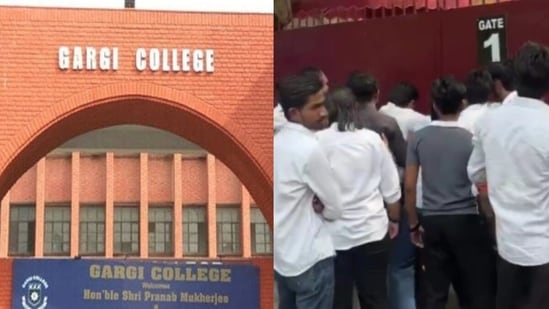
DUSU chief Aryan Maan, ABVP workers forcibly storm DU's Gargi College; AAP questions ‘sanskaar’| India News
# DUSU Chief Storms Gargi College; AAP Slams Act
**By Delhi Desk, India Education Post, April 19, 2026**
On April 19, 2026, Delhi University Students’ Union (DUSU) President Aryan Maan and several Akhil Bharatiya Vidyarthi Parishad (ABVP) workers forcibly entered the premises of Gargi College, a prominent women’s institution in New Delhi. The group breached security protocols after being initially denied entry by college guards under strict regulations that mandate prior verification for male visitors. The unauthorized intrusion has triggered significant political backlash, with the Aam Aadmi Party (AAP) fiercely condemning the incident and questioning the “sanskaar” (cultural values) of the right-wing student outfit, reigniting urgent debates over campus security and women’s safety at Delhi University.
## The Incident: A Breach of Protocol at Gargi College
The confrontation occurred on Sunday morning when DUSU Chief Aryan Maan, accompanied by a sizeable entourage of ABVP supporters, arrived at the gates of Gargi College in South Delhi. According to initial reports and eyewitness accounts, the group intended to hold an impromptu meeting with the student body regarding upcoming university-wide academic policies.
However, Gargi College enforces stringent access control measures. As a premier women’s college under Delhi University, its institutional policy dictates that male visitors are strictly prohibited from entering the campus without prior administrative clearance, verifiable academic purpose, or an official invitation for specific occasions such as authorized cultural festivals.
When private security guards and college staff halted the delegation at the main gate, citing the rulebook, a heated verbal altercation ensued. Tensions rapidly escalated, culminating in the political workers physically overpowering the security barricades and storming onto the campus grounds. Students present during the weekend hours reported a chaotic scene, with political slogans echoing through the academic blocks, causing distress and panic among the hostel residents and students utilizing the library facilities.
[Source: Hindustan Times | Additional: Public records on Delhi University College Security Guidelines]
## Political Fallout: AAP Questions ABVP’s “Sanskaar”
The forceful entry immediately transcended campus politics, drawing sharp condemnation from major political parties. The Aam Aadmi Party (AAP), which has consistently challenged the BJP-affiliated ABVP’s dominance in Delhi’s educational institutions through its own student wing, the Chhatra Yuva Sangharsh Samiti (CYSS), was quick to denounce the act.
Senior AAP leaders launched a scathing attack on the ABVP, strategically utilizing the term “sanskaar”—a Hindi word translating to cultural upbringing or values. The choice of words was a deliberate political maneuver aimed at the ABVP’s ideological parent organizations, which frequently position themselves as the custodians of traditional Indian values and respect for women.
“Is this the ‘sanskaar’ they claim to protect? Forcing their way into a women’s college, intimidating security staff, and instilling fear among young female students is an absolute disgrace,” stated a senior AAP spokesperson during a press briefing late Sunday afternoon. “The systematic erosion of institutional autonomy and the blatant disregard for the safety of women by elected student representatives reveals a deeply rooted culture of impunity.”
The AAP has demanded immediate intervention from the Delhi University Vice-Chancellor’s office, calling for the suspension of the involved student leaders pending an independent inquiry. Furthermore, they urged the Delhi Police to register a First Information Report (FIR) regarding trespassing and public nuisance.
## ABVP’s Defense: The Mandate of Elected Representation
In response to the mounting criticism, the ABVP and the DUSU leadership have offered a starkly different narrative, defending their actions as part of their mandated duties as democratically elected student representatives.
According to a press release issued by the ABVP’s Delhi unit later that day, DUSU President Aryan Maan was visiting Gargi College to address legitimate grievances raised by students regarding administrative inefficiencies and infrastructure issues. The statement argued that as the apex student body of the university, DUSU officials possess an inherent right to access all constituent colleges to fulfill their representational duties.
“The DUSU President was fulfilling his electoral mandate by reaching out to the student community. The college administration deliberately utilized private guards to block a peaceful, routine visit, turning a standard administrative interaction into a manufactured controversy,” an ABVP representative claimed. “The AAP’s attempt to politicize a minor administrative friction and brand it as an assault on women’s safety is purely opportunistic. We stand by our commitment to student welfare across all campuses, regardless of gender.”
The ABVP further contended that the rules regarding male visitors are often arbitrarily enforced to prevent union leaders from organizing students within women-only campuses, thereby stifling their political rights and participation in the broader university democratic process.
[Source: Hindustan Times | Additional: General principles of student union jurisdictions in Central Universities]
## Historical Context: Trauma and Security in DU Women’s Colleges
To understand the gravity of the reaction to Sunday’s event, one must look at the historical context surrounding women’s colleges at Delhi University. Gargi College, in particular, carries the lingering trauma of a highly publicized security failure.
In February 2020, during the college’s annual cultural festival ‘Reverie’, thousands of unauthorized men breached the college gates, resulting in mass harassment, molestation, and vandalism. The 2020 incident sparked nationwide outrage, leading to widespread student protests, parliamentary debates, and a massive overhaul of security protocols across all women’s colleges in Delhi University, including Miranda House, Lady Shri Ram College (LSR), and Kamala Nehru College.
**Standardized Visitor Protocols at DU Women’s Colleges (Post-2020):**
* **Routine Days:** No unverified male entry. Male relatives must provide ID and await students at the reception.
* **Academic Events:** Pre-registered male participants only, cross-referenced with a physical guest list.
* **Cultural Festivals:** Strictly restricted. Passes are non-transferable, heavily monitored, and supported by rapid action police deployments.
* **Student Union Visits:** Require a minimum 24-hour prior written notice and formal approval from the Principal’s office.
Given this history, any forced entry into a women’s college—even by elected student officials—is viewed not merely as an administrative violation, but as a severe threat to the physical and psychological safety of the students.
“For the students of Gargi, the sight of men aggressively pushing past security guards is incredibly triggering,” notes Dr. Meenakshi Verma, a sociologist and independent campus security analyst. “While the DUSU leadership may view this as an assertion of their political rights, they are deeply disconnected from the lived realities of female students who rely on these institutional boundaries for their basic safety.”
## Legal and Administrative Implications
The confrontation places the Delhi University administration in a precarious position, caught between enforcing collegiate autonomy and managing a powerful, politically connected student union.
Legal experts point out that forced entry onto restricted college property can attract charges under various sections of the Bharatiya Nyaya Sanhita (BNS), including criminal trespass, unlawful assembly, and creating public disorder. However, the initiation of police action entirely depends on whether the Principal of Gargi College formally files a complaint with the local police station.
Historically, college administrations are hesitant to pursue criminal charges against sitting DUSU office bearers due to the potential for prolonged campus unrest, strikes, and disruption of the academic calendar. Instead, the matter is likely to be referred to the University Proctor’s office for internal disciplinary review.
The incident also highlights a significant constitutional grey area within the university’s governance framework: *Does the mandate of a university-wide elected union supersede the autonomous administrative rules of individual constituent colleges?*
## Conclusion: Balancing Representation and Safety
The forced entry by DUSU chief Aryan Maan and ABVP workers into Gargi College is more than a fleeting weekend dispute; it is a flashpoint that exposes the deep structural and political fissures within India’s premier educational institutions.
**Key Takeaways:**
* **Safety vs. Access:** The incident underscores the ongoing friction between the need for robust security in women’s spaces and the operational demands of university-wide student politics.
* **Political Ammunition:** The quick intervention by AAP utilizing the “sanskaar” narrative illustrates how campus incidents serve as proxy battlegrounds for larger state and national political rivalries.
* **Need for Clear Guidelines:** The clash highlights the urgent need for Delhi University to establish unambiguous, legally binding protocols that govern how elected DUSU representatives can interact with restricted constituent colleges without violating institutional autonomy or compromising student safety.
As the situation develops, the response of the Delhi University Vice-Chancellor and the Gargi College administration will set a critical precedent. Whether the incident results in strict disciplinary action or is absorbed into the turbulent routine of campus politics remains to be seen. However, for the students demanding a secure learning environment, the event is a stark reminder that the battle for safe campus spaces is far from over.