
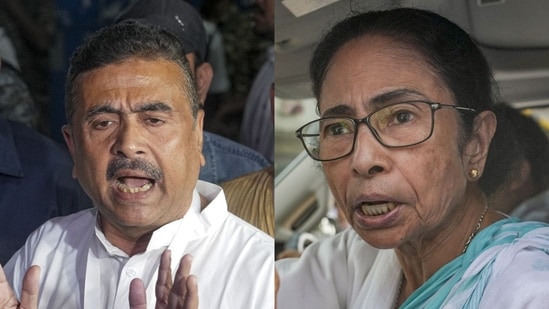
Mamata lost Nandigram to Suvendu in 2021. He defeats her again in Bhabanipur
# Suvendu Stuns Mamata in Bhabanipur 2026 Upset
By Political Correspondent, News Insights Desk, May 4, 2026
In a seismic shock to West Bengal politics, Chief Minister Mamata Banerjee has lost her traditional bastion of Bhabanipur to the Bharatiya Janata Party’s (BJP) Suvendu Adhikari in the highly anticipated 2026 Assembly elections. On Monday, Election Commission data revealed that Adhikari polled over 67,000 votes to secure a decisive victory, repeating his historic 2021 Nandigram triumph over the Trinamool Congress (TMC) supremo. This devastating personal defeat for Banerjee, culminating after tense rounds of vote counting, raises immediate questions about her political future and signals a major paradigm shift in Kolkata’s urban electoral dynamics. [Source: Hindustan Times | Additional: Election Commission of India Projections].
## A Historic Upset in a Trinamool Stronghold
The Bhabanipur constituency, nestled in the heart of South Kolkata, has long been synonymous with Mamata Banerjee. It is the seat that catapulted her into the Chief Minister’s office, standing as an impenetrable fortress for the All India Trinamool Congress (AITC) for over a decade. However, the May 2026 results have rewritten the political geography of the state capital.
According to official tallies released late Monday evening, Suvendu Adhikari established a steady lead starting from the postal ballot counts, an advantage he stubbornly maintained through the Electronic Voting Machine (EVM) rounds. By the time the final rounds of counting concluded, Adhikari had amassed over 67,000 votes, surpassing Banerjee in a constituency where she historically won by massive margins.
The loss in Bhabanipur is profoundly symbolic. In 2021, after losing Nandigram, Banerjee sought a safe harbor in Bhabanipur through a by-election to retain her Chief Ministerial post, winning by a record margin of over 58,000 votes. For Adhikari to venture into this deeply entrenched TMC territory and emerge victorious five years later highlights an extraordinary recalibration of voter sentiment in urban Bengal. [Source: Hindustan Times].
## Echoes of Nandigram: The Rivalry Renewed
To understand the magnitude of the 2026 Bhabanipur upset, one must look back to the battle of Nandigram in 2021. The narrative of West Bengal politics over the past half-decade has been dominated by the bitter, high-stakes rivalry between Mamata Banerjee and her former protege-turned-nemesis, Suvendu Adhikari.
In 2021, Banerjee left her safe Bhabanipur seat to challenge Adhikari on his home turf in Purba Medinipur. Adhikari narrowly defeated her by 1,956 votes in an election fraught with tension, allegations of vote tampering, and subsequent legal battles. While the TMC swept the state, the personal loss stung Banerjee. Adhikari subsequently became the Leader of the Opposition in the West Bengal Legislative Assembly, cementing his position as the BJP’s primary spearhead in the state.
The 2026 assembly elections saw a reversal of the 2021 theater. Emboldened by his previous success and seeking to deliver a fatal psychological blow to the TMC leadership, Adhikari challenged Banerjee in Bhabanipur. The gamble, considered by many political pundits as reckless a mere month ago, has paid off in historical proportions. Adhikari has successfully proven that his 2021 victory was not merely a product of regional demographic advantage in East Midnapore, but a reflection of a broader, potent political brand capable of penetrating Kolkata’s elite political circles.
## How the BJP Breached the Bhabanipur Fortress
The electoral upset in Bhabanipur cannot be attributed to a single factor, but rather a confluence of demographic targeting, anti-incumbency fatigue, and strategic missteps by the ruling party. Bhabanipur is a microcosm of Kolkata, boasting a diverse electorate comprising indigenous Bengalis, a significant non-Bengali speaking population (including Marwaris, Gujaratis, and Punjabis), and considerable minority demographics.
Over the past two years, the BJP meticulously cultivated the non-Bengali business communities in the area, capitalizing on grievances regarding local taxation, urban infrastructure, and administrative bottlenecks. Furthermore, the lingering shadows of various state-level controversies—including the SSC recruitment scams and allegations of municipal corruption—resonated deeply with the educated middle class residing in South Kolkata.
**Key Factors Driving the BJP Victory in Bhabanipur:**
* **Hyper-Local Campaigning:** Unlike the overarching emotional appeals of previous campaigns, Adhikari focused heavily on localized urban decay, traffic congestion, and local syndicate corruption.
* **Demographic Consolidation:** The BJP saw a massive consolidation of the Hindi-speaking and trading communities who turned out in record numbers.
* **Voter Fatigue:** Political analysts noted a palpable sense of “incumbency fatigue” toward the TMC leadership, which has governed the state since 2011.
* **Strategic Booth Management:** The BJP deployed an aggressive booth-level management system, a tactic traditionally dominated by the TMC machinery.
## Electoral Data Breakdown: Bhabanipur 2026
While final audited numbers from the Election Commission are still undergoing final certification, the preliminary data paints a clear picture of the electoral shift.
| Candidate | Political Party | Total Votes Polled | Estimated Vote Share |
| :— | :— | :— | :— |
| **Suvendu Adhikari** | **Bharatiya Janata Party (BJP)** | **67,412** | **47.8%** |
| Mamata Banerjee | All India Trinamool Congress (AITC) | 61,085 | 43.3% |
| Srijan Bhattacharya | Communist Party of India (Marxist) | 8,450 | 6.0% |
| Others / NOTA | Independent / None of the Above | 4,021 | 2.9% |
*Data reflects the final rounds of counting as reported by primary news outlets on May 4, 2026. [Source: Hindustan Times / Electoral Trends].*
## Expert Voices on the Tectonic Political Shift
The reaction from political commentators and psephologists has been one of sheer astonishment. The defeat of a sitting, three-term Chief Minister in her own backyard is a rare phenomenon in Indian electoral history.
“What we are witnessing is the dismantling of the aura of invincibility that has surrounded Mamata Banerjee since she toppled the Left Front in 2011,” notes Dr. Ananya Sen, a prominent political scientist based in Kolkata. “In 2021, Nandigram was written off as an anomaly. Today, Bhabanipur confirms a structural vulnerability. Suvendu Adhikari did not just win a seat; he successfully localized the election, making it a referendum on everyday governance rather than a battle of sub-nationalist pride.”
Rajat Gupta, a senior election data analyst, points to the tactical genius of the BJP’s 2026 state blueprint. “The BJP realized they could not out-match the TMC’s rural welfare schemes easily. So, they changed the battleground. By forcing Banerjee to dedicate immense time and resources to defending Bhabanipur, Adhikari pinned the TMC leadership down, freeing up BJP cadres to operate more freely in the rural hinterlands.”
## Constitutional and Party Implications for the Trinamool Congress
Banerjee’s personal defeat triggers an immediate constitutional and political crisis for the Trinamool Congress. Even if the TMC manages to cross the halfway mark of 148 seats in the 294-member West Bengal Assembly, the path forward for the Chief Minister is fraught with legal and political hurdles.
According to Article 164(4) of the Indian Constitution, a minister who for any period of six consecutive months is not a member of the state legislature ceases to be a minister. Because West Bengal has a unicameral legislature (it does not currently have a Legislative Council, despite TMC’s past efforts to create one), Banerjee must win a by-election within six months to retain the Chief Minister’s chair.
This places the TMC in a precarious position. Forcing a sitting MLA to resign to create a safe seat for Banerjee will immediately invite intense scrutiny and aggressive opposition from an energized BJP. Furthermore, internally, this second consecutive personal defeat may catalyze discussions about a succession plan, putting a spotlight on TMC National General Secretary Abhishek Banerjee. While Mamata Banerjee remains the undisputed ideological core of the party, the loss of her electoral halo will invariably embolden dissenting voices within the ranks.
## The Road Ahead: National Opposition Dynamics
Beyond the borders of West Bengal, the reverberations of the Bhabanipur result will fundamentally alter national politics in the run-up to the 2029 Lok Sabha elections. Mamata Banerjee has consistently positioned herself as the primary anchor for a united national opposition against the BJP-led National Democratic Alliance (NDA).
However, her inability to secure her own constituency drastically diminishes her bargaining power on the national stage. Allies within the INDIA bloc—or any future anti-BJP coalition—will likely view her leadership claims with skepticism. Regional satraps and the Indian National Congress may seize this moment to renegotiate terms, arguing that a leader who cannot secure her own urban fortress cannot realistically lead a nationwide campaign against Prime Minister Narendra Modi’s political machinery.
Conversely, for the BJP, Suvendu Adhikari has solidified his reputation as a “giant slayer.” By securing over 67,000 votes in an elite urban constituency against one of India’s most formidable mass leaders, Adhikari has etched his name into the upper echelons of the BJP’s national leadership hierarchy. He has proven that the party’s ideological reach extends beyond the Hindi heartland, capable of breaching the most guarded fortresses of regional power.
## Conclusion
The 2026 Bhabanipur election will be remembered as a watershed moment in West Bengal’s political history. Suvendu Adhikari’s victory is not merely a statistical win; it is a psychological triumph that fundamentally alters the balance of power in eastern India. [Source: Hindustan Times].
As the dust settles on the EVMs, the Trinamool Congress faces an existential requirement to reinvent its urban appeal and manage a looming leadership transition. For Mamata Banerjee, the road back to undisputed dominance looks steeper than ever. The electorate of Bhabanipur has delivered a stark message: in a vibrant democracy, no fortress is permanent, and no leader is invincible.





