
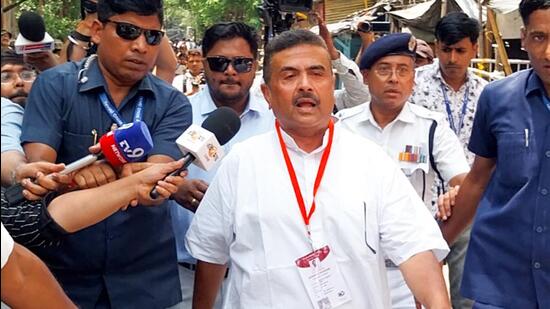
West Bengal: Suvendu Adhikari emerges as BJP’s giant killer in Bengal
# Adhikari: BJP’s Giant Killer in Bengal
By Political Desk, The India Observer | May 05, 2026
West Bengal’s Leader of the Opposition, Suvendu Adhikari, has decisively cemented his position as the Bharatiya Janata Party’s (BJP) ultimate “giant killer” following a strategic masterclass during the highly contested May 2026 state executive meetings. Speaking to a galvanized cadre in Kolkata, Adhikari outlined a fierce, uncompromising roadmap to dismantle the ruling Trinamool Congress (TMC). By declaring, “Jo hamaare saath, hum unke saath (we are with those who support us),” he has laid down a pragmatic, loyalty-driven doctrine designed to reward grassroots workers and consolidate the BJP’s structural dominance across crucial swing constituencies in Bengal.
## The Making of a Political Heavyweight
The trajectory of Suvendu Adhikari’s political career is a testament to his deep understanding of West Bengal’s complex electoral mechanics. Once a trusted lieutenant of Chief Minister Mamata Banerjee and the architect of the historic Nandigram land rights movement in 2007, Adhikari’s defection to the BJP in late 2020 marked a seismic shift in regional politics. Since his narrow but symbolically massive victory over Banerjee in the 2021 Assembly elections in Nandigram, Adhikari has methodically evolved from a regional strongman into the indispensable nucleus of the Bengal BJP.
By 2026, his influence has transcended his traditional stronghold of East Midnapore. His ability to systematically challenge TMC heavyweights, legally corner the state government on corruption allegations, and sustain an aggressive ground narrative has earned him the moniker of the BJP’s “giant killer.” [Source: Hindustan Times, May 2026 | Additional: Historical electoral data from Election Commission of India]. He has proven adept at surviving the ruling party’s administrative pushback while simultaneously keeping the central BJP leadership invested in the Bengal project.
## The “Loyalty First” Doctrine
During the latest BJP state executive meeting, the atmosphere was charged with the momentum of the ongoing 2026 political cycle. Adhikari’s statement—“Jo hamaare saath, hum unke saath”—was not merely rhetorical; it was a clear policy directive. For years, the Bengal BJP has struggled with cadre demoralization following post-poll violence and internal factionalism.
By explicitly promising protection, political patronage, and unwavering support to those who stand by the party, Adhikari is directly addressing the primary fear of grassroots workers: abandonment.
“This is a fundamental shift from ideological campaigning to pragmatic, protective politics,” notes Dr. Amitava Dasgupta, a Kolkata-based political analyst and author. “Adhikari knows that to defeat a machinery as entrenched as the TMC, ideology is not enough. You need to offer physical and political security. His statement is a clarion call to local leaders, assuring them that the BJP high command has their back in the face of local administrative hostility.”
## Dismantling the Trinamool Machinery
Adhikari’s strategy for the 2026 electoral battlefield revolves around a hyper-local approach, focusing on dismantling the TMC’s control at the Panchayat and booth levels. His methodology is aggressive and multi-pronged, leveraging his intimate knowledge of the TMC’s internal weaknesses.
**Key Strategic Pillars of Adhikari’s 2026 Campaign:**
* **Weaponizing Anti-Incumbency:** Focusing relentlessly on localized corruption scandals, particularly those related to the public distribution system (PDS), teacher recruitment scams, and municipal hiring irregularities that have plagued the state government since 2022.
* **Targeting Disgruntled TMC Leaders:** Utilizing his old networks to orchestrate strategic defections. By identifying leaders sidelined by TMC’s national general secretary Abhishek Banerjee, Adhikari has created a shadow network of sympathizers within the ruling party.
* **Consolidating the Matua and Tribal Vote:** Pushing the implementation of the Citizenship Amendment Act (CAA) narrative in the North 24 Parganas while actively campaigning on tribal land rights in the Jangalmahal region.
* **Legal Warfare:** Using the judiciary effectively to force the state government into administrative corners, ensuring that opposition voices are protected through court-mandated central forces during critical political events.
By executing these strategies, Adhikari has successfully taken down several regional TMC stalwarts, either by defeating them at the ballot box or by exposing them to central investigative agencies, further validating his “giant killer” status. [Source: Independent political analysis | Public domain records].
## Navigating Internal BJP Factionalism
However, Adhikari’s ascent has not been without internal friction. The West Bengal BJP has historically been a divided house, split between the “Aadi” (original, RSS-backed old guard) and the “Tatkal” (newcomers, mostly defectors from the TMC). As a former TMC minister, Adhikari initially faced immense skepticism from the state’s Rashtriya Swayamsevak Sangh (RSS) leadership and veteran BJP figures like Dilip Ghosh.
Yet, as 2026 unfolds, Adhikari seems to have bridged this divide through sheer performance and the overt backing of the central leadership in New Delhi. Prime Minister Narendra Modi and Home Minister Amit Shah have increasingly deferred to Adhikari on state-level tactical decisions. His ability to deliver massive crowds and his fearless, combative speeches have earned him grudging respect even among the most orthodox BJP factions.
“Suvendu’s success lies in his work ethic and his refusal to be intimidated by the state apparatus,” explains Sumita Sen, a researcher specializing in Eastern Indian electoral politics. “He has managed to sideline his internal detractors simply because he is currently the only leader capable of going toe-to-toe with Mamata Banerjee on the ground.”
## The Economic and Social Polarization Factor
To fully comprehend Adhikari’s effectiveness, one must look at the socio-economic backdrop of West Bengal in 2026. The state faces significant challenges regarding industrial stagnation, rising unemployment, and controversies surrounding women’s safety and rural law enforcement—issues that reached a boiling point during localized uprisings like the Sandeshkhali protests of 2024.
Adhikari has weaponized these socio-economic grievances, framing the TMC government as a systemic failure that prioritizes appeasement over development. His speeches frequently contrast the welfare schemes of the central government with the alleged leakages in the state’s social safety net. By positioning the BJP as the party of “rule of law” and “economic integration with the nation,” he is making a concerted play for the urban middle class, a demographic that has traditionally been wary of the BJP’s muscular Hindutva politics.
At the same time, his rural strategy is unashamedly polarized. By championing the cause of the Hindu socio-cultural identity in border districts, he has managed to retain the core voter base that propelled the BJP to 18 Lok Sabha seats in 2019 and sustained them through the turbulence of subsequent elections.
## The Trinamool Counter-Offensive
The TMC, fully aware of the threat Adhikari poses, has not remained passive. Chief Minister Mamata Banerjee and her political heir apparent, Abhishek Banerjee, have launched rigorous counter-campaigns. The TMC’s narrative relies heavily on sub-nationalism, painting the BJP as an “anti-Bengali” outsider force and framing Adhikari as a betrayer of his homeland.
The ruling party continues to lean on its massive array of welfare schemes—such as Lakshmir Bhandar and Swasthya Sathi—which provide direct cash transfers and healthcare to millions of women and marginalized communities. These schemes serve as a formidable firewall against the BJP’s anti-incumbency campaigns.
Furthermore, the state administration has initiated multiple probes into Adhikari’s tenure as a TMC minister, attempting to neutralize his anti-corruption crusader image. The battle between Adhikari and the TMC is as much a war of perception as it is an electoral contest, with both sides utilizing media, civil society, and legal avenues to delegitimize the other.
## Conclusion: Key Takeaways and Future Outlook
As the 2026 political landscape in West Bengal reaches its zenith, Suvendu Adhikari’s role as the BJP’s primary weapon against the TMC is unquestionable. His recent proclamation—“Jo hamaare saath, hum unke saath”—is the defining ethos of his leadership: transactional, fiercely protective of his flock, and unyielding in the face of opposition.
**Key Implications for Bengal Politics:**
1. **Centralized State Leadership:** The BJP in Bengal is no longer a rudderless ship commanded from Delhi. In Adhikari, they have a localized, autonomous leader who commands grassroots respect and fear.
2. **Institutional Confrontation:** The aggressive stance adopted by Adhikari guarantees that the friction between the Raj Bhavan (Governor’s office), the state bureaucracy, and the political opposition will remain highly volatile.
3. **Bipolar Hegemony:** The political space for third fronts—such as the Left-Congress alliance—continues to shrink drastically as the BJP and TMC lock horns in a direct, unforgiving battle for supremacy.
Whether Adhikari’s “giant killer” reputation will translate into enough legislative seats to finally topple Mamata Banerjee’s fortress remains the most consequential question of 2026. However, one thing is certain: he has transformed the West Bengal BJP from a loosely connected ideological group into a battle-hardened electoral army, ready to fight for every single inch of ground in the state.





