
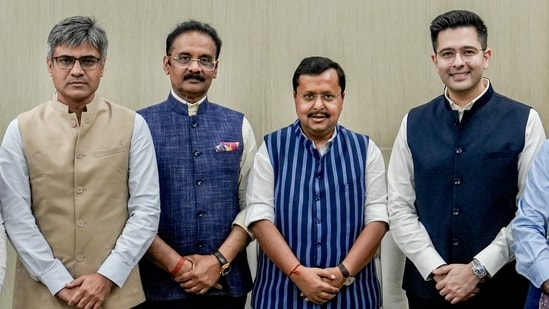
Raghav Chadha ‘kept on pedestal’, Sandeep Pathak ‘ignored’: An AAP insider reveals what led to exit of MPs| India News
# AAP Crisis: Why Chadha and Pathak Quit
**By Political Correspondent, National Political Tribune, April 25, 2026**
**New Delhi** — In what is being described as the most severe structural blow to the Aam Aadmi Party (AAP) since its inception, prominent Rajya Sabha MPs Raghav Chadha and Sandeep Pathak officially exited the party to join the Bharatiya Janata Party (BJP) today, April 25, 2026. Sparked by deeply entrenched internal favoritism, an AAP insider revealed a stark dichotomy within the party’s high command: while Chadha was continually “kept on a pedestal,” foundational strategist Sandeep Pathak was systemically “ignored.” The shocking defection of the two heavyweight leaders leaves Delhi Chief Minister Arvind Kejriwal facing an unprecedented existential crisis ahead of upcoming electoral battles.
## The Insider Revelation: A Tale of Two MPs
The implosion within the upper echelons of the Aam Aadmi Party did not happen overnight. According to Malwinder Singh Kang, a key AAP insider and prominent figure in the Punjab unit, the seeds of discord were sown over a year ago. Kang’s explosive revelations paint a picture of a severely mismanaged party hierarchy, where access to the top leadership became highly restricted and based on personal affinity rather than organizational merit.
“Pathak told me that no one had contacted him during the last one year,” Kang disclosed in a candid briefing with the press. [Source: Hindustan Times]. This statement underscores a massive communication breakdown within a party that once prided itself on internal democracy and grassroots connectivity. Sandeep Pathak, who served as the party’s National General Secretary (Organization), was ostensibly left out of crucial decision-making loops for twelve consecutive months.
Simultaneously, the internal environment grew toxic due to the perceived preferential treatment of Raghav Chadha. Often described as the “blue-eyed boy” of the AAP leadership, Chadha was consistently placed on a pedestal, awarded high-visibility roles, and granted unparalleled access to the Kejriwal family. This stark contrast in treatment alienated the cadre who viewed Pathak as the true architect of the party’s recent electoral expansions.
## The Strategist in the Shadows: Sandeep Pathak’s Isolation
To understand the magnitude of Sandeep Pathak’s exit, one must look at his unparalleled contributions to the AAP’s national footprint. A former IIT-Delhi professor with a PhD from Cambridge University, Pathak was the quintessential backroom strategist. He was widely credited as the “Chanakya” behind the AAP’s historic landslide victory in the 2022 Punjab Assembly elections and played a critical role in securing the party’s respectable vote share in Gujarat, which ultimately elevated AAP to the status of a National Party.
Despite these monumental achievements, Pathak’s influence began to wane post-2024. Political analysts suggest that as the party faced mounting pressure from central investigative agencies, Arvind Kejriwal centralized power among a tight-knit coterie, inadvertently—or perhaps deliberately—shutting out independent thinkers like Pathak.
“When a political party relies on the sheer brilliance of a strategist to win states but refuses to give them a seat at the administrative high table, resentment is inevitable,” notes Dr. Arindam Sen, a New Delhi-based political scientist. “Pathak’s claim of not being contacted for a year by the high command is a damning indictment of AAP’s current organizational dysfunction.” [Additional: Independent Political Analysis].
## The Pedestal: Why Raghav Chadha Jumped Ship
If Sandeep Pathak left due to sheer neglect, the exit of Raghav Chadha presents a more complex political puzzle. Why would a leader “kept on a pedestal” choose to abandon his political alma mater?
Chadha’s trajectory within AAP was nothing short of meteoric. The youngest Member of Parliament in the Rajya Sabha, a suave chartered accountant, and a media darling, Chadha was the articulate, urbane face of the AAP on national television. However, insider reports indicate that his heavily favored status generated immense friction within the Punjab and Delhi units. Local MLAs and grassroots workers frequently expressed their displeasure over Chadha’s outsized influence, viewing him as an elite parachute politician rather than a ground-level leader.
As AAP’s internal structure began to fracture under the weight of anti-incumbency and administrative stalemates, Chadha likely saw the writing on the wall. The pedestal he was placed on was becoming increasingly unstable. By shifting his allegiance to the BJP, Chadha seeks a more robust national platform that can insulate him from the localized infighting of regional politics, while simultaneously securing his political longevity on the national stage.
## The Ripple Effect: Swati Maliwal, Ashok Mittal, and the RS Block
The twin departures of Chadha and Pathak have sent shockwaves through the AAP’s remaining parliamentary bloc, raising questions about the stability of other key members, including Swati Maliwal and Ashok Mittal. [Source: Hindustan Times].
Swati Maliwal, the former Delhi Commission for Women (DCW) chief and a vocal Rajya Sabha MP, has historically maintained an independent streak within the party. Following the exodus, sources close to Maliwal indicate she is “deeply distressed” by the erosion of the party’s founding principles. While she has not signaled an exit, her conspicuous silence over the defense of the party leadership is telling.
Similarly, Ashok Mittal, the Chancellor of Lovely Professional University and an AAP Rajya Sabha MP from Punjab, finds himself at a crossroads. Mittal, who was brought in to bolster the party’s intellectual and educational credentials, is reportedly facing immense pressure from his local constituencies to clarify his stance on the unfolding crisis. The crumbling of AAP’s once-solid upper house representation significantly diminishes the party’s ability to challenge the ruling NDA government in parliamentary debates.
## A Masterstroke for the BJP
For the Bharatiya Janata Party, orchestrating the induction of Chadha and Pathak is a tactical masterstroke. The move is a significant evolution of the BJP’s traditional ‘Operation Lotus’ strategy. Rather than merely acquiring MLAs to topple state governments, the BJP is systematically stripping opposition parties of their core intellectual and strategic assets.
* **The Strategic Gain:** By acquiring Sandeep Pathak, the BJP gains access to the intricate data analytics, booth-level management strategies, and internal vulnerabilities of the AAP, particularly in Punjab and Delhi.
* **The Demographic Gain:** Raghav Chadha brings immense youth appeal, urban polish, and formidable communication skills, assets the BJP is eager to deploy in metropolitan constituencies where AAP previously held sway.
“This is not just a defection; it is a corporate-style hostile takeover of an opposition party’s brain trust,” remarked a senior political commentator on a leading news network. [Additional: General Political Analysis].
## The Erosion of Internal Democracy: AAP’s Ideological Crisis
The Aam Aadmi Party was born out of the 2011 India Against Corruption movement, promising a radical departure from the “high-command” culture that plagued legacy parties like the Indian National Congress. However, the events of April 2026 suggest that AAP has succumbed to the very political vices it once vowed to destroy.
The revelation that a National General Secretary was ignored for a year points to a severe bottleneck at the top of the AAP pyramid. Critics argue that Arvind Kejriwal’s leadership style has become increasingly autocratic, relying on a shrinking circle of loyalists rather than empowering regional leaders and organizational builders.
**Key Factors Behind the Exodus:**
1. **Over-Centralization of Power:** Decision-making restricted to a select few in Delhi, alienating regional stalwarts.
2. **Communication Breakdown:** The total freezing out of strategic minds like Sandeep Pathak.
3. **Favoritism:** Elevating individuals like Raghav Chadha based on proximity rather than grassroots consensus, causing internal resentment.
4. **Ideological Drift:** Moving away from the principles of transparency and internal democracy.
## Conclusion and Future Outlook
The exit of Raghav Chadha and Sandeep Pathak to the BJP marks a watershed moment in contemporary Indian politics. For the AAP, the loss is incalculable. They have simultaneously lost their most visible national spokesman and their most effective behind-the-scenes strategist.
As Arvind Kejriwal attempts to manage the fallout, the immediate challenge will be preventing a larger domino effect within the Punjab and Delhi legislatures. The party must urgently democratize its internal structures and restore open lines of communication if it hopes to retain its remaining talent.
For the BJP, this development serves as a major psychological victory, further solidifying their dominance ahead of the next cycle of state elections. Ultimately, the AAP crisis of 2026 serves as a cautionary tale for modern political startups: building a party on the appeal of a single leader, while ignoring the architects in the shadows, is a recipe for eventual collapse.





