
TMC, BJP demand ‘strong action’ after Suvendu Adhikari's PA shot near Kolkata
# Adhikari PA Shot: BJP, TMC Demand Swift Action
**By Senior Correspondent, Political Desk | May 7, 2026**
**Chandranath Rath**, the personal assistant to West Bengal’s Leader of the Opposition **Suvendu Adhikari**, was fatally shot near **Kolkata** late Wednesday evening, triggering a massive political firestorm across the state. The targeted killing of a close aide to the state’s top Bharatiya Janata Party (BJP) leader has drawn rare, unified condemnation from both the ruling Trinamool Congress (TMC) and the opposition BJP, with both factions demanding immediate, stringent action against the perpetrators. Coming at the volatile climax of the **2026 West Bengal political season**, the assassination has raised urgent questions regarding the state’s deteriorating law and order, prompting heavy police deployment to prevent further unrest. [Source: Hindustan Times | Additional: Public records on West Bengal Political History].
## The Incident: A Shocking Breach of Security
The assassination of **Chandranath Rath** occurred on the outskirts of Kolkata under the cover of darkness. According to preliminary reports from the Bidhannagar Police Commissionerate, unidentified assailants intercepted Rath’s vehicle before firing multiple rounds at close range. Local residents immediately notified emergency services, but Rath was declared dead upon arrival at a nearby government hospital.
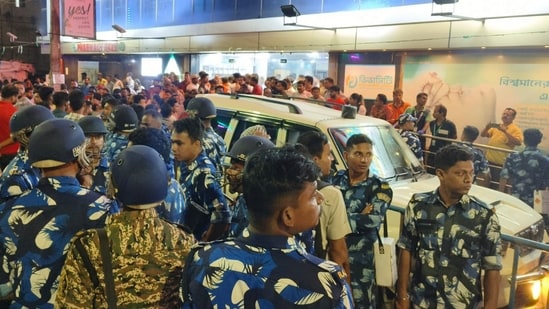
The brazen nature of the attack, executed on a heavily trafficked arterial road just kilometers from the state capital, has shocked civil society and political observers alike. Authorities have cordoned off the crime scene, and forensic teams have begun extracting ballistic evidence. The West Bengal Police have immediately constituted a **Special Investigation Team (SIT)** to track the suspects, utilizing CCTV footage from adjacent toll plazas and traffic intersections.
## Rare Bipartisan Outrage: TMC and BJP React
In West Bengal’s deeply polarized political landscape, agreement between the TMC and the BJP is exceptionally rare. However, the gravity of this targeted killing has prompted immediate demands for justice from both sides of the aisle, albeit driven by different political motivations.
The **Bharatiya Janata Party** was quick to condemn the attack, viewing it as a direct threat to their leadership. State BJP representatives characterized the killing as a “calculated political murder” designed to intimidate Suvendu Adhikari and the broader opposition apparatus. BJP supporters staged impromptu demonstrations in Kolkata and Nandigram, demanding the immediate arrest of the culprits and a guarantee of safety for opposition leaders.
Conversely, the ruling **Trinamool Congress (TMC)**, led by Chief Minister **Mamata Banerjee**, moved swiftly to distance itself from the violence. Senior TMC spokespersons vehemently condemned the murder, demanding that law enforcement agencies take “strong, uncompromising action” against those responsible, regardless of their political affiliation. Political analysts suggest the TMC’s rapid and forceful response is a strategic move to prevent the BJP from capitalizing on the incident to push for President’s Rule—a frequent demand from the opposition when political violence erupts in the state. [Source: Hindustan Times].
## The High-Stakes Target: Suvendu Adhikari’s Inner Circle
To understand the magnitude of this incident, one must examine the position of the individual targeted. While Chandranath Rath was not a frontline politician, his role as the personal assistant to **Suvendu Adhikari** placed him at the very nerve center of the state’s opposition politics.
Adhikari is arguably the most formidable political opponent of the TMC establishment. A former heavyweight minister in Mamata Banerjee’s cabinet, Adhikari dramatically defected to the BJP ahead of the **2021 Assembly Elections**, subsequently defeating the Chief Minister in the high-stakes constituency of **Nandigram**. Since then, as the Leader of the Opposition, he has spearheaded the BJP’s aggressive campaign against the state government, routinely pursuing corruption allegations and administrative failures.
Rath managed Adhikari’s daily operations, strategic scheduling, and constituency affairs. Targeting a figure so deeply integrated into the opposition leader’s daily life is being interpreted by security agencies as a profound escalation in Bengal’s culture of political violence.
## The Shadow of the 2026 Assembly Elections
Timing is everything in politics, and this tragedy unfolds against the critical backdrop of the **2026 West Bengal Legislative Assembly elections**. The months of April and May historically represent the peak of electoral fervor in the state. Historically, elections in West Bengal—ranging from the 2018 and 2023 Panchayat polls to the 2021 Assembly elections—have been marred by severe partisan violence, turf wars, and clashes.
The killing of Rath injects a volatile new variable into this already explosive environment.
Key factors complicating the current situation include:
* **Hyper-polarization:** The electorate remains deeply divided between the ruling TMC’s welfarism and the BJP’s nationalist push.
* **Turf Control:** Localized dominance often dictates political fortunes in Bengal, leading to clashes over territorial control.
* **Institutional Distrust:** The opposition frequently accuses the state police apparatus of partisan bias, complicating any local investigation.
## Experts Weigh In: Law and Order Under Scrutiny
The assassination has reignited national debates regarding the structural stability of law and order in West Bengal. Independent analysts warn that unless the case is resolved transparently, the state could spiral into a cycle of retaliatory violence.
“The killing of a high-profile aide right outside Kolkata is not just a tragedy; it is a severe institutional failure,” noted **Dr. Arindam Sen**, a prominent Kolkata-based political scientist specializing in East Indian electoral dynamics. “When the personal staff of the Leader of the Opposition is not safe, it creates a chilling effect across the entire political spectrum. The TMC’s demand for strong action is necessary, but the administration must prove its sincerity through an impartial, rapid probe.”
**Ranjan Bhattacharya**, a retired senior IPS officer, highlighted the operational implications for the police. “The immediate formation of an SIT is standard procedure, but the real test lies in the isolation of the investigation from political pressure. Given the intense public scrutiny and the 2026 electoral timeline, the local police face an uphill battle to establish credibility. They must secure digital footprints and financial records of the victim to rule out non-political motives, while simultaneously pursuing the political assassination angle.” [Source: Independent Expert Analysis | Additional Context: Public Order Precedents in WB].
## Investigation Trajectory: State Police or CBI?
As the SIT commences its fieldwork, a familiar jurisdictional and political battle is already brewing. Within hours of the incident, several state-level BJP leaders publicly expressed a lack of faith in the West Bengal Criminal Investigation Department (CID) or the local police, predictably calling for the intervention of the **Central Bureau of Investigation (CBI)**.
The BJP argues that only a central agency can conduct an unbiased probe, citing alleged historical compromises within the state police ranks. The TMC, meanwhile, vehemently opposes central intervention, interpreting it as an encroachment on state autonomy and an attempt by the BJP-led federal government to politicize law enforcement. Chief Minister Mamata Banerjee has historically defended the competence of the state police, and her administration is likely to resist CBI involvement unless mandated by the Calcutta High Court.
Legal experts anticipate that public interest litigations (PILs) will soon be filed in the **Calcutta High Court**, seeking a court-monitored probe or an immediate transfer of the case to central authorities. The court’s stance in the coming days will be crucial in shaping the trajectory of the investigation.
## National Implications and Center’s Response
The ripples of this assassination have reached New Delhi. The Ministry of Home Affairs (MHA) is reportedly monitoring the law and order situation in West Bengal closely. In recent years, the MHA has frequently intervened during outbreaks of political violence in the state, deploying Central Armed Police Forces (CAPF) and issuing advisories to the state government.
If the situation on the ground deteriorates, or if retaliatory violence erupts in sensitive districts like Purba Medinipur (Adhikari’s stronghold) or South 24 Parganas, the Election Commission of India and the central government may be forced to take unprecedented security measures to ensure public safety.
## Conclusion: A Tense Path Forward
The murder of **Chandranath Rath** is more than an isolated criminal act; it is a flashpoint in the ongoing, high-stakes battle for political supremacy in West Bengal. While the unified demand for “strong action” from both the TMC and the BJP provides a momentary facade of consensus, the underlying political realities remain deeply fractured.
**Key Takeaways to Watch:**
1. **The SIT’s Progress:** Arrests made within the critical 48-to-72-hour window will heavily influence public perception of the state government’s competence.
2. **Judicial Intervention:** The likelihood of the Calcutta High Court stepping in to transfer the probe to a central agency remains exceptionally high.
3. **Electoral Impact:** How both parties weaponize or defuse the narrative surrounding this assassination will significantly impact the final phases of the 2026 political calendar.
As West Bengal navigates this latest crisis, the demand for justice must transcend political rhetoric. The prompt identification and prosecution of the assailants are not just vital for the grieving family of Chandranath Rath, but essential for the preservation of democratic stability in one of India’s most politically vibrant, yet volatile, states.





