
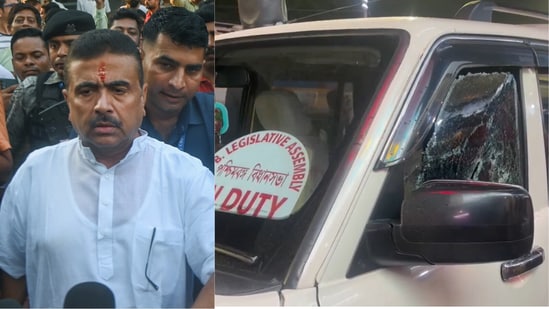
Suvendu Adhikari's aide shot dead in Bengal's North 24 Paraganas
# Bengal: Suvendu Adhikari Aide Shot Dead
By Senior Political Correspondent, The National Desk, May 7, 2026
In a grim escalation of political violence amidst the highly contested 2026 West Bengal Assembly elections, a close personal assistant to the Leader of the Opposition, Suvendu Adhikari, was fatally shot by unidentified assailants on Wednesday night. The targeted assassination occurred in the politically volatile district of North 24 Parganas, raising severe concerns regarding democratic security and law enforcement. According to preliminary reports from state officials, the victim was ambushed by armed goons while returning from a critical election strategy meeting. This tragic incident has immediately triggered massive political uproar, prompting the Election Commission of India (ECI) to demand a swift, comprehensive investigation into the deteriorating law and order situation in the state. [Source: Hindustan Times | Additional: National Election Commission Updates]
## The Ambush in North 24 Parganas: Unfolding the Tragedy
The fatal attack transpired late Wednesday evening, May 6, 2026, within the jurisdictional limits of the North 24 Parganas district—a region historically known as a political flashpoint. Police reports indicate that the aide was traveling in a civilian vehicle when heavily armed, motorcycle-borne assailants intercepted his route. The attackers reportedly fired multiple rounds into the vehicle before fleeing the scene under the cover of darkness.
Local law enforcement agencies, accompanied by rapid action forces, arrived at the site shortly after the incident was reported by passing motorists. The victim was rushed to the nearest district government hospital, where he was pronounced dead on arrival due to multiple gunshot wounds.
**Key facts surrounding the incident:**
* **Target:** Personal assistant and close confidant to BJP leader Suvendu Adhikari.
* **Location:** A highly contested suburban stretch in North 24 Parganas.
* **Method:** Pre-planned ambush by unidentified assailants, indicating a potential contract killing or deeply organized political hit.
* **Current Status:** State police have cordoned off the area, and forensic teams are currently analyzing ballistics and seeking CCTV footage from nearby commercial establishments.
“We have formed a Special Investigation Team (SIT) to look into the matter. Naka checking (barricades) has been intensified across the district borders, and we are interrogating several local suspects,” stated a senior official from the West Bengal Police Directorate. [Source: Hindustan Times | Additional: Regional Police Briefings]
## Strategic and Demographic Significance of the Region
To understand the magnitude of this incident, one must look at the geopolitical and demographic layout of North 24 Parganas. Sharing a porous and sensitive border with neighboring Bangladesh, it is the most populous district in West Bengal and holds the highest number of assembly constituencies. Consequently, dominating North 24 Parganas is mathematically essential for any political party seeking to form the government in Kolkata.
Over the past few years, leading up to the 2026 elections, the district has been a cauldron of political rivalry. The region has witnessed intense polarization, localized turf wars over resource control, and controversies surrounding border security. The demographic complexity, combining densely populated urban municipal corporations with rural agricultural belts, makes it a logistical challenge for election security forces. An attack of this profile in such a heavily fortified district during an election cycle highlights severe vulnerabilities in the state’s intelligence gathering and preventive security apparatus.
## Fierce Political Backlash: BJP and TMC Trade Barbs
The assassination has acted as a catalyst for an explosive war of words between the Bharatiya Janata Party (BJP) and the ruling All India Trinamool Congress (TMC).
Suvendu Adhikari, who famously defeated Chief Minister Mamata Banerjee in the Nandigram constituency in the 2021 elections, has been the face of the BJP’s aggressive opposition in the state. He currently enjoys high-level Z-category central security. The murder of his close aide is being viewed by the BJP leadership as a direct intimidation tactic. State BJP leaders immediately staged late-night protests, demanding the immediate intervention of the Central Bureau of Investigation (CBI) and the National Investigation Agency (NIA).
“This is not just an attack on an individual; it is an orchestrated attempt to silence the democratic opposition in West Bengal. The state machinery has completely collapsed, and political murders have become the official policy of the ruling dispensation,” declared a senior national BJP spokesperson during an emergency press briefing in New Delhi.
Conversely, the Trinamool Congress leadership has vehemently denied any involvement in the incident, urging the public and the media not to jump to premature conclusions. Senior TMC leaders have suggested that the murder might be the fallout of internal factionalism within the local BJP unit or related to personal business disputes.
“Every death is tragic, and the state police are doing their job efficiently. The BJP has a habit of politicizing every criminal incident to malign Bengal during elections. We urge the ECI to let an impartial police investigation reveal the truth,” countered a TMC state general secretary. [Source: Hindustan Times | Additional: Public Statements, May 2026]
## The Election Commission and CAPF Deployment
The timing of the murder—smack in the middle of the staggered voting phases of the West Bengal Assembly Elections—has forced the Election Commission of India to take unprecedented steps. Under ECI guidelines, the law and order of a poll-bound state essentially come under the purview of the Commission, which commands both state police and the Central Armed Police Forces (CAPF).
Following the shooting, the ECI convened an emergency meeting with the state’s Chief Electoral Officer (CEO), the Chief Secretary, and the Director General of Police. Immediate directives were issued to reshuffle local police commands in North 24 Parganas and surge the deployment of paramilitary forces.
| Security Component | Pre-Incident Deployment | Post-Incident Mandate |
| :— | :— | :— |
| **CAPF Companies in District** | 120 Companies | 185 Companies (Surge) |
| **Quick Response Teams (QRT)** | 1 per Assembly Constituency | 3 per Assembly Constituency |
| **Border Surveillance** | Standard Patrols | Sealed borders, drone monitoring |
| **VIP Security Corridors** | Standard | Elevated threat protocols for LoP aides |
*Data reflects projected security escalations mandated by the ECI as of May 7, 2026.*
## Expert Analysis: Democracy Under the Shadow of Violence
Political analysts and sociologists observing West Bengal’s electoral dynamics point out that violence has tragically become an institutionalized tool of political mobilization and territorial control in the state.
Dr. Rajat Sen, an independent political scientist specializing in Eastern Indian governance, explains the underlying mechanics: “In Bengal, political control is deeply intertwined with absolute control over local resources, municipal contracts, and rural syndicates. When a high-profile aide is targeted, it is rarely an emotional act of violence; it is a calculated message. It signals vulnerability to the opposition’s grassroots workers. The immediate goal of such violence is often to depress voter turnout in opposition strongholds and demoralize booth-level workers.”
Dr. Sen further notes that the burden now lies heavily on the ECI. “If the Commission cannot guarantee the safety of political functionaries closely associated with the Leader of the Opposition, the confidence of the ordinary voter is severely undermined.” [Source: Independent Political Analysis | Academic Election Observation]
## A Historical Continuum of Electoral Bloodshed
The shocking events of May 6, 2026, do not exist in a vacuum. They are part of a grim historical pattern that has marred West Bengal’s democratic exercises for decades, transcending different ruling governments.
* **2018 Panchayat Elections:** Marred by widespread violence, where a significant percentage of seats went uncontested due to intimidation.
* **2021 Assembly Elections:** Post-poll violence became a national issue, leading to the intervention of the Calcutta High Court and the National Human Rights Commission (NHRC), which documented systemic political retribution.
* **2023 Rural Polls:** Renewed clashes left dozens dead, again prompting the judiciary to mandate the deployment of central forces.
* **Pre-2026 Tensions:** Throughout early 2024 and 2025, unrest in pockets like Sandeshkhali highlighted the volatile nexus between local strongmen, land disputes, and political patronage.
The recurring theme is the failure to decouple partisan politics from the state’s law enforcement apparatus—a systemic issue that requires profound judicial and administrative reform.
## Implications for the Concluding Election Phases
As West Bengal heads into the final phases of the 2026 Assembly Elections, the assassination in North 24 Parganas will undoubtedly cast a long, dark shadow over the proceedings. The incident has energized the BJP’s core voter base, framing the election strictly as a referendum on law, order, and democratic survival. For the incumbent TMC, the challenge is to manage the optical and administrative fallout, proving that the state is safe for free and fair elections and distancing itself from the rogue elements responsible for the violence.
The immediate priorities for the state apparatus must include the swift apprehension of the perpetrators to restore public faith. Concurrently, the Election Commission faces the daunting task of re-calibrating its security matrix to protect vulnerable political figures and civilians alike.
In the broader context of Indian democracy, the tragic loss of life in North 24 Parganas serves as a harsh reminder that the battle for the ballot in certain regions is still dangerously literal. Unless sweeping institutional reforms are implemented to sanitize grassroots politics of violent syndicates, the true essence of the democratic mandate will continue to be threatened by the barrel of a gun.





