Tamil Nadu: Rajnath Singh slams DMK over women’s bill defeat| India News
# Rajnath Slams DMK Over Women’s Bill
**By Staff Reporter, The India Observer, April 20, 2026**
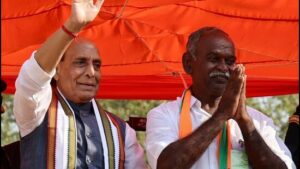
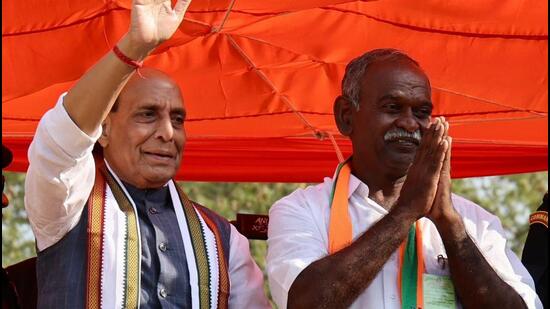
On Sunday, April 19, 2026, Union Defence Minister Rajnath Singh launched a blistering attack on the ruling Dravida Munnetra Kazhagam (DMK) during a massive political rally in Madurai, Tamil Nadu. Singh accused the state government of actively obstructing the political empowerment of women following legislative hurdles surrounding the Women’s Reservation Bill. Aiming to galvanize both female voters and conservative demographics ahead of the upcoming state assembly elections, Singh also made a major cultural pledge. He announced that if the Bharatiya Janata Party (BJP) secures power, it will immediately restore the sacred tradition of lighting the Karthigai Deepam atop the historic Thiruparankundram hill, a practice that had been suspended due to administrative disputes. [Source: Hindustan Times]
## The Battle for Tamil Nadu’s Electorate
As Tamil Nadu prepares for the highly anticipated 2026 Legislative Assembly elections, the political climate has reached a boiling point. The BJP has been aggressively working to expand its footprint in the southern state, aiming to dismantle the decades-old bi-polar dominance of the DMK and the All India Anna Dravida Munnetra Kazhagam (AIADMK). Rajnath Singh’s strategic visit to Madurai—a cultural and political nerve center in southern Tamil Nadu—highlights the BJP’s meticulously crafted dual-engine campaign strategy.
The strategy is clear: advocate for progressive national governance and equitable development while simultaneously positioning the party as the sole uncompromising guardian of Hindu cultural practices. Tamil Nadu’s electorate is notoriously complex, driven by deep-seated Dravidian ideologies, linguistic pride, and caste dynamics. However, the BJP leadership believes that by addressing grassroots governance issues—specifically women’s rights—while tapping into latent religious sentiments, they can forge a new, formidable voting bloc.
**Key facts regarding the demographic target:**
* Women voters currently outnumber men in Tamil Nadu, making them the ultimate deciders in tightly contested constituencies.
* Madurai and the broader southern districts have a higher concentration of conservative, religiously active voters compared to the northern industrial belts.
* The BJP is attempting to bypass traditional Dravidian narratives by focusing directly on central welfare schemes and cultural heritage preservation. [Additional: Electoral Commission Public Data]
## Controversy Over the Women’s Bill
The focal point of the Defence Minister’s address was a scathing critique of the DMK’s alleged resistance to the swift, on-the-ground implementation of the principles enshrined in the Women’s Reservation Bill. Officially known as the Nari Shakti Vandan Adhiniyam, the landmark legislation was passed by the Indian Parliament to reserve one-third of seats in the Lok Sabha and state assemblies for women.
However, the implementation of the bill has been legally tied to the contentious exercises of the decadal census and constituency delimitation. In Tamil Nadu, the DMK has historically expressed profound anxiety over the delimitation process, arguing that it could penalize southern states that have successfully controlled population growth, thereby reducing their overall political representation in Parliament.
During the Madurai rally, Singh leveraged this friction, accusing the DMK of using the delimitation debate as a smokescreen to effectively “defeat” the immediate empowerment of women in local state constituencies. “The DMK speaks of social justice, yet when the time comes to share power with the women of Tamil Nadu, they find legislative excuses,” Singh declared to the cheering crowd. He painted the state government as hypocritical, claiming that their opposition to the procedural roll-out of the bill betrays an entrenched patriarchal mindset within the Dravidian party’s leadership. [Source: Hindustan Times | Additional: Parliamentary Records]
## Cultural Politics and the Karthigai Deepam
While the discourse on the Women’s Bill targeted the progressive and female electorate, Singh smoothly transitioned into a deeply emotional and cultural appeal by invoking the sacred tradition of the Karthigai Deepam at Thiruparankundram.
Thiruparankundram is highly revered as one of the Arupadaiveedu—the six holy abodes of Lord Murugan, a deity who holds immense cultural and spiritual significance in Tamil Nadu. For centuries, devotees have observed the spectacular tradition of lighting a massive beacon (Maha Deepam) atop the Thiruparankundram hill during the Tamil month of Karthigai. This glowing lamp, visible for miles, serves as a symbol of spiritual illumination and divine presence.
However, in recent years, the tradition has faced severe administrative and legal hurdles. Citing ecological concerns, fire safety regulations, and the protection of the hill’s structural integrity (often overseen by the Archaeological Survey of India and local forest departments), local authorities restricted or halted the grand scale of the hill-top lighting. For many local devotees, these administrative decisions were perceived as an infringement on their religious freedom.
By explicitly promising that the sacred tradition “will be restarted again if the BJP comes to power,” Singh struck a powerful chord. This promise fits perfectly into the BJP’s broader national narrative that indigenous Hindu traditions are under threat from secular regional governments and require political protection to survive. [Source: Hindustan Times | Additional: Regional Cultural Archives]
## Expert Perspectives on BJP’s Dual Strategy
Political scientists and election watchers note that Rajnath Singh’s speech is a textbook example of the BJP’s evolving playbook in the southern states. By intertwining the modern, democratic right of women’s political representation with ancient religious rights, the party creates a multifaceted appeal.
Dr. V. S. Ramachandran, a prominent Chennai-based political analyst and author of *The Changing Tides of Dravidian Politics*, explains the efficacy of this approach:
> “The BJP understands that to break the DMK’s formidable fortress, they cannot rely on Hindutva alone. The Dravidian movement is too deeply entrenched in the psyche of Tamil Nadu. By championing the Women’s Reservation Bill, the BJP attempts to seize the moral high ground on social justice—a domain the DMK traditionally monopolizes. Simultaneously, invoking the Thiruparankundram Karthigai Deepam allows them to consolidate the fragmented conservative Hindu vote. It is a calculated pincer movement aimed at both the mind and the soul of the voter.” [Additional: Expert Analysis]
## DMK’s Response and the Dravidian Narrative
Unsurprisingly, the DMK has vehemently rejected Rajnath Singh’s accusations, framing the BJP’s rhetoric as divisive and factually misleading. Chief Minister M.K. Stalin’s administration has consistently highlighted its own pioneering record on women’s empowerment to counter the BJP’s claims.
DMK spokespersons are quick to point out the monumental success of the *Kalaignar Magalir Urimai Thittam*, a flagship state welfare scheme that provides a monthly financial assistance of ₹1,000 to over a crore eligible women across Tamil Nadu. The ruling party argues that real empowerment comes from economic independence and grassroots welfare, rather than delayed central legislations contingent on future censuses.
Regarding the Women’s Reservation Bill, DMK leaders assert that they fully support women’s representation but will not compromise the state’s demographic advantages by accepting a delimitation process that punishes southern states.
Furthermore, state officials dismiss the controversy over the Thiruparankundram Karthigai Deepam as a manufactured crisis. They maintain that the restrictions on the hill were implemented purely based on the recommendations of environmental experts and public safety officials, devoid of any anti-religious sentiment. The DMK accuses the BJP of attempting to inject north-Indian style communal polarization into Tamil Nadu’s largely peaceful social fabric. [Additional: State Government Press Statements]
## Implications for the 2026 Assembly Polls
The fallout from Rajnath Singh’s Madurai rally sets the stage for a fiercely contested election season. Madurai serves as the gateway to southern Tamil Nadu, a region where caste loyalties—particularly among the Thevar and Devendrakula Vellalar communities—frequently intersect with strong religious identities.
For the BJP to succeed in the 2026 assembly polls, it must convert the massive crowds seen at rallies into actual votes, a hurdle it has historically struggled to overcome in the state. By elevating hyper-local issues like the Karthigai Deepam to a national platform, the party leadership is attempting to build an emotional connection with the electorate. If the BJP can convince the female electorate that the DMK is stalling their political rise, while simultaneously convincing religious voters that their traditions are under siege, they may succeed in fracturing the traditional Dravidian vote bank.
Conversely, the DMK faces the challenge of defending its incumbency. To neutralize the BJP’s offensive, the state government must ensure the flawless delivery of its welfare schemes while effectively communicating its stance on the delimitation threat to the common voter.
## Conclusion: A High-Stakes Ideological Clash
The rhetorical clash initiated by Defence Minister Rajnath Singh in Madurai is much more than standard pre-election posturing; it represents a fundamental ideological collision. On one side stands the DMK’s Dravidian model, which champions linguistic nationalism, state autonomy, and a distinct brand of secular social justice. On the other side is the BJP’s vision of integrated national development, unified political representation for women under a central framework, and the robust defense of ancient Hindu heritage.
As April 2026 progresses and the shadow of the assembly elections looms larger, voters in Tamil Nadu will be forced to weigh these competing visions. Whether the promise to reignite the beacon atop Thiruparankundram hill and the push for the Women’s Reservation Bill will be enough to illuminate a path to power for the BJP in Tamil Nadu remains the ultimate political question of the year. Both parties have drawn their battle lines, and the women and devotees of the state now hold the keys to its political future.