
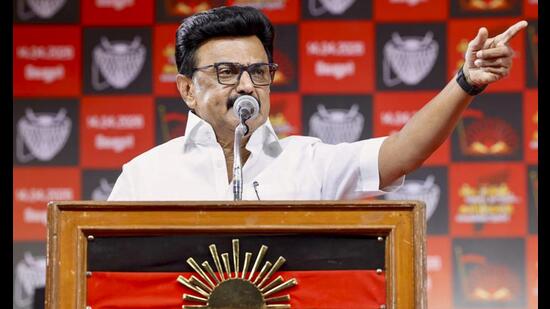
TN CM Stalin calls for statewide protest over delimitation, alleges bias against South| India News
# Stalin Protests 2026 Delimitation Bias
By Senior Staff Correspondent | April 15, 2026
On Wednesday, April 15, 2026, Tamil Nadu Chief Minister M.K. Stalin issued a clarion call for massive statewide protests against the impending national delimitation exercise, thrusting India’s federal structure into a high-stakes political battle. Describing the constitutional redistricting process as a “great danger” to Tamil Nadu’s autonomy and political representation, Stalin explicitly accused the ruling Bharatiya Janata Party (BJP) at the Centre of “betraying” southern states. The Chief Minister articulated a long-simmering grievance: that linking parliamentary representation purely to modern population metrics unjustly and disproportionately penalizes southern regions that have spent decades successfully implementing progressive national family planning policies. As the freeze on Lok Sabha seat allocation officially expires this year, Stalin’s mobilization sets the stage for a fierce federal showdown over the balance of demographic and democratic power in New Delhi. [Source: Hindustan Times].
## The End of the 1976 Constitutional Freeze
To understand the magnitude of Stalin’s protest call, one must look back half a century. In 1976, during the Emergency, the 42nd Amendment to the Indian Constitution froze the state-wise distribution of Lok Sabha seats based on the **1971 Census**. This freeze was implemented to assure states initiating robust population control measures that their success would not result in diminished political power in Parliament.
In 2001, the 84th Constitutional Amendment extended this freeze for another 25 years, explicitly pushing the deadline to 2026. Now, that deadline has arrived. Article 81 of the Constitution mandates that the allocation of Lok Sabha seats must be readjusted after 2026 based on the first census published thereafter.
For the BJP-led Union government, proceeding with delimitation is a constitutional obligation and a long-stated administrative goal. The inauguration of the new Parliament building in 2023—which boasts a Lok Sabha chamber capable of seating **888 members**—was widely viewed as a precursor to expanding the lower house. However, for regional leaders in the South, lifting this freeze is viewed as a systemic punishment for their socio-economic achievements over the last fifty years. [Source: Hindustan Times | Additional: Constitutional History of India].
## “A Great Danger”: Unpacking Stalin’s Betrayal Allegation
During his press briefing in Chennai, CM Stalin did not mince words, categorizing the impending delimitation as a “great danger” designed to sideline non-Hindi speaking states. His use of the word “betrayal” is a direct indictment of the Union government’s approach to cooperative federalism.
Stalin argued that the southern states—Tamil Nadu, Kerala, Karnataka, Andhra Pradesh, and Telangana—heeded the Union government’s call in the 1970s and 1980s to curb population growth. Through heavy investments in public health, female literacy, and family planning, states like Tamil Nadu successfully brought their Total Fertility Rate (TFR) well below the replacement level of 2.1.
Meanwhile, several northern states, particularly the heavily populated Hindi heartland states of Uttar Pradesh, Bihar, and Madhya Pradesh, lagged in demographic transition. Consequently, their populations have skyrocketed. Stalin asserts that shifting political power to these states now, simply because they failed to control their population, is a fundamental betrayal of the social contract between the Centre and the progressive states.
## The Stark Demographic Divide
The underlying data validates the anxieties of the southern political leadership. A comparative look at the demographic shift between the 1971 census and the projected post-2026 figures highlights a dramatic divergence.
**Comparative Population and Political Influence (Estimated):**
| Region / State | Share of India’s Pop (1971) | Share of India’s Pop (Est. 2026) | Current Lok Sabha Seats | Projected Seats (Strictly Proportional in a larger house) |
| :— | :— | :— | :— | :— |
| **Tamil Nadu** | 7.5% | ~5.4% | 39 | Significant relative dilution |
| **Kerala** | 3.9% | ~2.5% | 20 | Significant relative dilution |
| **Uttar Pradesh** | 16.1% | ~17.5%+ | 80 | Projected massive gain |
| **Bihar** | 10.4% | ~10.0%+ | 40 | Projected massive gain |
*Note: Demographers estimate that if the Lok Sabha is expanded to 848 seats to ensure no state loses its absolute number of seats, the proportion of power will still drastically tilt. The Hindi heartland would command an overwhelming majority, rendering the southern bloc politically marginalized.* [Source: Additional Demographic Projections / Public Data].
If delimitation occurs purely on population lines, a voter in Bihar or Uttar Pradesh would effectively hold more influence over the formation of the Union government than a voter in Tamil Nadu. This dilution of southern voting power is the crux of the protests Stalin is organizing.
## The Economic Grievance: Paying More, Getting Less
The political disenfranchisement feared by Tamil Nadu is compounded by existing economic grievances. Southern leaders frequently highlight the disparity in tax devolution.
Under the formulas utilized by recent Finance Commissions—which transitioned to using 2011 census data rather than 1971 data for fund allocation—southern states have already seen a reduction in their share of central tax revenues. It is a widely cited statistic in Tamil Nadu politics that for every **₹1 paid in direct taxes** to the Centre, the state receives less than **30 paise** back in devolution, whereas states like Uttar Pradesh receive upwards of **₹2.50**.
Stalin’s administration views the 2026 delimitation as the final phase of this marginalization. “First, they took our funds to subsidize the failure of northern states. Now, they want to take our political voice,” a senior DMK leader noted following Stalin’s announcement. The proposed protests are expected to heavily weave these economic realities into the narrative of federal betrayal.
## Expert Perspectives on Federal Friction
Political scientists and constitutional experts warn that the 2026 delimitation exercise represents one of the most perilous tests of India’s federal structure since the linguistic reorganization of states in 1956.
Dr. V. R. Srinivasan, a prominent constitutional scholar based in New Delhi, explains the complexity of the crisis: *”The Constitution fundamentally relies on the principle of ‘one person, one vote, one value.’ If a constituency in Rajasthan has 3 million voters and a constituency in Kerala has 1.5 million, the value of the vote is unequal, which is democratically problematic. However, federalism is the other bedrock of the Indian state. Punishing linguistic and cultural regions for achieving national developmental goals threatens national integration.”*
Experts suggest that the Union government must find a middle path. *”The BJP leadership faces a profound dilemma,”* notes Dr. Anjali Mathur, a policy analyst focusing on Centre-State relations. *”They can mathematically justify delimitation, but practically, ignoring the severe alienation of the five southern states could trigger a modern regionalist movement unlike anything seen in recent decades. Chief Minister Stalin is proactively positioning himself as the vanguard of this southern resistance.”*
## The Logistics of the Protest and Broader Opposition Strategy
Stalin’s call for a statewide protest is not merely a localized event; it is designed to be the catalyst for a broader, coordinated national opposition. By raising the alarm in April 2026, the DMK (Dravida Munnetra Kazhagam) is attempting to build a consensus among non-BJP ruled states.
Key elements of the upcoming protests include:
* **Mass Mobilization:** Rallies across all 38 districts of Tamil Nadu, spearheaded by DMK cadres and allied parties, emphasizing regional pride and state rights.
* **Legislative Action:** Potential resolutions passed in the Tamil Nadu Legislative Assembly explicitly rejecting any delimitation process that reduces the state’s proportional representation in Parliament.
* **Southern Alliance:** Stalin is expected to leverage this issue to unite southern Chief Ministers—cutting across party lines—to form a joint consultative council to lobby against proportional dilution.
* **Legal Challenges:** Preparations are reportedly underway to challenge the procedural aspects of the delimitation commission in the Supreme Court, citing violations of the basic structure doctrine concerning federalism.
The BJP’s state unit in Tamil Nadu has responded by accusing Stalin of fear-mongering. State BJP leaders emphasize that the Union government has not yet released the final parameters for the delimitation commission and argue that the Prime Minister has always respected cooperative federalism. They allege the DMK is using this constitutional mechanism as a distraction from local governance issues. [Source: Hindustan Times | Additional: Regional Political Statements].
## Implications for National Politics and 2029
The timeline of this crisis is critical. With the 2026 freeze lifted, the Delimitation Commission’s work will inevitably cast a long shadow over the **2029 General Elections**. If the delimitation is forcefully pushed through without a consensus, the political map of India will be radically rewritten.
If Parliament is expanded and the Hindi-speaking belt gains dozens of new seats, a national party could theoretically secure a comfortable parliamentary majority while entirely ignoring the southern peninsula. This scenario is exactly what Stalin fears. It threatens to reduce states with distinct linguistic identities and strong economic engines to mere vassal states within the democratic framework—taxed heavily but devoid of decisive political leverage.
## Conclusion and Future Outlook
Chief Minister M.K. Stalin’s announcement of statewide protests over the 2026 delimitation is much more than regional political theater; it is the opening salvo in a defining constitutional debate of modern India. The controversy forces the nation to confront a difficult question: How does a massive, diverse democracy balance the democratic principle of equal representation based on population with the federal necessity of protecting states that have successfully adhered to national development goals?
As Tamil Nadu prepares for widespread agitation, the eyes of the nation turn to New Delhi. The Union government’s response to these protests, and the eventual framework established for the Delimitation Commission, will either forge a new consensus in Indian federalism or deepen a perilous North-South divide.
***





